Omron A22N / M22N
22 mm pushbutton and pilot light for standard panel cut-out
Reference mode — everything visible. Use for live calls.
Three things to remember
Family scope
A22N: non-illuminated + illuminated pushbuttons, selector, key-selector, e-stop.
XB5 / HW (single catalogue); Omron splits pushbutton (A22N) from pilot light (M22N).
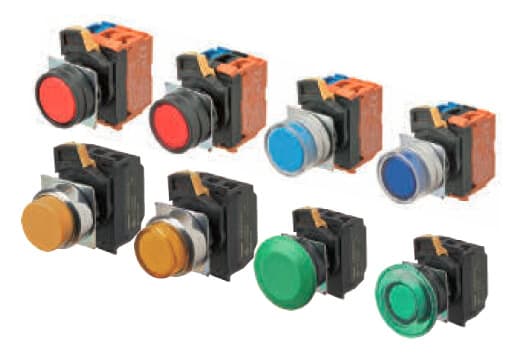
Mounting depth behind panel
A22N: <46.8 mm.
Omron (documented)
Headline
Push-In Plus terminal blocks on the full A22N / M22N range — true tool-less push-in insertion of a standard…
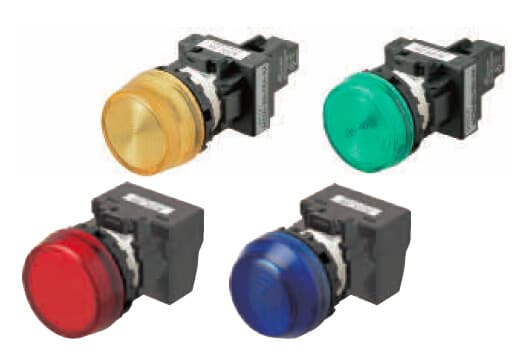
Competitor lineup


Key specifications
22 rowsColumns compared: Omron A22N / M22N vs Schneider XB5
Family scope
Omron- Omron A22N / M22N
- A22N: non-illuminated + illuminated pushbuttons, selector, key-selector, e-stop. M22N: pilot lights only.
- Schneider XB5
- Plastic bezel round / square pushbutton, selector, e-stop, pilot light — one unified family. Metal bezel sibling is XB4.
XB5 / HW (single catalogue); Omron splits pushbutton (A22N) from pilot light (M22N).
Bezel material
Tie- Omron A22N / M22N
- A22N: plastic or brushed metal (round ring). M22N: metal (screw-terminal models) or plastic (Push-In Plus models).
- Schneider XB5
- Plastic (glass-fibre-reinforced polyamide, PA). Chrome-plated metal is the XB4 sibling.
Tie
Mounting depth behind panel
Omron- Omron A22N / M22N
- A22N: <46.8 mm. M22N: <49.2 mm.
- Schneider XB5
- Not specified in captured source
Omron (documented)
Panel cut-out
Tie- Omron A22N / M22N
- 22.3 mm (with anti-rotation notch 25.4 mm as option)
- Schneider XB5
- 22.5 mm (IEC standard)
Tie (all IEC 60947 22.5 mm standard)
Terminal technology
Omron- Omron A22N / M22N
- Screw or Push-In Plus (tool-less, ~⅓ insertion force of typical push-in) across the full range.
- Schneider XB5
- Screw or push-in (Schneider markets push-in as "37 % thinner than spring clamps").
Omron (lowest insertion force on the push-in variant)
Contact-block architecture
Tie- Omron A22N / M22N
- Modular, symmetrical, snap-in. Up to 6 blocks in 3-wide × 2-deep layout on a single operator. LED block is separate and stacks with contact blocks.
- Schneider XB5
- Modular, stackable contact + light block on ZB4 / ZB5 carrier (same carrier across XB4 and XB5).
Tie — all three are modular-stackable
Contact rating — AC
other- Omron A22N / M22N
- A22N contact block (from captured source): 10 A AC / 8 A DC; voltage examples 120 VAC, 24 VDC. Per-block AC-15 / DC-13 utilisation category not specified in captured source — confirm from Omron datasheet.
- Schneider XB5
- 10 A @ 230 VAC typical; IEC utilisation AC-15 typical (confirm per block SKU)
All three rate to DACH standard 230 VAC / 10 A control-circuit duty
Gold-plated contact option (for PLC logic signals <5 mA)
Tie- Omron A22N / M22N
- A22N: gold-plated contact block available (part suffix per Omron datasheet — confirm SKU)
- Schneider XB5
- Schneider ZB*E low-level contact block available
Tie — all three offer it; Julian must verify exact part suffix per quote
Light source
Tie- Omron A22N / M22N
- LED (across A22N and M22N)
- Schneider XB5
- LED (integral block, also incandescent available on legacy SKUs)
Tie
Colours available
Tie- Omron A22N / M22N
- Black, Blue, Green, Orange, Red, White, Yellow
- Schneider XB5
- Black, Blue, Green, Red, White, Yellow (std set)
Tie
Operator types — pushbutton
Tie- Omron A22N / M22N
- Flat, mushroom, full-guard (extended guard)
- Schneider XB5
- Flush, projecting, mushroom, guarded, flush-guarded
Tie
Emergency-stop head
Tie- Omron A22N / M22N
- Separate A22N E-stop SKU line (push-to-lock / turn-to-release, key-release variant). IEC 60947-5-5 compliance — confirm per SKU.
- Schneider XB5
- Schneider ZB5AS / ZB4BS e-stop heads, IEC 60947-5-5 / ISO 13850, Trigger-Action / TriggerAction indication.
Tie on compliance; Schneider's ZB5AS indicator-equipped e-stop is a recognisable DACH field reference.
Mechanical life
other- Omron A22N / M22N
- A22N: 500 000 operations (captured from A22NW variant) — confirm per SKU
- Schneider XB5
- Not specified in captured source (Schneider publishes 1 million mechanical on XB4 metal, typically lower on XB5 plastic — confirm)
All similar order of magnitude — Julian should pull per-SKU numbers for a specific quote
Electrical life
- Omron A22N / M22N
- Not specified in captured source
- Schneider XB5
- Not specified in captured source
—
Distribution depth in DACH
Competitor- Omron A22N / M22N
- Omron Swiss / DE distributor network + Distrelec, RS, Farnell
- Schneider XB5
- Rexel, Sonepar, EM (CH), Schneider e-shop, Distrelec, RS — densest
Schneider (unmatched in DACH)
Catalogue churn / SKU stability
Omron- Omron A22N / M22N
- A22N has been in production more than a decade, part-number pattern stable
- Schneider XB5
- XB5 / ZB5 catalogue stable; Schneider occasional mid-life repackaging
IDEC (most stable); Omron close second
At a glance
- Category: 22 mm (standard IEC 22.5 mm panel-hole) control and signalling devices. The A22N is Omron's pushbutton-and-illuminated-pushbutton family — plastic bezel (A22NN / A22NL with plastic ring) and brushed-metal bezel variants, round operator, momentary or maintained, flat / mushroom / full-guard profiles, emergency-stop heads on separate E-stop part numbers. The M22N is Omron's matching 22 mm pilot-light-only family — delivered with metal bezel on screw-terminal models and plastic bezel on Push-In Plus terminal models. Read: A22N drives the panel, M22N signals back. They share the 22.5 mm panel cut-out, the contact-block / LED-block ecosystem (symmetrical, snap-in, up to six blocks in 3 × 2 layout), and the terminal-technology choice (classic screw vs Push-In Plus).
- Typical applications: machine-control panels (start / stop / reset / e-stop), MCC (motor control centre) doors and starter cubicles, control stations for conveyors and mixers, HMI-complement hard-wired buttons next to a touchscreen, pendant stations, operator consoles, lockable maintenance disconnects (key-type selector), mushroom reset for safety circuits, pilot lights for drive status / feeder level / alarm / PLC-output echo, PUSH-TO-TEST pilot lights for lamp-test procedures, cabinet-door interlock indicators.
- Price positioning: Mid-market in DACH. Usually at parity or slightly below Schneider XB5 on a like-for-like illuminated pushbutton with 24 VDC LED and 1NO + 1NC block; noticeably below IDEC HW on the heavy-duty metal-bezel comparisons. The commercial pressure point is Schneider's distribution depth (Rexel, Sonepar, Elektro-Material / EM in Switzerland, Schneider's own e-shop), not unit price.
- Headline selling point: Push-In Plus terminal blocks on the full A22N / M22N range — true tool-less push-in insertion of a standard ferrule or solid conductor at roughly one-third the insertion force of a typical push-in spring terminal, with the same vibration resistance and no re-torque maintenance. Combined with the symmetrical, snap-in contact-block carrier (up to six blocks), the panel-assembly labour on a 30-device starter cubicle is materially lower than with screw-terminal XB5 or HW. For machine builders in DACH where panel-wiring labour is the dominant cost line, this is the winnable argument.
Key specifications
DACH-standard panel wiring for 22 mm devices: 24 VDC pilot (PLC output echo, drive status) or 230 VAC pilot (mains-side indication), 1 NO (normally-open) + 1 NC (normally-closed) contact block on start/stop pairs, gold-plated contacts when switching low-level logic signals (<5 mA @ <24 VDC, typical PLC input), 22.5 mm panel hole per DIN EN 60947-5-1, IP66 / IP67 Schutzart (ingress protection per IEC 60529) on the front bezel, IP20 finger-safe on the back-of-panel terminals per IEC 60529.
Where Omron wins
- Push-In Plus terminal across the full range. Omron's Push-In Plus is not a rebadged standard push-in — the published insertion force is around one-third of a conventional push-in terminal on equivalent cross-sections. On a 30-device panel (typical MCC door or control console) the wiring-labour delta over Schneider screw XB5 is on the order of 20–30 minutes of skilled-electrician time, which in DACH (average loaded rate CHF 110 – 140 / h) is the concrete saving you can quote. Schneider's push-in exists but Omron's insertion-force and no-retorque claim is documented. IDEC HW's push-in variant exists but the mainstream HW DACH installed base is still screw-terminal.
- Symmetrical, snap-in contact-block carrier with up to six blocks in a 3×2 footprint. The A22N carrier takes three blocks across and two deep on a single operator — useful for combined start-push-button-with-status-feedback wiring, or a 2NO + 2NC + 1 LED stack without going to a second operator. Schneider's ZB4 / ZB5 carrier also stacks, but the 3×2 symmetric layout and consistent snap-mechanism across the whole A22N / M22N range is a panel-assembly convenience.
- Same ecosystem for pushbutton (A22N) and pilot light (M22N). Same panel cut-out, same terminal technology choice, same bezel look on the metal variants, LED voltages match, so a panel can be built with one supplier's 22 mm family end-to-end with visual consistency — useful on higher-end HMI consoles where panel-builder aesthetics matter (machine-tool OEMs in BW and the Swiss arc in particular).
- Stable catalogue, Swiss / DE next-day availability through Distrelec and RS. The A22N part-number tree has been stable long enough that electrician muscle memory around the SKUs exists in DACH panel shops. Forum feedback (Electrician Talk thread) ranks Omron at parity with ABB on 22 mm operators and above IDEC in that specific population.
- Brushed-metal bezel on A22N without pushing the customer to a separate XB4 line. Schneider splits plastic (XB5) and chrome-metal (XB4) across two catalogues sharing the ZB4/ZB5 carrier. Omron offers brushed-metal on A22N itself, which simplifies the BOM on panels that mix plastic buttons (back of cabinet) with metal-bezel e-stops or HMI-complement buttons (operator-facing).
Where Schneider XB5 wins
- Ingress-protection spec sheet. Captured Schneider material explicitly states IP66 / IP67 / IP69 / IP69K on XB5 head. Captured Omron EU pages confirm IP66 on M22N but do not specify IP67 / IP69K for A22N in the captured source. On a wash-down dairy or food-processing panel where IP69K is in the specification, Schneider is the safer recommendation without a datasheet deep-dive. Do not try to spin this — either pull the Omron datasheet IP rating per SKU before the meeting, or concede.
- Distribution depth in DACH. Rexel, Sonepar, EM, Schneider's own e-shop, plus the distributor stack. Ordering a specific XB5 SKU in Germany or Switzerland for next-day delivery is effectively a solved problem. Omron is next-day on the common SKUs through Distrelec / RS but the long tail is thinner.
- Single unified plastic family for pushbutton + pilot light + selector + e-stop. Schneider's XB5 catalogue covers the whole 22 mm board in one family (and XB4 is the metal sibling sharing the ZB carrier). Omron splits pushbutton (A22N) and pilot light (M22N) into two product families. For a panel shop doing mixed small-volume work, the single-family mental model is lower friction.
- Certifications scope documented on the public page. Marine approvals, CCC, EAC listed explicitly. Omron's EU A22N page confirms RoHS but does not enumerate UL, CSA, CE, IEC 60947-5-1 in the captured snippet. Omron has these certifications, but the DACH specifier wants them on the page, not in a factory letter.
- Mainstream XB5 illuminated pushbutton is often the "boring safe choice" in a DACH machine-builder's specification template. That is a real commercial moat — you are displacing an installed habit, not just a product.
Where IDEC HW wins
- Mechanical robustness reputation. IDEC's HW is positioned as "heavy-duty", with pure-silver self-cleaning contacts and tamperproof mounting. In high-cycle industrial applications (foundry, press shop, heavy assembly) the installed-base sentiment on HW is durable. Omron A22N is a general-industrial device, not marketed as heavy-duty.
- Catalogue stability. IDEC tends to keep product generations in production for very long periods, which is valuable for end-user MRO spare-parts stocking. The same HW SKU ordered in 2010 is typically still orderable today.
- Metal and plastic bezel inside the same SKU tree. Customer changes their mind from plastic to chrome without having to re-specify across two families (as Schneider forces with XB4 ↔ XB5).
Where Omron is honestly weaker than XB5 in DACH
- DACH brand-gravity for 22 mm operators is Schneider-Telemecanique. Electricians and panel shops have decades of muscle memory on XB2 / XB4 / XB5. The A22N is technically equal and wiring-labour-better, but the switch story is never technical alone — it is about giving the panel shop a reason to break a routine.
- Captured public material for the A22N / M22N on the Omron EU site is less complete on IP rating, contact rating per block, mechanical life per SKU, and certification list than Schneider's XB5 product page. Either pull the Omron datasheet before the customer meeting, or accept that the spec-sheet side of the argument is not winnable on the public page alone.
- There is a forum-level perception that Schneider XB5 moved "from metal bases to all plastic with cheap crap design" (Electrician Talk, machine-builder commenter). That cuts both ways — it is an attack surface against XB5 (use it), but it is also a reminder that a plastic-bezel A22NN is being compared to a plastic-bezel XB5, and the emotional bar is "is this plasticky?" not "is this Omron?"
Typical objections & responses
Researched from Electrician Talk (pushbutton-brand opinion thread), Schneider Electric FAQs on XB4 vs XB5, and public IDEC HW product-range material. Cited so Julian can re-verify before a specific customer.
- "We're standardised on Schneider XB5 across the plant. No reason to change." → Valid. The response is not "switch everything" — it is "let us win the next new panel build on wiring labour". Quote the Push-In Plus terminal time saving on a concrete 30-device panel in front of them. Push-In Plus Omron insertion force is around one-third of a conventional push-in; on a cubicle with roughly 80 wire terminations (30 operators × 2 contact block terminations + LED), the labour delta is real. Let them keep their spare-parts stock and add Omron to the approved vendor list for the next build.
- "Schneider's XB5 data sheet says IP69K, does your A22N?" (Real concern on food / pharma / dairy panels.) → Honest answer in the captured Omron EU page: M22N is documented IP66. A22N IP rating is not fully specified in the captured public page — pull the Omron datasheet per SKU before the meeting. If the application genuinely requires IP69K wash-down, and the Omron SKU does not reach it on the datasheet, concede the panel and aim for the next (dry) cubicle. Do not force it.
- "IDEC HW is more robust, we use it in the press shop." → Agree on the reputation. Then redirect: "For the press-shop consoles HW is fine. For the MCC door, HMI-complement, and operator console where you're wiring 30+ devices per panel, the wiring labour on A22N Push-In Plus pays back on build two." Specifically do not try to unseat IDEC where HW is already specified for mechanical-robustness reasons — that is a losing argument.
- "Schneider's catalogue is broader — one family covers everything 22 mm." → "That's true on the Schneider side. On ours, A22N + M22N share the panel cut-out, the carrier, and the terminal technology. The mental model is two family names for one ecosystem. Once your panel shop has done one build, the split disappears." Then hand over a panel-ready selection sheet showing A22N pushbutton + M22N pilot light next to each other with matching bezel. The visual ecosystem argument lands better than the catalogue argument.
- "Omron 22 mm is a sensor company side-line — Schneider does this as core business." (Pure brand gravity; hear this often in DACH machine-builder shops.) → Two-part response. (1) Omron's push-button-and-pilot-light history in Europe goes back to the A22 series predating A22N, and the DACH-installed base is deeper than first appears (check the customer's own MCC BOMs — A22 / A22N devices are often already there from retrofits). (2) The Omron story is not "better than Schneider on brand heritage" — it is "better on panel-wiring labour and ecosystem visual consistency with your HMI". Play on the strength, don't argue the heritage.
- "The 230 VAC pilot light — is yours as reliable as Schneider's?" (Real concern on mains-side indication on MCCs.) → M22N publishes the 200–240 VAC LED voltage range on the captured Omron EU page; lifetime and specific failure-rate data are per datasheet — Julian pulls these before the meeting. There is no reliability argument Schneider can win on LED pilot lights at 230 VAC that Omron cannot match spec-for-spec. Concede nothing here.
- "For low-level PLC logic signals we always spec gold-plated contacts. Does A22N have that SKU?" → Yes, a gold-plated (low-level) contact block exists in the A22N catalogue. Confirm the exact part suffix from the Omron datasheet before quoting — do not guess the SKU. All three competitors (Schneider ZB*E low-level, IDEC HW bifurcated / gold, Omron A22 gold-plated) offer this; the choice comes down to the rest of the ecosystem, not this contact block.
The switch story
The DACH 22 mm board is a Schneider Telemecanique stronghold, full stop. An electrician who has wired XB2 in the 90s, XB4 in the 2000s, and XB5 in the 2010s is not going to change brand because you have a better data sheet. The winnable fight is new panel builds with Push-In Plus as the wedge — specifically on machine-builder OEMs in BW, Bavaria, and the Swiss arc who are building one-off or small-batch control panels where wiring labour is the dominant cost line.
The economic argument has three parts. (1) Push-In Plus insertion force is around one-third of a typical push-in spring terminal, and zero re-torque on the life of the device (vs screw terminals that IEC 60947 service procedures recommend re-torquing during scheduled maintenance). (2) The symmetric 3×2 contact-block carrier on A22N allows two operators' worth of block density on one operator, saving a panel hole and a bracket on complex start / reset / status-feedback stacks. (3) A22N + M22N share visual bezel and panel cut-out, so the HMI-complement buttons next to the operator panel match the pilot lights on the MCC door — an aesthetic argument the customer's own end-customer actually notices on delivery.
Where this story does not win, be honest: (a) wash-down dairy / pharma / food-processing panels where IP69K is specified and the captured Omron public material does not confirm IP69K on A22N (pull the Omron datasheet per SKU; if it doesn't reach IP69K, concede that cubicle and fight for the next dry one); (b) retrofits on a Schneider-standardised MCC where single-SKU-replacement logic dominates and the maintenance crew has XB5 spares on the shelf — do not fight the retrofit, target the next new cubicle; (c) heavy-duty press-shop or stamping consoles where IDEC HW is specified on robustness reputation — agree with the reputation, take the MCC door instead.
There is one counter-intuitive angle that works in DACH specifically: some XB5 customers have been burned by Schneider's move away from metal housings on the XB5 range (referenced in the Electrician Talk thread). Those customers are already emotionally primed to try an alternative. They will not jump to IDEC because IDEC's DACH distribution is thin. Omron A22N brushed-metal bezel — not Schneider-metal-XB4 — is the exact "I want metal without going back to my Schneider rep" answer for them. Small segment, high-intent conversions.
Application examples (DACH)
- Machine start / stop / reset station on the cabinet door. A22NN (non-illuminated) flat momentary: green start (1 NO), red stop (1 NC), blue reset (1 NO), plus M22N 24 VDC pilot-light green for "machine ready". Wired to Push-In Plus terminals on the A22N and M22N — single ferrule insertion, no torque maintenance. Direct replacement for an XB5 set.
- Emergency-stop on machine-control panel. A22NE e-stop head (push-to-lock, twist-to-release), 1 NC + 1 NC contacts, IEC 60947-5-5 / ISO 13850 chain. Pair with a 24 VDC red pilot M22N-light in the lamp test group. Honest caveat: Schneider's ZB5AS e-stop with Trigger-Action indicator is a stronger visible-field reference in DACH — pick A22NE when the rest of the panel is already Omron ecosystem.
- MCC (motor control centre) cubicle door — drive status pilot bank. M22N 24 VDC green "run", yellow "warn", red "fault", white "mains on" — four pilot lights across the top of a starter cubicle. Push-In Plus models for faster cubicle assembly on panel-shop day.
- Control station for conveyors (start / stop / e-stop stack). A22NN start + stop + A22NE e-stop in a three-hole horizontal stack on the conveyor side-pillar. 1 NO + 1 NC per station. Gold-plated contact block on start/stop if the PLC input is <5 mA logic-level.
- HMI (human-machine interface) touchscreen complement — hard-wired backup buttons. Brushed-metal-bezel A22NL illuminated buttons mounted on the HMI bezel for "manual mode", "jog forward", "jog reverse" — metal bezel for the look, so the customer-facing panel has a consistent aesthetic with the HMI frame. Direct alternative to an XB4 metal-bezel set-up.
- Key-operated selector for maintenance-mode lock-out. A22NK key-selector, 2-position or 3-position, with key retention in both positions. Wired into the safety PLC input that enables engineer-mode. IEC 60947-5-1 contact block. Same panel cut-out as the pushbuttons next to it.
- Lamp-test / push-to-test pilot light on alarm panels. M22N push-to-test pilot — operator presses the lens, LED illuminates regardless of the driving PLC output. Standard on annunciator panels in water-treatment, building services, Swiss pharma utilities.
- MCC feeder-level indicator (pilot light) at 230 VAC on a mains-side contactor echo. M22N 200–240 VAC red pilot light — direct wiring from the mains-side of the contactor, no 24 VDC auxiliary required. Competes directly with an XB5 AC pilot light.
- Pendant control station for overhead crane or gantry. A22NN flat momentary pushbuttons (up / down / left / right) inside a pendant enclosure. Push-In Plus terminal preferred — pendants vibrate, and the no-retorque characteristic is specifically valuable where re-torquing a screw terminal inside a sealed pendant is impractical.
- Safety-reset pushbutton for a category-3 safety circuit. A22NN blue flat momentary with 1 NO contact, wired into the reset input of a Sick or Pilz safety relay. Blue is the DACH colour convention for reset. M22N blue pilot light alongside for "safety OK" echo.
- Door-interlock status pilot (cabinet locked / unlocked). M22N 24 VDC LED pilot driven by the Schmersal or Euchner interlock's auxiliary contact. White or green lens. Push-In Plus terminal for field-service electrician speed.
- Dual-hand control on a press or cutting tool — two A22NN momentary buttons spaced per ISO 13851. 1 NO each, wired through the dual-hand-control safety relay. Same operator style as the rest of the machine-control panel, same bezel look.
Sources
- Omron A22N product page (Europe) —
https://industrial.omron.eu/en/products/a22n, captured 2026-04-20 via WebFetch. Confirms: A22N "22-mm Pushbutton switches with universal design", plastic / brushed-metal / metal bezel, flat / mushroom / full-guard operators, up to 6 contact blocks in 3-wide × 2-deep symmetric layout, momentary, mounting depth <46.8 mm below panel, Push-In Plus terminal option, RoHS. IP rating, contact rating per block, mechanical life, full certification list were not specified on the page captured — Julian pulls these from the Omron datasheet before a customer-specific quote. - Omron M22N product page (Europe) —
https://industrial.omron.eu/en/products/m22n, captured 2026-04-20 via WebFetch. Confirms: M22N is pilot-light-only, metal bezel on screw-terminal models and plastic bezel on Push-In Plus models, IP66 rating, LED voltages 6 VDC / 12 VDC / 24 VDC(AC) / 100–120 VAC / 200–240 VAC, flat and flat-etched profile, mounting depth <49.2 mm behind panel. - Schneider Electric XB4 / XB5 product range —
https://www.se.com/us/en/product-range/61148-harmony-xb4-xb5-push-buttons/and Schneider FAQ FA127638 (XB4 vs XB5) / FA142752 (IP rating for XB4 / XB5), captured 2026-04-20 via WebSearch. Confirms: XB5 is plastic bezel (XB4 is chrome-plated metal), IP66 / IP67 / IP69 / IP69K, −40 °C to +70 °C operating, IEC / UL / CSA / CCC / EAC / JIS / CE / marine certifications, 22 mm standard panel cut-out, push-in contact-block technology marketed as "37 % thinner than spring clamps", ZB4 / ZB5 shared carrier across the XB4 / XB5 families. - Schneider XB5AA51 product detail (RS Online) —
https://us.rs-online.com/product/schneider-electric/xb5aa51/70008679/, captured 2026-04-20 via WebSearch. Confirms: 1 NO contact, 10 A @ 230 VAC, momentary, flush guarded, plastic bezel. - IDEC HW product range (US) —
https://us.idec.com/Switches-and-Pushbuttons/Pushbuttons-and-Pilot-Lights/HW-22mm-Heavy-Duty/c/HW_Series, captured 2026-04-20 via WebSearch. Confirms: HW is heavy-duty 22 mm family, choice of black plastic or metallic front bezels, locking-lever removable contact blocks, IP20 finger-safe screw terminals on the back, pure-silver contacts with self-cleaning action, tamperproof mounting. - IDEC HW Push-In catalogue —
https://us.idec.com/idec-us/en/USD/medias/HW-Push-in-Catalog-20210409.pdf(PDF not downloaded — cited for completeness; Julian should pull the exact push-in contact-block part numbers if IDEC comes up as a named competitor). - Objections research — Electrician Talk thread "Any strong opinions about the following brands of push buttons?" (one experienced builder ranked Omron and ABB tied for 22 mm operators, IDEC distant third; separate commenter called Schneider's move to "all plastic with cheap crap design" a reason he stopped using XB5); Schneider Electric FAQ FA127638 "What is the difference between XB4/XB5 and ZB4/ZB5"; Omron A22N DigiKey product-highlight page. Snapshots not stored — cited so Julian can re-verify per customer.
Open questions
- A22N front-of-panel IP rating, per SKU. Captured Omron EU public page confirms IP66 on M22N pilot lights but does not specify IP66 / IP67 / IP69K on A22N pushbuttons. Pull from Omron datasheet
pdfs/omron/a22n_datasheet.pdfon day 1 and add the exact rating to this card. Critical for wash-down panel conversations against XB5. - A22N exact contact-block mechanical life per SKU. Captured material cites 500 000 operations on A22NW; the main A22NN / A22NL mechanical life per block type is not in the captured material. Pull from datasheet.
- Gold-plated (low-level) contact-block exact part suffix for A22N. Captured material confirms it exists as a concept; SKU not captured. Confirm from Omron price matrix before quoting.
- UL / cULus scope on A22N / M22N — confirm per SKU. Captured Omron EU page confirms RoHS explicitly but does not enumerate UL, CSA, CE / IEC 60947-5-1 (control-circuit devices), IEC 60947-5-5 (e-stop). Confirm per SKU, especially on e-stop heads.
- DACH list-price delta A22N vs XB5 illuminated pushbutton (e.g. A22NL green illuminated 24 VDC 1 NO + 1 NC vs XB5AW33B5 equivalent). Pull from Omron SSC price matrix and Schneider e-shop list.
- Swiss and German distributor stock depth on A22N long-tail SKUs (key-selector, e-stop with key-release, push-to-test pilot). Map against Distrelec, RS, Servostar, Rexel CH, EM.
- Does the Swiss SSC offer a contractual lead-time guarantee on the A22N mainstream SKUs comparable to Schneider's distribution-plus-e-shop availability? This is the real commercial blocker — "I can get XB5 tomorrow from EM" is the sentence Omron has to beat.
- Push-In Plus insertion-force measured comparison vs Schneider push-in — Omron markets ~⅓ the force of typical push-in, but a direct side-by-side measurement against a Schneider ZB5 push-in block would be a powerful demo. Worth requesting from Omron product management as a DACH-market enablement asset.
Before you leave — retrieval check
Customer says
“We're standardised on Schneider XB5 across the plant. No reason to change.”
Source battlecards/components/a22n.md