Omron D40A & D40Z
Non-contact safety door switches
Reference mode — everything visible. Use for live calls.
Three things to remember
Series-wiring (how many switches cascaded to one safety input)
Up to 30 D40A-2 switches per G9SX-NS controller, across up to 200 m of series run, preserving PL e
Schmersal on diagnostics-preserving series count; Omron on maximum published chain length (30 in 200 m)
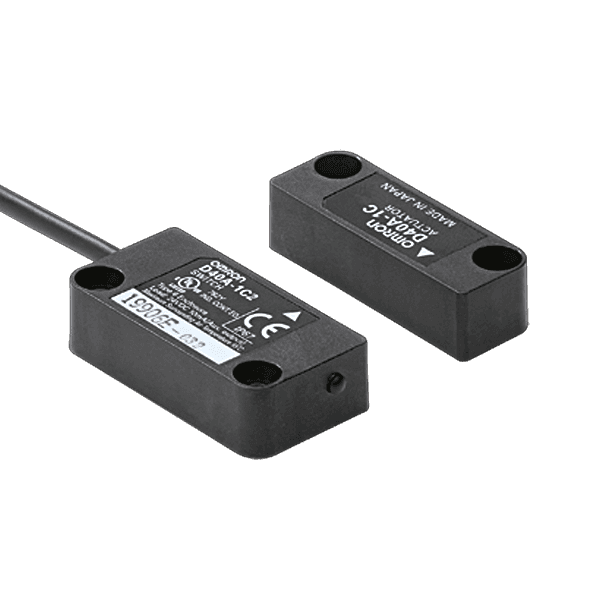
Headline
One vendor and one safety-file stack — Omron D40A/D40Z switches plus G9SX-NS / NX-SL controller plus…
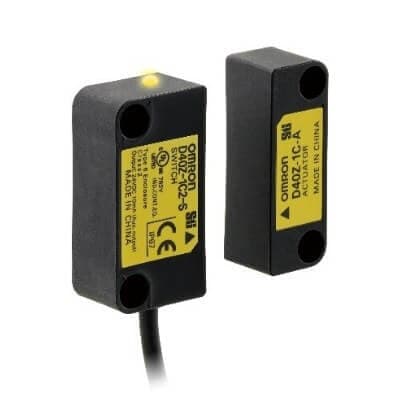
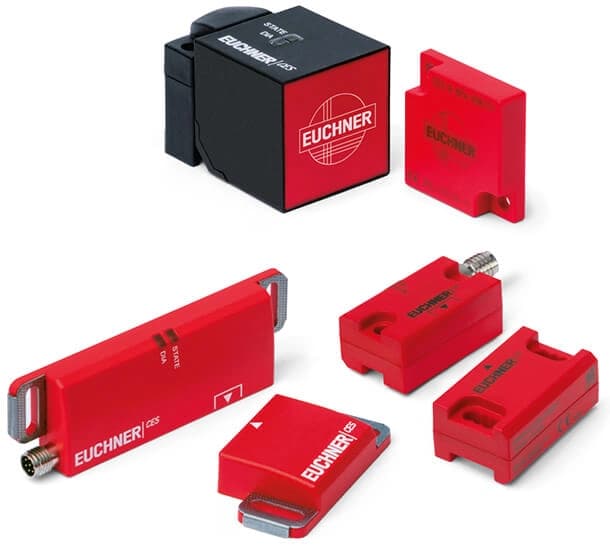
Competitor lineup

Key specifications
15 rowsColumns compared: Omron D40A-2 vs Omron D40Z
Sensing principle
Tie- Omron D40A-2
- Electronic detection with coded actuator (D40A product page: "Electronic detection mechanism for better stability"); actuator-specific pairing
- Omron D40Z
- Magnetic induction with coded magnet
Tie on approach
Series-wiring (how many switches cascaded to one safety input)
Omron- Omron D40A-2
- Up to 30 D40A-2 switches per G9SX-NS controller, across up to 200 m of series run, preserving PL e
- Omron D40Z
- Up to 30 D40Z switches per G9SX-NS
Schmersal on diagnostics-preserving series count; Omron on maximum published chain length (30 in 200 m)
At a glance
- Category: Non-contact position-monitoring switches used as interlocking devices associated with a guard per EN ISO 14119 (European Norm / International Organization for Standardization 14119 — safety of machinery, interlocking devices). Two Omron products cover the slot: D40A (electronic detection, RFID/Hall-effect-style coded actuator, higher tamper resistance) and D40Z (magnetically-actuated non-contact, compact, lower cost). Both pair with an Omron Safety Controller (G9SX-NS, G9SP, or NX-SL Safety Control Unit) to reach Category 4 / Performance Level e (PL e) per EN ISO 13849-1 and Safety Integrity Level 3 (SIL 3) per IEC 61508 / IEC 62061.
- Typical applications: Perimeter guard doors on machining cells, CNC (computer numerical control) enclosures, robot cells, filler and packaging-line doors, palletiser entry gates, press guards, FPD (flat-panel-display) clean-booth doors, food & beverage process-zone access doors.
- Price positioning: Below Euchner CES in DACH (Deutschland-Austria-Switzerland) list. D40Z in particular is priced as a volume magnetic non-contact option, clearly under Schmersal RSS and Euchner CES. D40A sits between the magnetic entry point and the Euchner premium.
- Headline selling point: One vendor and one safety-file stack — Omron D40A/D40Z switches plus G9SX-NS / NX-SL controller plus NX-series safety I/O — versus Euchner/Schmersal where the switch is best-in-class but the customer still has to marry it to a third-party safety relay or safety PLC (programmable logic controller). Up to 30 D40A switches can be daisy-chained to a single G9SX-NS over a 200 m run with PL e preserved.
Key specifications
DACH-standard safety output is PNP (positive-switching) OSSD (output signal switching device). The comparison below uses Omron D40A-2 (the current-generation RFID/Hall-effect-coded non-contact switch) and Omron D40Z (magnetic non-contact) against Euchner CES-AP (transponder-coded, the category-defining product) and Schmersal RSS 36-I2-D-ST (RFID electronic safety sensor, high-coded).
Where Omron wins
- Single-vendor safety-file stack. D40A or D40Z switch → G9SX-NS non-contact door-switch controller → NX-SL safety control unit → NX safety I/O → Sysmac Studio EtherCAT-based safety programming, all under one Omron order number with one set of declarations of conformity and one EPLAN macro set. A German or Swiss machine-builder putting an ISO 13849-1 file together gets one vendor for the full safety chain. Euchner and Schmersal own the switch; they do not own the safety PLC, so the customer still picks Pilz PNOZ, Sick Flexi Soft, Phoenix PSR, or Siemens F-CPU. That is extra supplier count, extra declaration paperwork, and (for Schmersal) a separate Protect PSC / Safety Fieldbus Gateway on top if they want integrated diagnostics.
- Cascaded run length. Published 30 × D40A or D40Z across 200 m on one G9SX-NS safety input. For long perimeter guarding (FPD clean-booths, printing-press enclosures, large packaging lines, 50 m+ palletiser perimeters) this removes a whole row of safety-relay channels. Euchner CES-AR publishes 20 in series; Schmersal RSS 36 publishes unlimited but loses the individual-sensor diagnostic at device number 32 (serial diagnostic interface maxes out at 31). On a real 40-door perimeter the Omron + G9SX-NS topology is genuinely simpler.
- Price on D40Z specifically. Magnetic non-contact at a price point well under a CES transponder switch — for any machine where EN ISO 14119 risk assessment concludes Low-coded is sufficient (motivated-defeat unlikely: interior machining doors, back-of-machine service hatches, door-plus-pallet-grille combinations where mechanical geometry already prevents defeat), D40Z wins outright on cost without giving up PL e.
- Auxiliary monitoring output. D40A-2 includes a 24 V PNP open-collector auxiliary on top of the safety chain — useful for a "door open" signal into the PLC independent of the safety logic, without wiring a second sensor. Euchner CES-AP brings the two safety outputs and an LED; aux diagnostics come over a separate bus-gateway module (AS-Interface variant).
- Omron-side ecosystem in DACH is quietly broad. Omron Electronics AG (Switzerland) sells through Distrelec, Servostar, and direct; Omron Electronics GmbH (Germany) has the DACH SSC network; EPLAN macros and Sysmac Studio safety libraries are standard. This is not a "Keyence aggressiveness" story — it's a "the customer already has Sysmac on the line PLC" story, and if they do, the D40A is the lowest-friction path to PL e.
Where Euchner wins
- High-coding per EN ISO 14119 is the category default at Euchner. CES is literally the product that made transponder-coded safety switches a recognised category — the first generations of EN ISO 14119 Type 4 High-coded interlocks in DACH. For any risk assessment concluding a motivated operator might attempt defeat (easily removable / replaceable guards, small machines where operators have incentive to keep production running), High-coded is effectively mandated, and D40A-2 is Low-coded per the Omron F133 datasheet. Do not try to fight this spec — concede, and move the conversation to D40A only where Low-coded is defensible, or pair the Omron safety architecture with a future-spec Omron High-coded product where one exists.
- Brand trust in DACH machine-building. Euchner is a Leinfelden-Echterdingen (Baden-Württemberg) company with a 70-year safety-products heritage. Safety engineers at Trumpf, Homag, Heller, Liebherr, DMG Mori, KraussMaffei routinely specify Euchner by name in the safety concept. You will not flip that on a first meeting with a spec-sheet argument. Plan for a second meeting, a pilot, and a TCO (total cost of ownership) story.
- Fully-encapsulated PPS housing on the CES-A read head. Higher chemical resistance than PBT against machining-fluid aerosol, hot-alkali washdown on food lines, and cutting-oil mist. Not published on the CES-AP page we captured, but the companion CES-A accessory documentation is explicit.
- 5-direction approach on CES-AR. Some Euchner CES variants offer an adjustable actuating head with five approach directions — useful where door geometry does not allow a single fixed approach line. D40A uses a fixed approach geometry.
- ATEX (Atmosphères Explosibles) variants exist in the CES family. Customer in a solvent-handling or dusty-powder zone (pharma, cosmetics, flour-mill, paint-mixing) has a ready Euchner path; Omron's equivalent would be a different family entirely.
Where Schmersal wins
- IP69K is explicit and published on the SKU. IP6K9K per DIN 40050-9 = dust-tight + close-range high-pressure (80–100 bar) high-temperature (≈80 °C) water-jet resistant, the food-and-pharma washdown standard. D40A is IP67 only, D40Z is IP67 only. For any food-and-beverage line running daily caustic-foam CIP (cleaning-in-place) at pressure, RSS 36 is the lower-risk recommendation unless the switch is mounted outside the washdown zone.
- Published PFHd on the product page. 2.70 × 10⁻¹⁰ /h printed directly on the RSS 36-I2-D-ST page. That number goes straight into a SISTEMA (Safety Integrity Software Tool for the Evaluation of Machine Applications) calculation; the machine-builder's safety file closes without waiting for a factory letter. Omron publishes PFHd for the G9SX-NS controller, not prominently on the D40A page itself — confirm in the G9SX-NS manual before quoting against Schmersal.
- Coldest low-end temperature, explicitly −28 °C. Industrial cold-store perimeter doors, outdoor winter-site palletisers in Alpine logistics, deep-freeze-adjacent guarding: Schmersal published spec covers it. D40A stops at −10 °C.
- High-coded RFID with three coding levels published. Fixed-coded, individually-coded with multi-teach, individually-coded with single-teach — the full EN ISO 14119 defeat-resistance toolbox is in one SKU family. Omron D40A-2 is Low-coded only.
- Unlimited series wiring on the raw topology. Above 31 the individual sensor diagnostics are lost, but the safety chain itself scales. For very long OEM perimeter-monitoring where per-door diagnostics are not required, this is a spec feature Omron cannot match on paper (even if 30 is the honest real-world number for either).
Typical objections & responses
Researched 2026-04-20 from forum threads (PLCtalk, ElektrotechnikerForum, Automatisierungstechnik-Forum), EN ISO 14119 guidance notes, BG / DGUV machine-safety notes, and the Schmersal / Euchner / Omron product pages. Each objection is tied to a concrete source so you know it's real, not invented.
- "Euchner is the DACH default for safety-door switches. Our safety concept already names CES." (Extremely common. Euchner has run Cat 4 / PL e advertising in Konstruktion, Werkstatt+Betrieb, A&D, and Der Konstrukteur for 15+ years; many German Maschinenrichtlinie / ISO 13849 templates used by consultancies default to CES.) → Honest answer: "For a genuinely High-coded requirement under EN ISO 14119 with a motivated-defeat risk, Euchner CES is the right tool and I will say so. Where I want to reopen the question is the rest of the safety chain: the safety PLC, the distributed safety I/O, the diagnostics path to your line PLC. If that's Omron NX already — and on Sysmac sites it usually is — putting a Euchner switch on one end means a second DoC (Declaration of Conformity) stack and a separate SISTEMA branch. D40A gets you one Omron safety file; D40Z gets you magnetic non-contact at half the list price where Low-coded is defensible. Show me the risk assessment; we'll pick per door."
- "D40A is 'Low-coded' — we need 'High-coded' under EN ISO 14119." (True if the risk assessment actually concludes it. But EN ISO 14119 explicitly allows Low-coded where motivation to defeat is low — e.g. doors behind other physical barriers, service hatches requiring tools, interior doors of a cell that is itself perimeter-guarded.) → "You are right on the spec — D40A-2 is Type 4 Low-coded per the Omron F133 datasheet. EN ISO 14119 Annex H lets you argue Low-coded where: (a) the guard is not routinely opened in production, (b) opening requires a tool, (c) a second safety device is in series on the same cycle, or (d) a physical or organisational measure already prevents routine bypass. Walk me through the door-by-door risk assessment. Where High-coded is genuinely required I will concede — for example, single removable front-access panels on a small machine where the operator has a production-rate motive to defeat. Where Low-coded is defensible, D40A saves the customer 30–40 % per door and D40Z saves more."
- "Schmersal publishes PFHd on the sensor itself. Where is yours?" (Fair challenge — DACH safety-file practice treats published-on-page PFHd as evidence the vendor has done the work.) → "PFHd for the full D40A + G9SX-NS safety function is in the G9SX-NS manual and in our safety calculator — it is the G9SX-NS number that closes the SISTEMA file because the safety output is on the controller. Send us the application and we return the PFHd and the SISTEMA block in writing. Schmersal's 2.70 × 10⁻¹⁰ is on the sensor alone; they still owe you a safety-relay or F-PLC PFHd to close the loop. Compare loop-to-loop, not device-to-device."
- "IP69K is in our spec. D40A isn't." (True. Food & beverage, dairy, pharma, and anywhere with high-pressure hot-water washdown or CIP foam will specify IP69K.) → "On an IP69K washdown line I will not specify D40A for the in-wash-zone door. Two honest options: (1) mount the D40A outside the washdown envelope and use a mechanical guard on the zone boundary — common pattern on packaging lines where the washdown is pre-labelling; (2) use the Schmersal or an Omron D4N / D4NS mechanical lever switch rated for washdown where it applies. Don't try to spin IP67 as equivalent to IP69K — the test pressure is different (≈80–100 bar close range, 14 L/min, 80 °C) and the seal geometry matters."
- "We need 40+ doors in series. Omron caps at 30." (Real on long FPD or large-perimeter packaging lines.) → "30 × D40A per G9SX-NS is the published maximum, and over 200 m that already covers most real machines. For genuinely longer chains we split the perimeter into two G9SX-NS controllers feeding the same NX-SL safety CPU — you get 60 doors with full per-door diagnostics over NX I/O, which Schmersal's 'unlimited series' loses past door 32 because the SD (Serial Diagnostic) interface maxes out. Schmersal's unlimited-in-series is a spec-sheet line; ask them how the customer pinpoints which door out of 50 tripped the chain."
- "Euchner's CES housing survives coolant mist better than your PBT." (Possibly true — Euchner's CES-A read head is fully-encapsulated PPS per their accessory documentation, higher chemical resistance than PBT against machining-coolant aerosol and hot alkali.) → "On a CNC or transfer line running cutting oil at high aerosol density, concede the material and specify the switch to be mounted outside the mist envelope with a deflector — which is good safety-engineering practice regardless of housing material because ingress through the cable gland is the real failure mode, not the housing. Where the customer insists on in-mist mounting, D40A is not the right tool; look at Omron D4N / D4NS mechanical or at an IP69K-rated product."
The switch story
Omron's play in DACH non-contact door switches is not "beat Euchner on spec" — Euchner will win spec for spec on High-coding and brand trust, and Schmersal will win spec for spec on IP69K and published PFHd. Omron's play is "we own the whole safety chain end-to-end": switch (D40A or D40Z) → controller (G9SX-NS) → safety CPU (NX-SL) → safety I/O (NX) → programming (Sysmac Studio). A machine-builder buying Omron for the line PLC gets the safety-door monitoring with zero additional-vendor integration work, one DoC stack, one SISTEMA branch, one EPLAN macro, one spares catalogue.
Two decision patterns matter. First, per-door risk assessment under EN ISO 14119: where the assessment genuinely requires High-coded (obvious defeat motivation, removable guards without tools, small machines with operator production-rate pressure), concede to Euchner or specify the customer run Schmersal RSS. Where Low-coded is defensible (service hatches, interior cell doors inside a perimeter that is itself monitored, doors opened only with tools, doors in a cycle that also has a second safety device), D40Z or D40A is the right-priced answer at PL e.
Second, washdown zone boundary: if the switch sits in the IP69K CIP-foam envelope, Schmersal is the safer recommendation. If it sits outside the envelope (most real installations — door frame is in the clean-room gown-up area, not in the wash zone itself), D40A's IP67 is fine and the price delta pays for the entire controller.
Where the customer is a Siemens F-CPU shop running Profisafe and is already committed to the Pilz / Schmersal ecosystem for safety, accept it. Do not force an Omron switch onto a safety PLC that isn't Omron — the integration work eats the savings and creates a single point of blame on service calls. Omron D40A/D40Z wins where Sysmac is on the machine or on the roadmap.
Euchner and Schmersal carry strong DACH brand trust. Do not attack them. Lead with the two honest angles: (1) chain economics (switch + controller + safety I/O + programming from one vendor is cheaper and faster than best-of-breed integration), and (2) D40Z as the value play where High-coded is not required.
Application examples
At least eight DACH-specific safety-door applications follow. Model choice between D40A and D40Z is driven by the EN ISO 14119 coding decision.
- CNC machining-centre front access door (EMO Hannover / AMB Stuttgart standard target). D40A-2 cable 2 m, G9SX-NS controller, NX-SL CPU. Operator opens the front door to change a workpiece or reset a tool; the assessment may accept Low-coded because opening requires the workpiece to be exchanged (tool-use). Against Euchner CES-AP the argument is chain economics.
- Back-of-machine service hatch on a packaging line (Bosch / IMA / Syntegon tissue, blister, case-packer). D40Z magnetic non-contact cable 2 m, G9SX-NS. Rear hatch, opened monthly for maintenance, tooling required — Low-coded defensible, price is the driver. Direct hit against Euchner CES on cost.
- Perimeter guard fence on a Kuka / Fanuc / Stäubli robot cell (typical Tier-1 automotive supplier in Baden-Württemberg / Upper Austria). 4 × D40A-2 on the perimeter + light-curtain on the entry, G9SX-NS daisy-chained, NX-SL CPU. Each gate reports individually to the line PLC via NX safety I/O. Competes against a Euchner CES + Pilz PNOZmulti architecture; win on single-vendor stack.
- Palletiser / depalletiser entry door, long perimeter (Kühne+Nagel, DHL, Gebrüder Weiss DC). Up to 10 × D40A-2 over 60 m on one G9SX-NS input. Schmersal RSS would take two safety-relay channels at similar door count; Euchner CES-AR caps at 20 per chain, identical in practice but Omron closes the stack with NX-SL.
- FPD / clean-room booth perimeter door (semiconductor / display glass assembly — Austria AT&S, Switzerland Evatec / VAT). D40A-2 with IP67 (mounting outside the clean-down zone) or specify Schmersal RSS inside the wash-down envelope. Honest: concede the IP69K-in-wash case; win the rest.
- Press or punch-cell guarding (Schuler, Bystronic, Trumpf). D40A-2 + G9SX-NS + E-stop light-curtain integration into NX-SL. High cycle count; non-contact is the point because mechanical-lever life fails first. D40A electronic detection has no mechanical wear.
- Food & beverage process-zone entry door where the switch sits outside the CIP envelope (Migros, Coop, Hochwald, Emmi). D40Z if Low-coded is defensible, D40A if High-coded is required; specify IP69K Schmersal RSS only where the switch is genuinely in the wash zone. Use the wall of the wash zone as the boundary.
- Pharma clean-room airlock door (Roche Basel, Novartis, Boehringer Ingelheim, Takeda Wien). D40A-2 outside the aerosolised-cleaning zone; pair with Omron F39-CN2 / G9SX-NS. High-coded may be specified — if so, concede to Euchner CES-AP or equivalent Omron High-coded future variant.
- Solar / PV module assembly line (Meyer Burger, SMA, Fronius). D40A-2 on robotic-frame perimeter, G9SX-NS + NX-SL, Low-coded defensible because doors are tool-opened at maintenance. Price-competes against Schmersal direct.
- Railway / tram vehicle manufacture assembly-line guards (Stadler, Siemens Mobility München, ÖBB Technische Services). D40A-2 + D40Z mix: High-coded D40A on operator-access doors (or Euchner CES-AP if insisted), D40Z on service hatches. Long perimeter benefits from the 30 × 200 m cascade.
- Intralogistics stacker-crane / automated-storage-and-retrieval-system (AS/RS) access gate (Jungheinrich, SSI Schäfer, Knapp, TGW Wels). D40A-2 on the gate, G9SX-NS into the stacker safety PLC. Long run to the control cabinet — 200 m cable budget helps here versus a point-to-point wiring topology.
- Sheet-metal laser-cutting enclosure (Trumpf Ditzingen, Bystronic Niederönz). D40A-2 on the enclosure door. High-cycle lifting hood needs non-contact; D40A electronic detection with no wear is the value case against a mechanical hinge-style switch.
Sources
- Omron D40A product page — https://industrial.omron.eu/en/products/d40a — captured 2026-04-20. Fields: IP67, PBT housing, cable or M12 pigtail connection, 2-colour LED, Low-coded classification, image asset URL.
- Omron D40A-2 datasheet — https://files.omron.eu/downloads/latest/datasheet/en/f133_d40a-2_non-contact_safety_door_switch_datasheet_en.pdf — document F133, captured 2026-04-20. Fields: EN ISO 14119 Type 4 Low-coded, operating distance 5 mm–15 mm, Cat 4 / PL e with G9SX-NS / G9SP / NX-SL, up to 30 switches per controller over 200 m series cable, IEC 60947-5-3 PDDB, SIL 3 per IEC 61508. Note the WebFetch call on the PDF returned a binary-encoded payload; the specific figures above were cross-confirmed against the Omron IA Japan global spec page and against the Mouser / RS Components product-detail pages for D40A-1C5 and D40A-2 variants.
- Omron D40Z product page — https://industrial.omron.eu/en/products/d40z — captured 2026-04-20. Fields: Cat 4 / PL e with G9SX-NS or G9SP, operating temperature −10 to +65 °C, IP67, PBT, 2-colour LED, 1 NO auxiliary, up to 30 switches per controller, magnetic induction principle.
- Euchner CES-AP product page — https://www.euchner-usa.com/en-us/products/transponder-coded-safety-switches-without-guard-locking/safety-switch-ces-ap/ — captured 2026-04-20. Fields: Cat 4 / PL e per EN ISO 13849-1, RFID Unicode / Multicode variants, 2 × PNP safety outputs OA / OB, 24 VDC, test pulse ≤0.4 ms, M12 / M8 / PVC / PUR cable connection options, "high level of protection against tampering" (High-coded).
- Euchner CES-AR product page — https://www.euchner.com/en-us/products/transponder-coded-safety-switches-without-guard-locking/safety-switch-ces-ar/ — captured 2026-04-20. Fields: up to 20 safety switches in series, integrated short-circuit monitoring by pulsing, PNP outputs, M12 8-pin connector, 5-direction adjustable actuating head on C01 housing.
- Euchner CES-A-LNA-SC accessory page — https://www.euchner.com/en-us/a/077715/ — captured 2026-04-20. Fields: PPS fully-encapsulated housing, IP67 / IP69K, −25 to +70 °C, inductive operating principle, DGUV and cUL us approvals.
- Schmersal RSS 36-I2-D-ST product page — https://products.schmersal.com/en_IO/rss-36-i2-d-st-101216956.html — captured 2026-04-20. Fields: PL e / SIL 3, PFHd 2.70 × 10⁻¹⁰ /h, High-coded per EN ISO 14119, Sao 10 mm / Sar 20 mm, 2 × PNP safety outputs, 24 VDC −15 %/+10 %, IP65 / IP67 / IP69K, −28 to +70 °C, M12 8-pin, up to 31 sensors with serial-diagnostic preservation, RFID three-coding-variant family.
- Objections research — PLCtalk threads on non-contact safety switch coding-level interpretation under EN ISO 14119; BG / DGUV guidance notes on Annex H of EN ISO 14119 (motivation-to-defeat categorisation); Schmersal / Euchner / Omron published product pages for the Low-vs-High-coded debate; Omron IA Japan global specification page for D40A-2 conformity statements. Snapshots not stored — cited so Julian can re-verify before a customer meeting.
Open questions
- PFHd for the D40A + G9SX-NS combined safety function — not on the D40A product page; confirmed to live in the G9SX-NS manual. Pull the exact value from the Omron Safety Calculator (Omron Functional Safety Calculator or the G9SX-NS manual table) before quoting side-by-side with Schmersal's 2.70 × 10⁻¹⁰.
- Is there an Omron High-coded non-contact door switch in the current / near-term catalogue that directly answers Euchner CES-AP and Schmersal RSS 36 on the EN ISO 14119 coding level? D40A-2 is Low-coded per F133. If the answer is "in the roadmap," get the SKU and timing from product management before the next meeting with a High-coded-specifying customer.
- IP69K variant of D40A or D40Z? Not on the captured product page. Confirm with Omron EU product management whether IP69K or equivalent washdown housing exists.
- DACH list-price delta D40A-2 vs Euchner CES-AP vs Schmersal RSS 36-I2-D-ST — pull from the Omron DACH price matrix on day 1. Anecdotal "D40A well below CES" holds on the mainstream forums but the specific delta per SKU moves the conversation.
- Swiss / DACH next-day availability of D40A-2 and D40Z through Distrelec, RS Components Schweiz, Servostar, and ELFA — map per variant. Euchner and Schmersal have deeper stocked catalogues at DACH distributors today; closing this is a sales-logistics fix, not a product fix.
- Does Omron publish a SISTEMA library block for D40A + G9SX-NS + NX-SL? SISTEMA library blocks are a common DACH machine-builder ask. If the library block exists, lead with it — it removes a full day of file work for the safety engineer.
- ATEX variant parity — Euchner has CES ATEX variants for Zone 1 / Zone 21 explosive atmospheres. Does the D40A / D40Z family have an equivalent? If not, the solvent-handling and dusty-powder applications (pharma, flour, paint) remain out of reach and must be flagged internally.
- UL / cULus approval status per D40A / D40Z SKU — Omron product page indicates certifications exist; confirm per SKU with product management, because DACH customers with North-American export business will ask.
Before you leave — retrieval check
Customer says
“Euchner is the DACH default for safety-door switches. Our safety concept already names CES.”
Source battlecards/safety/d40a.md