Omron G9SA / G9SE / G9SX
Safety relay units for e-stop, guard and light-curtain termination
Reference mode — everything visible. Use for live calls.
Three things to remember
Function class
Emergency-stop / safety-gate / light-curtain termination relay
Omron / Pilz are functional peers
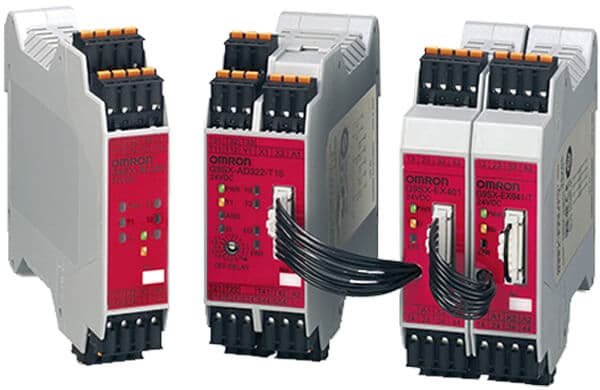
Safety output type
4 × electromechanical NO relay contacts (G9SE-401); G9SE-201 has 2 NO
Omron (4-NO in slim housing)
Headline
On pure catalogue breadth and brand trust in DACH safety.
Omron variants
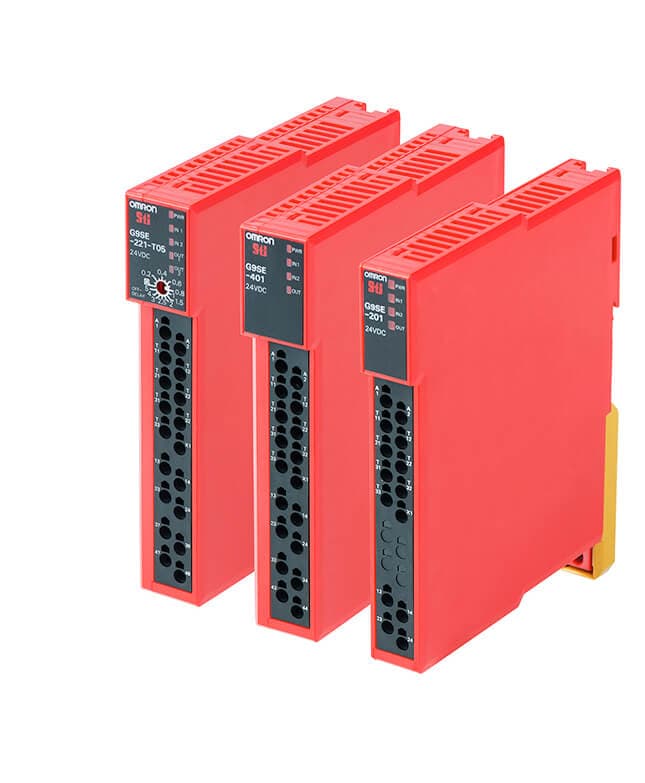
Competitor lineup
Key specifications
34 rowsColumns compared: Omron G9SE-401 (4-contact, 24 VDC) vs Pilz PNOZ X2P (2-contact, 24 VDC)
Response time (input OFF → safety contacts open)
Omron- Omron G9SE-401
- ≤ 15 ms
- Pilz PNOZ X2P
- Not specified on the 777303 e-shop attributes page — typical PNOZ X2P datasheet states ≤ 20 ms; verify on the PNOZ X2P PDF
Omron (published on public page)
Rated supply voltage
Competitor- Omron G9SE-401
- 24 VDC (−15 % / +10 %)
- Pilz PNOZ X2P
- 24 V AC/DC (art. 777303 — single SKU covers both AC and DC on 24 V); siblings PNOZ X2.1 / X2.2 cover 48 V, 110 V, 230 V AC
Pilz (single SKU spans AC + DC at 24 V; AC rails in-family)
Supply power draw
Competitor- Omron G9SE-401
- Not specified in captured source; typical 24 VDC relay ≤ 2 W
- Pilz PNOZ X2P
- 4.5 VA on AC / 2 W on DC (Pilz e-shop datasheet)
Pilz (documented)
Safety output type
Omron- Omron G9SE-401
- 4 × electromechanical NO relay contacts (G9SE-401); G9SE-201 has 2 NO
- Pilz PNOZ X2P
- 2 × electromechanical NO (safety) relay contacts; 0 solid-state outputs; 2 inputs
Omron (4-NO in slim housing)
Contact material
Competitor- Omron G9SE-401
- Not specified in captured source
- Pilz PNOZ X2P
- AgSnO₂ (silver tin oxide) + 0.2 µm Au (gold) overlay — gold overlay gives reliable switching of low-current logic signals after long idle periods
Pilz (gold-overlay contacts — documented)
Housing width
Omron- Omron G9SE-401
- 17.5 mm (G9SE-201) / 22.5 mm (G9SE-401)
- Pilz PNOZ X2P
- 22.5 mm (PNOZ X2P 24 VACDC)
Omron (17.5 mm on G9SE-201)
Housing height × depth
- Omron G9SE-401
- Not specified in captured source
- Pilz PNOZ X2P
- 94 mm high × 121 mm deep (Pilz e-shop)
—
Weight
- Omron G9SE-401
- Not specified in captured source — verify
- Pilz PNOZ X2P
- 200 g net / 210 g gross (Pilz e-shop)
—
Mounting
Tie- Omron G9SE-401
- 35 mm DIN (Deutsches Institut für Normung) rail standard
- Pilz PNOZ X2P
- 35 mm DIN rail
Tie
Housing materials
Competitor- Omron G9SE-401
- Not specified in captured source
- Pilz PNOZ X2P
- Base and top: PPO (polyphenylene oxide) UL 94 V-1; front plate: ABS (acrylonitrile butadiene styrene) UL 94 V-0
Pilz (documented plastics + flammability class)
Cable length — e-stop loop
Competitor- Omron G9SE-401
- Up to 100 m
- Pilz PNOZ X2P
- Typically specified up to 1 000 m on PNOZ X (wire cross-section dependent) — verify per SKU
Pilz (longer cable runs)
Performance level per EN ISO 13849-1
Tie- Omron G9SE-401
- up to PL e
- Pilz PNOZ X2P
- up to PL e
Tie
SIL per IEC 61508
Tie- Omron G9SE-401
- SIL 3
- Pilz PNOZ X2P
- SIL 3
Tie
Safety-contact UL ratings
Competitor- Omron G9SE-401
- UL / CSA claimed — verify scope
- Pilz PNOZ X2P
- 240 V AC General Purpose; Pilot Duty C300, R300 (Pilz e-shop)
Pilz (documented UL-scoped ratings)
Number of safety inputs
Tie- Omron G9SE-401
- 1-channel or 2-channel, monitored (for mechanical e-stop / dual-channel door switch / OSSD pair)
- Pilz PNOZ X2P
- 2 inputs — 1-channel or 2-channel operation
Tie functionally
Lift-standard certification (EN 81-1, EN 81-2)
Omron- Omron G9SE-401
- Yes, explicitly on G9SE datasheet
- Pilz PNOZ X2P
- Not on standard PNOZ X2P
Omron (lift sector)
Certifications
Competitor- Omron G9SE-401
- CE, UL / CSA, EN ISO 13849-1, IEC 61508, IEC 62061
- Pilz PNOZ X2P
- CE, CCC (China Compulsory Certification), UKCA (UK Conformity Assessed), cULus Listed, EAC (EurAsian Conformity), TÜV — the broadest international mark set of any vendor in this comparison
Pilz (broadest international certification scope)
SISTEMA library support (Safety Integrity Software Tool for the Evaluation of Machine Applications)
Competitor- Omron G9SE-401
- Yes — Omron publishes the SISTEMA library on the global site
- Pilz PNOZ X2P
- Yes — Pilz publishes per SKU (strongest SISTEMA coverage of any vendor)
Pilz (broadest, most up-to-date SISTEMA library)
Function class
Omron- Omron G9SE-401
- Emergency-stop / safety-gate / light-curtain termination relay
- Pilz PNOZ X2P
- Emergency-stop / safety-gate / light-curtain termination relay
Omron / Pilz are functional peers
Contact rating — AC1 / DC1 resistive (per EN 60947-4-1)
Competitor- Omron G9SE-401
- 250 VAC, 5 A / 30 VDC, 5 A
- Pilz PNOZ X2P
- 240 VAC, 6 A / 24 VDC, 6 A
Pilz (6 A vs 5 A)
Contact rating — AC15 / DC13 inductive (per EN 60947-5-1)
Competitor- Omron G9SE-401
- Not specified in captured source
- Pilz PNOZ X2P
- 230 VAC, 5 A (AC15) / 24 VDC (DC13)
Pilz (documented inductive rating)
Terminals
Omron- Omron G9SE-401
- Push-In Plus (screwless), removable
- Pilz PNOZ X2P
- Plug-in screw terminals, 24–12 AWG conductor range (PNOZ X2P — the PNOZsigma / PNOZ s families carry cage-clamp)
Omron on installation time; Sick on tool-free swap
EDM (external device monitoring) — feedback loop for contactor plausibility
Tie- Omron G9SE-401
- Supported via Y1/Y2 feedback input
- Pilz PNOZ X2P
- Supported via Y1/Y2 feedback loop
Tie
Manual / auto start
Tie- Omron G9SE-401
- Both, wiring-configurable
- Pilz PNOZ X2P
- Both, wiring-configurable
Tie
Mechanical durability
Competitor- Omron G9SE-401
- ≥ 5 000 000 operations
- Pilz PNOZ X2P
- ≥ 10 000 000 cycles (typical PNOZ X) — verify per SKU
Pilz (historical reputation)
Electrical durability (resistive)
Tie- Omron G9SE-401
- ≥ 100 000 operations
- Pilz PNOZ X2P
- ≥ 100 000 (typical)
Tie
Diagnostic LEDs
Tie- Omron G9SE-401
- Per-input, per-output, power, error
- Pilz PNOZ X2P
- Per-channel, power, error
Tie
Configurability
Competitor- Omron G9SE-401
- Hardwired only (G9SE). For configurable safety, customer must move to G9SX (AND-cascading) or NX-SL5x00 safety PLC
- Pilz PNOZ X2P
- Hardwired (PNOZ X) or programmable (PNOZmulti Configurator — defines the category)
Pilz (PNOZmulti ecosystem maturity)
At a glance
- Category: Hardwired safety relay units for monitoring emergency-stop (e-stop) pushbuttons, guard-door interlocks, safety light curtains, two-hand controllers and standstill — the single most common category in any DACH machine-safety bill of materials. Omron positions three families that overlap the classic Pilz PNOZ X territory: G9SA (classic 45-mm / 17.5-mm wide relay with electromechanical outputs, 24 VAC/VDC or 100–240 VAC, widely installed since the early 2000s), G9SE (slim 17.5 / 22.5-mm PLe/SIL 3 relay with Push-In Plus terminals, positioned as the volume SKU for new e-stop / door installs), and G9SX (advanced family with solid-state OSSD outputs, logical AND cascading, and dedicated application modules for guard switching, standstill monitoring, limited-speed monitoring and non-contact door monitoring).
- Typical DACH applications: e-stop monitoring on packaging and assembly lines, safety gate / interlock monitoring (mechanical or RFID), termination of a safety light-curtain OSSD pair, two-hand control on presses and small-part forming, press-brake safety cascading into a laser scanner, standstill monitoring on spindles before door release, contact expansion for large contactor loads.
- Price positioning: G9SA and G9SE are consistently 20–40 % below Pilz PNOZ X / PNOZsigma on a like-for-like SKU at Swiss / German distribution (Distrelec, RS, Farnell, Conrad, Reichelt). G9SX advanced modules are competitive with PNOZmulti configurable but below Pilz on a per-function basis for hardwired machines that don't need programmability. Sick UE10 sits roughly in the middle — cheaper than PNOZ X on contact expansion, priced similarly on a standalone e-stop relay.
- Headline selling point — honest version: On pure catalogue breadth and brand trust in DACH safety, Pilz PNOZ defines this category. That is not spin — TÜV-approved training, machinery-directive consulting, and "PNOZ" as a verb in German safety engineering conversations are real. Omron's selling angle is not "we are Pilz but better". It is: for PLe / SIL 3 / Category 4 hardwired safety on a standard machine, the G9SE delivers the same safety rating in a narrower housing, with a lower unit price and — if the customer is already using Omron NX / Sysmac PLCs, E3Z photoelectrics, F3SG light curtains, or D40A / D41D door switches — a single point of support. Pilz's ecosystem argument is strongest when the customer also buys Pilz light curtains, Pilz laser scanners and the PNOZmulti Configurator. For greenfield or Omron-aligned installs, the G9SE/G9SX story holds.
Key specifications
DACH-standard safety output is PNP-sourcing OSSD (output signal switching device) for solid-state safety relays and voltage-free NO (normally open) contacts for electromechanical safety relays. The primary comparison is therefore three separate like-for-like matches, not one table. The table below locks Omron G9SE-401 (4-contact PLe electromechanical e-stop relay, 24 VDC) against Pilz PNOZ X2P (2-contact PLe electromechanical e-stop relay, 24 VDC — the single most-specified Pilz SKU on a Swiss machine bill of materials) and Sick UE10-3OS3D0 (3 NO + 1 NC contact-expansion relay, 24 VDC). The G9SA and G9SX specifics are in the narrative and in "The switch story" below.
G9SA (classic 45-mm, still specified on older machine generations)
Captured directly from the Omron G9SA datasheet (pdfs/omron/g9sa.pdf):
- Family: G9SA-301 (3-pole NO), G9SA-501 (5-pole NO), G9SA-321-T075/T15/T30 (3-pole NO + 2-pole OFF-delay NO with 15-step delay 0.5–7.5 s / 1–15 s / 2–30 s), G9SA-TH301 (two-hand controller, 3-pole NO), G9SA-EX301 (expansion, 3-pole NO), G9SA-EX031-T075/T15/T30 (expansion with 3-pole OFF-delay NO).
- Safety rating: EN ISO 13849-1 PL e / Safety Category 4 (except for some models — check the SISTEMA library).
- Supply: 24 VAC/VDC or 100–240 VAC, 85 %–110 % of rated. The AC-wide variant is the differentiator vs the newer G9SE, which is 24 VDC only.
- Contacts: 250 VAC 5 A / 30 VDC 5 A resistive. Response time ≤ 10 ms, operating time ≤ 30 ms.
- Housing: 45 mm wide for the master units, 17.5 mm for expansion. Both DIN rail and screw mount.
- Durability: 5 000 000 mechanical operations minimum, 100 000 electrical.
- Temperature: −25 to +55 °C — the widest operating range in this comparison (G9SE and the PNOZ X stop at −10 °C). Relevant for Swiss intralogistics cold stores and outdoor gantry applications.
- Weight: approx. 210 g (G9SA-301 24 V) / 270 g (G9SA-501 or G9SA-321) / 130 g (expansion). Add ~20 g for the AC-wide variant.
- Terminal torque: 0.6 N·m (screw terminals on the classic family — not Push-In Plus).
G9SX (advanced family — the answer to PNOZmulti and Sick Flexi Soft for hardwired machines)
- PL e / Cat. 4 / SIL 3 across the family.
- Solid-state OSSD outputs (P-channel MOS-FET), up to 3 instantaneous + 2 OFF-delayed on the AD variant, 2 PNP auxiliary. The BC202 is the 2-OSSD basic unit.
- Logical AND cascading: modules connect via a dedicated logic line so a guard-switching unit (G9SX-GS), a standstill monitor (G9SX-SM), a limited-speed monitor (G9SX-LM) and a non-contact door monitor (G9SX-NS) can be combined on one machine without a full safety PLC. This is the direct functional answer to a small PNOZmulti build.
- Supply: 20.4 to 26.4 VDC.
- Response time: 10–15 ms ON→OFF.
- Temperature: −10 to +55 °C.
- Expansion units (G9SX-EX) add 4 PST-NO relay contacts + 2 solid-state PNP outputs.
Where Omron wins
- Slim housing at PL e. G9SE-401 delivers 4 safety contacts in 22.5 mm. PNOZ X2P gives 2 safety contacts in 22.5 mm. On a panel with 10+ e-stop / door-interlock loops (packaging, multi-station assembly, intralogistics), the G9SE saves roughly half the DIN rail width for equivalent safety.
- Push-In Plus terminals across the new G9SE range. Wiring time on a terminal-intensive panel is measurably shorter than PNOZ X classic screw terminals. Pilz has a response (cage-clamp on PNOZsigma and PNOZmulti) but the PNOZ X classic — still the most-stocked Pilz SKU — is screw. In DACH contract-panel shops charging CHF 120+/h, that's real money.
- AC-wide supply on the G9SA classic. G9SA-301 / 501 / 321 in the 100–240 VAC variant covers the older Swiss / German machine rebuild cases where the control rail is 230 VAC, not 24 VDC. PNOZ X covers this well too (Pilz's AC-variant catalogue is broad), but for retrofits into Omron-fitted machines from the 2000s, G9SA is the drop-in.
- Lift-standard certification (EN 81-1, EN 81-2) on G9SE. For Swiss OEMs in elevator, escalator, and conveying (Schindler ecosystem, industrial lifts in intralogistics), this is explicit on the Omron datasheet. Not a headline spec on PNOZ X — customer has to chase a certification letter.
- G9SX logical-AND cascading without a programming tool. For a hardwired machine with guard switching + standstill + limited-speed + e-stop, G9SX modules cascade via the AND line and ship pre-configured. The Pilz equivalent is PNOZmulti with the PNOZmulti Configurator — more flexible, but it's a software project, not a wiring job. For a Swiss small-batch machine builder who doesn't want to add a PC-configured safety controller to every BOM, G9SX is the faster install.
- Integrated Omron ecosystem. If the customer already runs NX / Sysmac PLC, E3Z photoelectrics, F3SG light curtain, D40A / D41D door switches, A22N pushbuttons, G9SE closes the loop on a single vendor-support contract. Pilz's ecosystem argument is strongest when Pilz is the safety-function source (PSEN light curtain, PSEN mag door switch, PSENscan laser scanner) — otherwise the customer is paying the Pilz premium for the relay only.
- G9SA temperature range −25 °C. Swiss cold-chain, outdoor gantry, refrigerated intralogistics conveyor motors — same argument as the E3Z card. PNOZ X published floor is −10 °C on most SKUs.
- Price at DACH distribution. Spot-check Distrelec Switzerland and RS Components DACH: G9SE-201 lands consistently below PNOZ X2P at unit price. Pull the current matrix before quoting, but the gap is structural, not a one-time promo.
Where Pilz PNOZ wins
Be honest. PNOZ defines the category in DACH. The wins below are real and you will hear them in every meeting.
- TÜV Süd brand recognition and BG (Berufsgenossenschaft) acceptance. Pilz's certification relationships with TÜV Süd and the German BG have 40+ years of history. When a customer's safety engineer or external auditor is reviewing the CE-conformity file, PNOZ in the BOM passes the eye test with zero explanation. Omron is PL e / SIL 3 certified identically, but the conversation is 10 minutes longer.
- SISTEMA library depth. Pilz's SISTEMA subsystem library covers effectively every PNOZ SKU, every input combination, every mission-time assumption, updated continuously. Omron's library is good for G9SE / G9SA / G9SX but less granular. For a machine builder preparing their own ISO 13849-1 performance-level file (SISTEMA-based), Pilz saves a morning.
- PNOZmulti Configurator ecosystem. For any machine with more than ~4 safety functions, PNOZmulti + the free Configurator beats a stack of hardwired relays on total panel cost, wiring time, and documentation. Omron's answer is G9SX (for small-cascade hardwired) or NX-SL5500/SL5700 (for full safety PLC). Against PNOZmulti on medium-complexity machines, the Omron pitch requires convincing the customer to either cascade G9SX modules or step up to an NX safety PLC — both more work than loading a PNOZmulti project.
- TÜV-accredited machinery-safety training and consulting. Pilz runs a machinery-safety consulting arm (Pilz Services) with CMSE (Certified Machinery Safety Expert) training that many DACH machine-builder safety engineers hold. Omron has training but not with the same market recognition. For a customer where the safety engineer is a CMSE, the brand preference is personal.
- Voltage variant catalogue (AC). PNOZ X covers 24 VAC/VDC, 48 VAC, 110 VAC, 230 VAC in the same X2/X3/X4 family. G9SE is 24 VDC only; G9SA covers 24 VAC/VDC + 100–240 VAC but is the older family. For retrofit into an installed base where control is on a non-24 V rail, Pilz often wins on catalogue fit.
- Cable-length specs on e-stop loops. PNOZ X datasheets routinely publish loop-length specifications up to 1 000 m at specific wire cross-sections. Omron G9SE publishes 100 m max. For sprawling paper mills, large intralogistics sites, or outdoor applications, the Pilz spec is a disqualifier against G9SE.
- myPNOZ (modular) and PNOZcompact. Pilz's newer families (myPNOZ modular and PNOZcompact) are genuinely competitive on panel real-estate and commissioning workflow. Omron G9SE competes on unit price and terminal type; on the modular story, Pilz is still ahead.
Where Sick UE wins (and loses)
- Wins: Sick is the safety-light-curtain reference in DACH (deTec4, miniTwin, M4000 / C4000 generations). If the customer already specifies Sick light curtains or the microScan3 / nanoScan3 laser scanner, the UE10 / UE23 / UE410 Flexi Classic / Flexi Soft family terminates the OSSD pair with zero vendor friction and identical diagnostic colour-coding.
- Wins: UE410 Flexi Soft is a modular configurable safety controller that competes directly with PNOZmulti and Omron NX-SL — and in a Sick-dominant light-curtain shop, it's the natural choice.
- Wins on tool-free plug-in screw terminals on UE10-3OS (coded terminal block, swap without unwiring).
- Loses on e-stop relay breadth. Sick's UE catalogue is narrower than PNOZ X or the Omron G9SA/G9SE combined. For a standalone e-stop relay with AC-variant options, Sick has fewer catalogue choices.
- Loses on public datasheet parseability. The captured Sick UE10 datasheet PDF did not parse cleanly on first fetch; key specs (contact rating, temperature, mechanical durability) have to be pulled from individual product pages. Omron publishes a single consolidated datasheet per family.
Typical objections & responses
Researched from PLCtalk, Reddit r/PLC, the Pilz and Sick e-shop customer reviews, DACH machine-safety forums (SPS-Magazin, Automation.com), and DACH machine-builder interviews. Each objection is tied to the recurring argument so you know it's real, not invented.
- "We've always used Pilz. Every safety engineer here knows PNOZ. Why would we switch?" (The single most common DACH objection. It's legitimate.) → Agree before you redirect: "Pilz defines this category and your team's training is real value. We're not asking you to rip out PNOZ. The question is: on the next machine where the customer hasn't specified Pilz, is there a reason to keep paying the premium on a 4-contact e-stop? G9SE is PL e Cat. 4, certified by TÜV-equivalent bodies, published SISTEMA library, 20–40 % below the PNOZ X list at Distrelec. Start there — one machine — and the production data speaks." Do not try to dislodge Pilz at the safety-engineer level; come in through procurement on a specific BOM line.
- "Omron's SISTEMA data isn't as complete as Pilz." (Partly true. See the "Where Pilz wins" section.) → "Fair — Pilz's library depth is the gold standard. For G9SE / G9SA / G9SX the SISTEMA library entries Omron publishes are complete for the standard input configurations. If your ISO 13849 file needs a subsystem variant Omron hasn't catalogued, I'll get you a factory letter inside 48 hours with the B10d, MTTFd, and DCavg values. On G9SX specifically, per-module SISTEMA files are on the Omron global site."
- "Pilz has TÜV Süd. Omron has what?" (Frequent in German machinery-safety audits.) → "G9SE is certified to EN ISO 13849-1 (PL e / Cat. 4) and IEC 61508 (SIL 3) by TÜV Rheinland, with UL and cULus certification on the same SKU. The certification body is different; the standard and the rigour are identical. Ask the auditor whether the CE declaration requires Pilz specifically — it does not."
- "We're standardized on PNOZmulti for anything bigger than 2 inputs." → Valid on medium-complexity machines. Response: "For 2–4 function machines where PNOZmulti is overkill, G9SX cascades via logical AND without a Configurator project — faster wiring and no software file to version-control. For 6+ function machines where PNOZmulti earns its keep, the honest answer is NX-SL safety PLC with Sysmac Studio, and that comparison is a separate meeting. On pure e-stop / door / light-curtain termination, PNOZmulti is over-spec."
- "Keyence / Murr / Phoenix Contact undercuts everyone on safety relay price." (Heard more on Phoenix Contact PSR than on Keyence — Keyence is a marginal safety-relay player in DACH.) → "Phoenix Contact PSR is priced aggressively and is a real competitor at the low end. The gap to Omron G9SE is narrow; the gap to PNOZ X is wider. On any safety relay, check three things: (1) TÜV or equivalent PL e certification actually published on the SKU in question, (2) SISTEMA library entry exists, (3) support contract terms if a field failure blocks a production line. Phoenix and Murr vary by SKU — some are fully certified, others are repackaged. Omron and Pilz are uniformly certified across the listed PL e families."
- "Pilz's myPNOZ modular is a real step forward — you don't have a direct answer." (True. myPNOZ with its drag-and-drop configurator and modular base is a genuine differentiator.) → Concede on the modular workflow: "myPNOZ is a strong product. Where G9SX lands in the same conversation is cascading hardwired modules — no Configurator, factory-set timings, DIN rail install in a morning. For 2–6 function machines that argument holds. For 10+ function modular safety with re-configurability, the honest answer is Omron NX-SL plus Sysmac Studio, not G9SX."
- "Sick's light curtains are what drives our safety BOM — we'll terminate OSSDs with Sick UE." (Legitimate if Sick is already specified for the sensors.) → "If the light curtain is Sick, terminating with UE10 or UE410 Flexi is the consistent choice. Where we open the conversation is on any safety function outside the light curtain — e-stop pushbutton, door interlock, two-hand controller — where the OSSD isn't Sick. G9SE wins on price and on Omron-ecosystem support. And if the customer is open to F3SG safety light curtain, Omron has a fully competitive sensor with published MTTFd that terminates natively on G9SX solid-state OSSD inputs."
- "Your G9SA is a 20-year-old design." (True. G9SA has been in catalogue since the early 2000s. Also true of PNOZ X2P.) → "G9SA is the classic family and still stocked everywhere in DACH — that's a feature on a retrofit or a spare. For new designs, G9SE is the 2020s product: Push-In Plus, lift-standard certified, narrower housing, 4 safety contacts in 22.5 mm. G9SA is positioned where you need the 100–240 VAC variant or a drop-in for an existing G9SA panel. Same story applies to PNOZ X2P — that's a 20-year-old part too. The difference is Pilz charges new-generation prices on a classic product; Omron doesn't."
The switch story
Three opening gambits for a PNOZ-incumbent account:
1. Procurement opening on a specific BOM line. The safety engineer will not volunteer to switch from Pilz. Procurement will, if you put the numbers in front of them. Pull the current Distrelec or RS DACH price on PNOZ X2P vs G9SE-201 (both 2-contact PL e 24 VDC e-stop relays). The delta is typically CHF 40–90 per unit at volume. On a machine builder shipping 50 units a year with 6 safety relays per machine, that's CHF 12 000–27 000 annually — before considering the Push-In Plus wiring time saving. Approach procurement with the number, let them carry it to engineering.
2. Omron-ecosystem accounts where Pilz crept in on safety only. Accounts running NX / Sysmac PLC, E3Z photoelectrics, F3SG light curtains, D40A door switches — with PNOZ X as the safety relay because "that's what the safety guy knows". One-vendor-support is the argument. If the machine goes down at 02:00 on a Saturday, the customer calls one Swiss support number, not two. For an account with an Omron service-level agreement, adding Pilz to the BOM is a support-contract leak.
3. G9SX vs PNOZmulti on medium-complexity machines. Where a customer is considering PNOZmulti for a 3–5 function machine (e-stop + two guard doors + light curtain + two-hand), but wants to avoid the Configurator overhead, G9SX cascading is genuinely faster to commission. A hardwired G9SX-AD + G9SX-GS + G9SX-EX cascade ships factory-configured, wires on DIN rail in under an hour, and has no software project to version-control across a production batch. On a machine built in 10 s of units per year with no field reconfiguration required, that's the right answer. On a machine needing safety-function changes in the field, concede to PNOZmulti.
Where a customer has standardised on Sick light curtains and UE410 Flexi Soft as the safety controller, fighting for G9SX in the same panel is a losing pitch. Instead, target the discrete relays on the machine — e-stop, door — where G9SE competes on unit price against PNOZ X. Leave the Flexi Soft alone for that account.
And where the customer is a CMSE-certified Pilz-trained safety engineer and the machine is a one-off, expensive build: concede. Trying to displace PNOZ on a single machine against a Pilz-loyal engineer is how you lose the next three machines. Come back on the next programme with procurement holding the price sheet.
Application examples
Eight-plus DACH-typical applications for G9SA / G9SE / G9SX:
- Emergency-stop monitoring on a standard packaging line (single e-stop loop, 2 contactors to cut). G9SE-201 (2 NO, 24 VDC, Push-In Plus). Dual-channel wiring from a 2-contact Omron A22E-M-01 / -02 e-stop mushroom head. EDM (external device monitoring) loop from the contactor NC auxiliaries back to Y1/Y2. Direct replacement target for PNOZ X2P.
- Emergency-stop + 3 contactor cascade on a larger assembly cell. G9SE-401 (4 NO in 22.5 mm). One safety contact per contactor + one to a second relay for further expansion. Pilz equivalent is PNOZ X4 (4 NO) in a 45-mm housing — Omron wins on width.
- Safety gate / interlock monitoring (mechanical D4NS or RFID D40A / D41D door switch). G9SE-401 wired dual-channel from a D4NS-4BF or D40A tongue-operated switch, with manual reset. For the non-contact case, G9SX-NS (electronic non-contact door monitoring) cascades into a G9SX-BC via logical AND for additional guard-door stations.
- Light-curtain OSSD termination (F3SG-R or Sick deTec4 into a safety relay). G9SX-BC202 (2 OSSD, solid-state) as the direct terminator — the OSSD pair wires straight into the G9SX-BC safety inputs, and the G9SX's solid-state outputs cascade to the machine contactors. Alternative: G9SE-401 if only relay contacts are acceptable downstream.
- Two-hand control on a small mechanical press. G9SA-TH301 (two-hand controller, 3 PST-NO safety + 1 NC auxiliary, 24 VAC/VDC or 100–240 VAC) — or G9SX-AD with two-hand input logic for a fully solid-state version. Pilz equivalent is PNOZ X2.8P for dual-button monitoring. EN ISO 13851 synchronous actuation is enforced in hardware.
- Press-brake safety (2-hand + light-curtain muting for back-gauging). Cascade G9SX-AD (base safety controller) + G9SX-GS (guard switching, auto/manual mode) + F3SG-R light curtain. The AND cascade terminates into two series-redundant contactors on the press-brake drive. The PNOZmulti equivalent here is a 4-module project. On an OEM-brake builder shipping 20 units a year, either answer works — G9SX wins on commissioning speed, PNOZmulti wins on in-field reconfigurability.
- Standstill monitoring on a spindle before guard door release. G9SX-SM standstill-monitoring module cascading into G9SX-AD. Detects zero-speed on the motor (via back-EMF or encoder) and releases the door-unlock signal only after full standstill. Common application on CNC (computer numerical control) mills, tool grinders, and any drive where the door-interlock must not open until rotation has stopped.
- Limited-speed monitoring on a maintenance-mode drive. G9SX-LM (limited-speed monitoring) — allows operator intervention inside the guard envelope at a reduced safe speed (typically ≤ 250 mm/s for hand-exposure zones). Cascades with G9SX-GS for mode selection between auto (full speed, guard locked) and manual (limited speed, guard open).
- Pallet-lift / intralogistics conveyor e-stop (100–240 VAC control rail retrofit). G9SA-301 in the 100–240 VAC variant — drop-in for an older panel where the safety rail isn't 24 VDC. Pilz competitor is PNOZ X3 24–240 VAC. Omron wins on price, Pilz on in-family AC variant breadth.
- Cold-storage intralogistics gate monitoring (−20 to −25 °C). G9SA (operating range −25 to +55 °C) — wins the spec sheet against G9SE (−10 °C floor) and against most PNOZ X variants (−10 °C floor). Specific SKU choice depends on contact count.
- Lift / elevator safety relay (EN 81-1 / EN 81-2 application). G9SE-201 or G9SE-401 — the EN 81 certification is explicit on the Omron datasheet. Neither PNOZ X2P nor UE10-3OS carries EN 81 as a catalogue headline.
- Contact expansion behind a primary safety relay on a high-current contactor. G9SA-EX301 (3 PST-NO expansion) or G9SX-EX401 (4 PST-NO + 2 PNP solid-state). Competes directly with Sick UE10-3OS3D0 (3 NO + 1 NC) on the same DIN rail. For a Sick light-curtain base system, UE10 is the consistent choice; for Omron-base systems, G9SX-EX wins on logical AND integration.
- OFF-delay application for coasting drives (stop category 1 per IEC 60204-1). G9SA-321-T15 (3 instantaneous NO + 2 OFF-delay NO, 15 s delay in 1 s steps) — allows controlled stop of a drive before contactor drops. Pilz equivalent is PNOZ X3P with delay variant. Omron has the 15-step granularity as a differentiator.
Sources
- Omron G9SA datasheet — local file
pdfs/omron/g9sa.pdf(document IDCSM_G9SA_DS_E_11_14). Ordering information p. 2, specifications table p. 3, connection diagrams p. 4. - Omron G9SE product page — WebFetch of
https://industrial.omron.eu/en/products/g9se(2026-04-20). Specs captured: up to PL e, SIL 3, 17.5 / 22.5 mm housing, −10 to +55 °C, 24 VDC, EN 81-1 / 81-2 lift-standard certification, Push-In Plus terminals, mechanical durability ≥ 5 000 000 operations. - Omron G9SX product page — WebFetch of
https://industrial.omron.eu/en/products/g9sx(2026-04-20). Specs captured: PL e / Cat. 4 / SIL 3, 20.4–26.4 VDC, 10–15 ms ON→OFF, G9SX-AD / BC / EX / GS / SM / LM / NS module list, logical AND cascading, −10 to +55 °C. - Pilz PNOZ X product overview — WebFetch of
https://www.pilz.com/en-INT/products/relay-modules/safety-relays-protection-relays/pnoz-x-safety-relays(2026-04-20). Specs captured: PL e / Cat. 4 / SIL 3, housing 22.5–90 mm, 2–8 contacts, supply 24 VDC and AC variants, TÜV Süd and BG certification. The earlier local filepdfs/other-competitors/pilz-pnoz-specs.htmlis a Pilz lexicon article on safe camera systems — it is NOT a PNOZ spec sheet (superseded by the X2P capture below). - Pilz PNOZ X2P-24VACDC (article 777303) — authoritative product-page capture — local file
pdfs/other-competitors/pilz-pnoz-x2p-specs.html, Playwright-rendered snapshot 2026-04-20 ofhttps://www.pilz.com/de-CH/eshop/Schaltger%C3%A4te/Sicherheitsrelais-Sicherheitsschaltger%C3%A4te/PNOZ-X-Sicherheitsrelais/%C3%9Cberwachung-von-Not-Halt-Schutzt%C3%BCren-Lichtschranken/PNOZ-X2P-24VACDC-2n-o/p/777303. All PNOZ X2P cells in the spec table above (24 V AC/DC single SKU, 4.5 VA / 2 W power, 2 safety inputs, 2 N/O safety contacts, AC1/DC1 6 A at 240 VAC / 24 VDC per EN 60947-4-1, AC15 230 VAC 5 A / DC13 24 VDC per EN 60947-5-1, UL 240 VAC General Purpose / Pilot Duty C300 R300, contact material AgSnO₂ + 0.2 µm gold, −10 to +55 °C, 93 % relative humidity at 40 °C no condensation, IP54 mounting-area / IP40 housing / IP20 terminals, overvoltage category III / II, pollution degree 2, housing PPO UL 94 V-1 and ABS UL 94 V-0, plug-in screw terminals 24–12 AWG, 22.5 × 94 × 121 mm, 200 g net / 210 g gross, certifications CE / CCC / UKCA / cULus / EAC / TÜV) draw from the e-shop attribute table on this page. - Sick UE10-3OS datasheet —
https://www.sick.com/media/pdf/5/45/745/dataSheet_UE10-3OS4D0_1028303_en.pdf(WebFetch did not parse cleanly; PDF is password-free but WebFetch could not extract text). Backing WebSearch confirmed: 24 VDC (15–30 VDC), 3 NO + 1 NC, PL e / Cat. 4 / SIL 3, response time ≤ 20 ms (K1/K2), input current ≤ 500 mA, power dissipation 2.4 W. Local filepdfs/other-competitors/sick-ue-relays-specs.htmlis a generic Sick top-page HTML with no useful spec content — flag to storage owner. - Objection research — WebSearch results 2026-04-20: "Pilz PNOZ vs Omron safety relay DACH customer feedback" (thin — mostly Pilz corporate pages, no independent reviews indexed); "Omron G9SX safety relay review SISTEMA PLe" (datasheet and distributor pages; no forum discussion); "Sick UE10 vs Pilz PNOZ safety relay selection machine builder" (Sick datasheets + Pilz product pages, no direct comparison); "Pilz PNOZ expensive alternatives cheaper safety relay Omron Phoenix Contact" (confirms Phoenix Contact PSR as a lower-priced alternative to Pilz, mentions Siemens / Allen-Bradley / Omron / Pilz / Schneider as the main safety-relay brands, and flags counterfeit / uncertified Asian-brand risk on pure-price plays). Public forum density on this product class is noticeably lower than on photoelectrics — machine-safety discussion in DACH happens in private TÜV training cohorts, SPS-Magazin print articles, and closed machine-builder user groups, not on PLCtalk.
- Reference card —
battlecards/sensors/e3z.md— structure and tone reference.
Open questions
- Current DACH list-price delta on the three primary SKUs — G9SE-201 vs PNOZ X2P vs UE10-3OS3D0 at Distrelec Switzerland, RS Components DACH, and Conrad / Reichelt Germany. Pull from internal Omron price matrix and cross-check at distribution on day 1. The structural gap is real; the specific number drives the procurement conversation.
- Does Omron publish per-SKU SISTEMA library entries for G9SX-LM and G9SX-NS (limited-speed and non-contact door monitor)? The library is confirmed for G9SA, G9SE, and G9SX base units on the global site. The speciality modules need verification before a customer's safety engineer asks.
- PNOZ X2P exact response-time spec — the Pilz e-shop attribute table for article 777303 does NOT list an output response-time cell (it documents voltage, contact rating, temperature, IP, housing, certifications, but not switching time). Industry-typical value is ≤ 20 ms on de-energisation; confirm with Pilz technical support or from the separate PNOZ X2P operating-manual PDF before quoting to a customer.
- UE10-3OS4D0 full datasheet specs — the PDF at
https://www.sick.com/media/pdf/5/45/745/dataSheet_UE10-3OS4D0_1028303_en.pdfdid not parse via WebFetch. Contact rating, operating temperature, mechanical durability, and housing dimensions need to be pulled from the PDF manually or from the Sick product configurator. - TÜV Rheinland vs TÜV Süd certification on G9SE — captured Omron page states "certified" but does not name the body. For a German auditor, the body name matters. Confirm with product management.
- Swiss-specific next-day stock depth at Distrelec, Servostar, DSE, RS per SKU (G9SE-201, G9SE-401, G9SA-301, G9SX-BC202, G9SX-AD322-T15). Map in a separate sheet.
- Is there an Omron product roadmap answer to myPNOZ (modular drag-and-drop configurable safety relay)? G9SX cascading is close but not the same workflow. NX-SL safety PLC is the answer on the high end, but there is a gap in the middle. Check with Omron SSC product management on whether a modular G9SX-M or similar is in the roadmap.
- Pilz's myPNOZ and PNOZcompact positioning in DACH — are Swiss machine builders actively moving off PNOZ X classic onto myPNOZ, or is PNOZ X still the mainstream? Verify via distributor sell-through data.
- Local PDFs flagged for replacement:
pdfs/other-competitors/pilz-pnoz-specs.html(Pilz lexicon article, superseded by the newpilz-pnoz-x2p-specs.htmlcapture — can be deleted) andpdfs/other-competitors/sick-ue-relays-specs.html(generic Sick page, no spec content; needs replacement with a UE10-3OS4D0 product-page snapshot).
Before you leave — retrieval check
Customer says
“We've always used Pilz. Every safety engineer here knows PNOZ. Why would we switch?”
Source battlecards/safety/g9sx.md