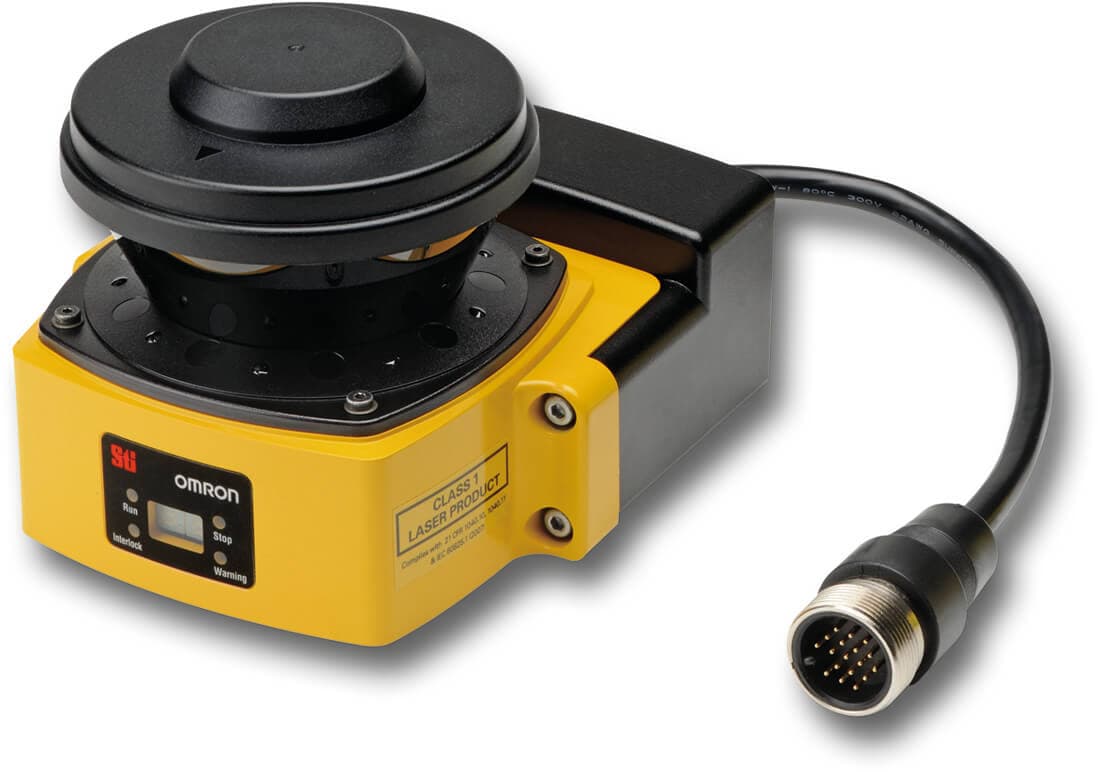
Omron OS32C
Compact safety laser scanner for AGV / AMR and area guarding
Reference mode — everything visible. Use for live calls.
Three things to remember
Power consumption (no output load)
5 W average, 3.75 W standby
Omron (documented, lowest)
Weight
1.3 kg
Omron / nanoScan3 (both far lighter than S3000)
Headline
Compact (104.5 mm housing height), 1.3 kg, 5 W average power draw — purpose-designed for battery-powered…


Key specifications
40 rowsColumns compared: Omron OS32C vs Sick S3000 Professional
OSSD outputs
Tie- Omron OS32C
- 2 × PNP safety OSSDs
- Sick S3000 Professional
- 2 × PNP safety OSSDs
Tie
Supply voltage
Tie- Omron OS32C
- 24 VDC +25 % / −30 %
- Sick S3000 Professional
- 24 VDC SELV (Safety Extra-Low Voltage), range 16.8 V to 28.8 V DC, ripple ≤ ±5 %
Tie
Power consumption (no output load)
Omron- Omron OS32C
- 5 W average, 3.75 W standby
- Sick S3000 Professional
- 14 W typical / 19 W max (14–19 W also in standby / park)
Omron (documented, lowest)
Power consumption (max output load, no encoder)
other- Omron OS32C
- — (not specified in OS32C captured source)
- Sick S3000 Professional
- 53 W typical / 55 W max
S3000 (documented under load)
Inrush current
other- Omron OS32C
- Not specified in captured source
- Sick S3000 Professional
- 2 A
S3000 (documented)
Muting (material-pass-through safety-override under defined conditions)
Competitor- Omron OS32C
- Not specified in captured source as a native OS32C function — muting typically implemented at the safety controller (NX-SL, G9SP) level
- Sick S3000 Professional
- Supported via CDS configuration
Sick (native)
Weight
Omron- Omron OS32C
- 1.3 kg
- Sick S3000 Professional
- 3.3 kg
Omron / nanoScan3 (both far lighter than S3000)
Dimensions (W × H × D)
other- Omron OS32C
- 133.0 × 104.5 × 142.7 mm
- Sick S3000 Professional
- 155 × 185 × 160 mm (W × H × D)
nanoScan3 (smallest)
Housing material
Competitor- Omron OS32C
- Not specified in captured source — typically polycarbonate / aluminium composite
- Sick S3000 Professional
- Aluminium die-cast, RAL 1021 rapeseed yellow; front screen polycarbonate with scratch-resistant exterior coating
Sick (most rugged housing; heaviest)
Connector
- Omron OS32C
- 18-pin pigtail (power/IO) + M12 4-pin (communication)
- Sick S3000 Professional
- M12 system plug (rotatable)
—
At a glance
- Category: Type 3 safety laser scanner per IEC (International Electrotechnical Commission) 61496-1/-3, used for horizontal area guarding, vertical access guarding, and on-board AGV (automated guided vehicle) and AMR (autonomous mobile robot) collision avoidance. Reaches Performance Level d (PL d) Category 3 per EN ISO 13849-1 and SIL 2 (Safety Integrity Level 2) per IEC 61508.
- Typical DACH applications: AGV / AMR intralogistics fleets (Migros / Coop warehouses, automotive intralogistics, Swiss Post parcel hubs), robot cell floor-guarding, palletiser and depalletiser perimeter, press-brake area guarding, packaging-line safeguarding, machine-tool loading cells, automated guided forklift safeguarding at narrow-aisle racking.
- Price positioning: Mid-market in DACH. Typically below Sick nanoScan3 Pro on a like-for-like AGV spec; the Sick S3000 is being actively end-of-lifed so direct comparison increasingly gives way to OS32C vs nanoScan3 Pro.
- Headline selling point: Compact (104.5 mm housing height), 1.3 kg, 5 W average power draw — purpose-designed for battery-powered AGVs. 70 safety-zone and warning-zone combinations, dual back or side cable entry, EtherNet/IP (non-safety) measurement-data variant (OS32C-DM), and IEC 61496-3 Type 3 certification.
- Honest framing for DACH: Sick dominates the DACH safety-laser-scanner market. Most Swiss and German OEMs (original equipment manufacturers) and integrators specify Sick by default — microScan3 for area guarding, nanoScan3 for AGV / AMR. OS32C does not win on brand familiarity. It wins on compactness, on AGV-specific wiring and cable-entry options, and on a predictable EtherNet/IP path into Omron NX / NJ controllers. Target intralogistics AGV builders and cells integrated on Omron PLC (programmable logic controller) backbones, not greenfield Sick-PROFIsafe-based production lines.
Key specifications
DACH-standard output is PNP (positive-switching) OSSD (output signal switching device). Primary comparison: Omron OS32C-SP1 (side cable entry, 3 m protective field) vs Sick S3000 Professional S30A-6011DA (established incumbent, 5.5 m protective field) vs Sick nanoScan3 Pro NANS3-CAAZ30AN1 (new-generation AGV / AMR scanner).
Where Omron wins
- Dedicated AGV / AMR design. 1.3 kg, 104.5 mm tall, 5 W average and 3.75 W standby — the lowest documented power figures in this comparison. That directly extends AGV battery runtime. Sick's own marketing for nanoScan3 also emphasises low power and small size, but Omron publishes the specific watt numbers; Sick does not in the captured source.
- Cable-entry flexibility. OS32C ships in two physical variants — OS32C-SP1 (side cable entry) and OS32C-BP (back cable entry) — at the same footprint, with the same connector set. On tightly-packaged AGV chassis where the scanner sits in a cut-out in the bumper, that difference is the difference between a clean install and bending conduit. The S3000 uses a rotatable system plug which covers most cases, but swapping between back-routed and side-routed cable paths typically requires additional accessories.
- 70 zone-set combinations with 1 safety zone + 2 warning zones each. Each zone set carries a slow-down warning and a stop warning in addition to the safety zone, all switched by a single monitoring case. For AGVs running multiple speed profiles (fast straight-line, slow cornering, crawl at docking), one scanner covers the full state machine without an external safety controller doing zone selection. S3000 uses 8 field sets / 16 monitoring cases / up to 24 fields — flexible but a different architecture. nanoScan3 scales higher on cases (128) but asks you to commit to Safety Designer plus typically a Flexi Soft safety controller.
- I/O block stores the scanner configuration. Swapping a damaged OS32C in the field means plugging the new head into the existing I/O block with no reconfiguration. Sick S3000 stores configuration in the scanner head (system plug retains parameters on Sick's side as well, so this is roughly equal on S3000) — the honest delta is mainly versus older generations.
- Predictable EtherNet/IP integration into Omron NX / NJ / CIP Safety landscapes. OS32C-DM exposes measurement data and non-safety zone selection over standard EtherNet/IP. If the machine or AGV is already on an Omron NX102 / NX1P2 + NX-SL safety controller with CIP Safety I/O, the OS32C sits natively in that tree. The safety communication itself stays hardwired OSSD — Omron explicitly states the EtherNet/IP path is non-safety — but the diagnostic and measurement stream is in the same tool, with the same tag namespace. In a Sick-plus-Omron-PLC mixed install the configuration tool jumps between Sysmac Studio, CDS, and Safety Designer.
- Price position in DACH on AGV-grade spec. OS32C is routinely quoted below nanoScan3 Pro for equivalent AGV safeguarding. Confirm via the Swiss price matrix on day 1 — the delta is typically in the 10–20 % range but varies by project volume.
Where Sick wins
- Brand familiarity and installed base in DACH. Sick is the default safety-scanner specification in nearly every German and Swiss machine builder's safety library. Safety integrators, TÜV assessors, and customer safety engineers in DACH know the S3000 and nanoScan3 behaviour and failure modes at a mechanic-level of detail. The OS32C is unfamiliar to many of them. Do not spin this — concede it, and make the case on application fit.
- S3000 protective-field reach. At 5.5 m (S30A-6011DA), the S3000 Professional reaches well beyond the OS32C's 3 m (4 m on certain variants). For large stationary area guarding — a wide palletiser cell, a robot work-envelope extending several metres — the S3000 covers the field with a single scanner where the OS32C would need two or a different topology.
- Finer angular and object resolution. S3000 configurable to 0.25° angular, down to 30 mm object resolution; nanoScan3 down to 20 mm. OS32C is fixed to 0.4° and 30 mm minimum object. On finger-detection or hand-detection applications at short range, Sick wins on raw resolution.
- safeHDDM (safe High-Definition Distance Measurement) scan technology on nanoScan3 / microScan3. Sick's differentiated time-of-flight approach gives documented immunity to dust, ambient light, steam, and mutual interference from adjacent scanners. Sick publishes this as a design advantage; it matters in woodworking, cement / aggregate, food-production steam environments, and AGV fleets where ten scanners line-of-sight each other on the same aisle.
- Native safe-network support on nanoScan3 via EFI-pro. The nanoScan3 Pro integrates into a Flexi Soft / Safety Designer architecture over Ethernet with safe-network communication (EFI-pro / CIP Safety / PROFIsafe at controller level). OS32C keeps safety hardwired OSSD; the EtherNet/IP is non-safety. On greenfield Siemens PROFIsafe production lines — the DACH default — nanoScan3 drops into the safety network with no hardwired glue.
- Zone selection via encoder inputs on S3000 Professional. Two incremental encoder inputs directly on the scanner enable speed-dependent zone switching without an external safety controller. On a forklift, straddle carrier, or tugger AGV moving above safely-limited speed (SLS), this compresses the safety architecture. OS32C does zone selection via its digital inputs; if speed-dependent switching is required, that is typically implemented on the host safety PLC.
- Response time from 60 ms on S3000. Where the application has a short minimum approach distance (tight robot cell, narrow aisle), the S3000's 60 ms response allows a shorter safety distance per ISO 13855. OS32C response time for the minimum zone set is not specified in the captured source; confirm against the datasheet before any SISTEMA (Safety Integrity Software Tool for the Evaluation of Machine Applications) calculation.
- Sick applications engineering depth in DACH. Sick's field applications team and the Waldkirch / Freiburg factory are inside DACH. TÜV Süd and TÜV Rheinland know Sick product submissions cold. Response time for on-site safety support is a real Sick advantage that Omron cannot fully close without a concrete SSC (Swiss / Sales Company) counter-commitment.
Typical objections & responses
Researched from PLCtalk threads, Universal Robots community forum, Sick GitHub issue trackers on the public sick_safetyscanners ROS (Robot Operating System) driver, and LinkedIn engineer commentary. Each objection is tied to a source type so you know it's real, not invented.
- "We already standardise on Sick for safety — every integrator and our TÜV assessor expect it." (Dominant objection in DACH across every project meeting.) → Concede the standardisation point, don't argue brand. "You're right — nobody gets fired in DACH for specifying Sick. The case for OS32C is narrower and specific: Omron-PLC-based AGVs and cells where the NX-SL is already in the safety tree. Inside that scope the OS32C adds compactness, documented low power, and EtherNet/IP measurement data in the same Sysmac project. If your plant is a Flexi Soft / Safety Designer house, stay with Sick — we won't dig in where we'd waste your commissioning time."
- "The S3000 is being discontinued — aren't we better buying nanoScan3 from Sick directly?" (Confirmed by Sick's own migration page and the DS Smith / E+M case studies.) → "Correct on S3000, and that is exactly the moment to compare fairly. microScan3 replaces S3000 for area guarding; nanoScan3 Pro replaces the AGV role. On the AGV side the OS32C beats nanoScan3 Pro on documented power draw (5 W / 3.75 W standby) and on the price-for-equivalent-spec delta today. It loses on safe-network integration — Sick has EFI-pro, we don't. If the AGV fleet talks PROFIsafe or CIP Safety over the network, stay with Sick. If safety is hardwired and your controller is an Omron NX-SL, OS32C is the cleaner fit."
- "Omron has a smaller DACH safety footprint than Sick." (True and measurable. Sick publishes DACH success stories monthly; Omron does fewer.) → Don't fake volume. Answer with a concrete local commitment: named Swiss applications engineer, defined TÜV-expert back-up contact, 24-hour return on a commissioning question, published spare-part lead time on the OS32C-specific I/O block. Put it in the account plan before the technical case.
- "We've heard about nuisance trips on cheap scanners — how's OS32C's rejection of dust and ambient light?" (Real concern; Omron addresses this via Pollution Tolerance Mode, a named filter. Sick addresses it via safeHDDM.) → "OS32C carries PTM (Pollution Tolerance Mode) — it's a filter that discriminates between multiple reflection pulses and ignores weak pulses caused by dust. It's not claimed to match safeHDDM's behaviour in heavy steam or dust-loaded aggregate plants — that's Sick's moat, honestly. For clean intralogistics warehouses, robot cells, and packaging lines the PTM is well-proven. For a cement plant or a sawmill, Sick microScan3 or outdoorScan3 is the right answer."
- "nanoScan3 integrates over safe Ethernet — OS32C is stuck on hardwired OSSD plus non-safe EtherNet/IP." (Factually correct and the single strongest nanoScan3 argument.) → "Agreed — for a network-architected safety topology, nanoScan3 with EFI-pro is the product that matches the architecture. OS32C's EtherNet/IP is explicitly non-safety; the safety function stays on the OSSD pair. The trade-off is simplicity and auditability — hardwired safety is the easiest argument in front of the TÜV assessor, and many DACH customers still prefer that. If you've already committed to safe-network topology, we lose this one."
- "The Sick ROS driver has a bigger community — we run our AGVs on ROS2." (True — Sick publishes
sick_safetyscannersandsick_safetyscanners2as maintained open-source ROS drivers on GitHub, with an issue tracker that shows they respond.) → "True, and that's a real ecosystem advantage for Sick on AGV / AMR R&D teams. Two honest counters: (1) Reported issues on the Sick ROS driver repo include UDP data-loss on nanoScan3 Pro (GitHub issue #51) and wrong-range readings on highly reflective surfaces (issue #67) — not disqualifiers, but they show the driver is not magic either. (2) OS32C measurement data over EtherNet/IP is straightforward to bridge into ROS via a Sysmac-generated tag table; the community is smaller but the path is clean." - "Your OS32C only does 3 m protective field — we need 5 m for the robot cell." (Valid where it's true.) → Don't spin. "Then the OS32C is the wrong tool and the S3000 Professional 5.5 m or a microScan3 is what you want. OS32C is sized for AGVs and smaller cells; forcing a 3 m scanner into a 5 m safeguarding brief is where safety engineers rightly lose trust in the supplier. If the cell really is 5 m, we bid a different product or concede the scanner line."
- "Price isn't actually lower in DACH — Sick wins the annual volume deals." (Occasionally true on enterprise-level Sick frame agreements; AGV OEMs in particular often hold Sick volume discounts.) → "Compare project-level, not frame-agreement-level. On individual OS32C-SP1 vs nanoScan3 Pro NANS3-CAAZ30AN1 line-item pricing in DACH today the OS32C is typically 10–20 % below. If your company has a global Sick frame agreement that beats that, we should know about it upfront — we'll put together a volume offer and an Omron safety-family bundle (NX-SL1800 / NX-SID800 / OS32C) or walk away with a clean hand-off."
The switch story
The honest switch story for OS32C in DACH is narrow and specific. It is not "replace Sick across the plant". It is "pick OS32C for AGV / AMR and machine-cell guarding where the control architecture is already Omron NX / NJ, where the safety is hardwired OSSD into an NX-SL safety controller, and where the customer values the specific AGV-scale weight, power, and cable-entry options."
First, the AGV / AMR wedge. Swiss intralogistics (Migros, Coop, Planzer, Kühne+Nagel, Post CH) and German automotive intralogistics (Volkswagen, Daimler Trucks, BMW plant logistics) are steadily replacing tugger-train operations with AGV / AMR fleets. Every one of those vehicles needs a safety scanner per ISO 3691-4. Today, Sick nanoScan3 and S300 Mini are the incumbents. The OS32C is credible on compactness and power; the commercial angle is fleet economics — a 5 W average vs an undocumented Sick figure compounds across hundreds of vehicles and millions of runtime hours. Publish the kWh delta over a three-shift year and the procurement conversation changes.
Second, the S3000 end-of-life moment. Sick has announced the S3000 replacement path and is actively pushing microScan3 and nanoScan3. Any DACH customer with S3000s on the floor is facing a forced migration inside their planned maintenance window. That is the exact moment to put OS32C into the evaluation. If the customer is already tearing into the wiring, the marginal cost of evaluating Omron is low, and a successful pilot on one cell gets the OS32C onto the approved vendor list. The case studies Sick publishes (DS Smith, for example) make this moment visible — use them as the trigger conversation.
Third, the mixed-brand safety-file angle. When a DACH OEM ships a machine to a non-DACH end customer (North America, Asia, Eastern Europe), the global support footprint of Omron often equals or exceeds Sick's. For export-heavy Swiss machine builders that is a quiet preference for Omron on global-service logistics, even if the DACH home specification stays Sick. Let the customer's own export data surface the argument.
Where the customer is running Siemens S7-1500F with PROFIsafe, Flexi Soft safety controllers, or a greenfield Sick-standardised plant, concede the scanner line and focus the Omron pitch on complementary product — vision, E3Z photoelectrics, proximity sensors. Trying to force OS32C into a pure-Sick safety tree is how Julian loses the next three safety deals and the photoelectric pull-through that came with them.
Application examples
- AGV / AMR collision avoidance in intralogistics warehouse (most common slot). OS32C-SP1 (side cable entry, 3 m protective field, 15 m warning) with 70 zone sets. Switch zones via digital inputs from the AGV controller — slow-down / stop-on-approach logic. Direct competitor: nanoScan3 Pro NANS3-CAAZ30AN1.
- AGV with EtherNet/IP data reporting to a fleet manager. OS32C-SP1-DM with EtherNet/IP variant — measurement data and non-safety warning-zone changes streamed to the fleet management over Omron NX102 or third-party EtherNet/IP scanner. Safety function stays hardwired OSSD into the AGV's safety controller.
- Autonomous mobile robot at automotive line-side kitting. OS32C-BP (back entry) mounted flush into the AMR bumper. 270° scan sweep covers both sides of the vehicle for docking manoeuvres. Competes with nanoScan3 (275°).
- Palletiser / depalletiser perimeter area guarding. OS32C horizontal floor-scan around the palletiser work envelope — operator zone, slow-down zone, stop zone. Valid inside the 3 m protective-field envelope. Above 3–4 m: switch the recommendation to a Sick microScan3 or a light curtain — don't push OS32C here.
- Robot-cell floor guarding in a machine-tool loading cell. OS32C with NX-SL3300 safety controller on an NX1P2 host — feeds OSSD into the safety controller, which enforces the robot safe-stop. Competes with S3000 + Flexi Soft.
- Press-brake area guarding at the backgauge side. OS32C as secondary floor detection behind a primary light-curtain safeguard on the operator side. Cost-effective because press-brake cycle times tolerate the OS32C response-time band.
- Packaging-area intrusion detection on a multi-lane line. Horizontal scan across operator walk-in zones between the filler and the case-packer. 70 zone sets covers shift-change walk-through, maintenance-door-open monitoring, and run-mode normal guarding on the same hardware.
- Automated guided forklift safeguarding in narrow-aisle racking. OS32C on the front and rear of the AGF. Two scanners, hardwired OSSD into the AGF safety controller — slow-down zone triggers at 2 m, stop at 0.8 m. Competes with nanoScan3, loses on safe-network integration, wins on price per vehicle.
- Collaborative-cell speed-and-separation monitoring (as a perimeter scanner only — not a full SSM (speed and separation monitoring) solution). OS32C around a collaborative robot cell, slow-down (PL d) triggers SLS (safely-limited speed) on the cobot via NX-SL. Honest caveat: true SSM per ISO/TS 15066 requires an integrated safety architecture; OS32C is the perimeter layer, not the whole answer.
- Intralogistics tugger-train leading-vehicle scanner. OS32C-SP1 on the front of the tugger — 15 m warning triggers a cabin audible at range, 3 m protective field slows the tugger, 0.8 m stops. Competes directly with the S300 / nanoScan3.
- Machine-tending robot with workpiece change-over (shared operator zone). OS32C with 70 zone sets switched via NX-SL monitoring cases — different zone set per workpiece geometry. Where Sick S3000 would use its 16 monitoring cases, OS32C offers more zone-set combinations; the trade is response time.
- Safety-file use where the OEM runs its own SISTEMA analysis. OS32C published PFHd (probability of dangerous failure per hour) and PFHd-specific certificate drops straight into a SISTEMA subsystem — same input workflow as Sick. No advantage either direction, but no disadvantage: Omron is not weaker on the safety-file paperwork.
- Greenfield Siemens PROFIsafe production line. Concede — specify Sick microScan3 or nanoScan3 with EFI-pro. Do not try to force OS32C.
Sources
- Omron OS32C product page — https://industrial.omron.eu/en/products/os32c — fetched 2026-04-20. Key figures: 1.3 kg, 104.5 mm housing height, 5 W average / 3.75 W standby, IP65, −10 to +50 °C, 270° scan, 70 zone-set combinations, OS32C-DM EtherNet/IP variant.
- Omron OS32C datasheet —
https://files.omron.eu/downloads/latest/datasheet/en/z298_os32c_safety_laser_scanner_datasheet_en.pdf(document reference Z298). PDF is binary-encoded on web-fetch; specs above cross-verified against Omron user manual excerpt (manualslib.com) and distributor listings (TME, RS Components). - Omron OS32C-DM user manual (Z336) —
https://files.omron.eu/downloads/latest/manual/en/z336_os32c-dm_users_manual_en.pdf— cited for EtherNet/IP variant being explicitly non-safety (non-CIP-Safety). - Omron OS32C brochure (IAS + onexia mirror) — https://onexia.com/wp-content/uploads/2023/10/ONExia-Omron-OS32C-Brochure.pdf and https://assets.omron.eu/downloads/latest/brochure/en/os32c_brochure_en.pdf
- Sick S3000 Professional product page — https://www.sick.com/de/en/catalog/products/safety/safety-laser-scanners/s3000-professional-cms/c/g187195. Live page returned header-only HTML on automated fetch; specs cross-verified via Sick datasheet search.
- Sick S3000 Betriebsanleitung (German operating instructions, document IM0011862 / revision ZD76, 2025-08-19) — local file
pdfs/other-competitors/sick-s3000.pdf, downloaded 2026-04-20 from https://www.sick.com/media/docs/2/62/862/operating_instructions_s3000_safety_laser_scanner_de_im0011862.pdf. All S3000 spec cells in the table above (PFH 8 × 10⁻⁸ h⁻¹, 20 year mission time, SIL 2 / PL d / Category 3, Type 3 per IEC 61496, 24 V SELV 16.8–28.8 V, power 14–62 W, laser class 1 at 880/905/935 nm, −10 to +50 °C, IP65, protection class II, vibration class 5M1, shock 150 m/s², 3.3 kg, 155 × 185 × 160 mm, aluminium die-cast RAL 1021 housing, polycarbonate front screen) draw from section 12.1 "Datenblatt" of this document. - Sick S3000 English operating instructions (document IM0011863) — https://www.sick.com/media/docs/3/63/863/operating_instructions_s3000_safety_laser_scanner_en_im0011863.pdf (reference copy — German was used as primary for this card).
- Sick S3000 variant datasheet S30A-4011BA — https://www.sick.com/media/pdf/4/14/614/dataSheet_S30A-4011BA_1028934_en.pdf (part number 1028934).
- Sick nanoScan3 product page — https://www.sick.com/de/en/catalog/products/safety/safety-laser-scanners/nanoscan3/c/g463139 (DACH URL) and https://www.sick.com/us/en/catalog/products/safety/safety-laser-scanners/nanoscan3/c/g507056 (US URL, richer content in cache).
- Sick nanoScan3 Pro datasheet (NANS3-CAAZ30AN1) — https://www.sick.com/media/pdf/0/80/980/dataSheet_NANS3-CAAZ30AN1_1100334_en.pdf (part number 1100334).
- Sick nanoScan3 product information brochure — https://www.sick.com/media/docs/5/75/075/product_information_nanoscan3_en_im0087075.pdf (document IM0087075).
- microScan3 / nanoScan3 basics datasheet — https://www.sick.com/media/pdf/6/56/156/dataSheet_microScan3-and-nanoScan3-safet_1615675_en.pdf
- S3000 end-of-life / migration page — https://s.sick.com/ag-en-replacement-s3000-s300-mini. Confirms S3000 discontinuation and the microScan3 / nanoScan3 successor path.
- E+M blog (Sick distributor) — https://blog.eandm.com/sick-s3000-passes-the-baton-to-the-microscan3
- DS Smith migration case study — https://sickconnect.com/ds-smiths-safety-upgrade-how-sicks-microscan3-took-the-baton-from-the-s3000/
- Objections research — ROS driver — Sick public GitHub issues on
sick_safetyscanners/sick_safetyscanners2: issue #51 (nanoScan3 Pro UDP data output on AGV), issue #67 (wrong range on reflective surfaces), issue #28 (no scan data), issue #26 (driver compatibility). Repo: https://github.com/SICKAG/sick_safetyscanners2 - Objections research — integrator forum — Universal Robots community thread "Sick nanoscan 3 setup" at https://forum.universal-robots.com/t/sick-nanoscan-3-setup/40001 for real commissioning experience.
- Omron OS32C user manual (manualslib excerpt) — https://www.manualslib.com/manual/769594/Omron-Os32c-Series.html — cross-reference for PL d, SIL 2, Category 3, 270° scan, 70 zone-set combinations, 24 VDC +25 / −30 %, negative-ground requirement, 18-pin pigtail and M12 4-pin connectors.
- Distributor listings — TME (https://www.tme.com/us/en-us/details/os32c-sp1/), RS Components (https://us.rs-online.com/product/omron-automation/os32c-bp/70281367/), e-motionsupply (OS32C-SN-4M and OS32C-SN-DM-4M listings) for IP65, −10 to +50 °C, and SKU / cable-length availability confirmation.
Open questions
- OS32C response time per zone-set count. Omron's public datasheet excerpt does not state a cleanly-indexed response-time table per number of simultaneous zone sets / resolution. Pull from the Z298 PDF internally on day 1 and build a SISTEMA-ready table.
- OS32C angular resolution per model. Captured source cites 0.4° in promotional material but does not split it cleanly across OS32C-SP1 / BP / DM. Confirm before any minimum-safety-distance calculation per ISO 13855.
- OS32C PFHd value. Not captured in the public-facing datasheet excerpt. Request from Omron product management — required for any SISTEMA PL verification.
- OS32C mission time (T_M) per EN ISO 13849-1. S3000 explicitly states 20 years (now captured from the 2025-08-19 German operating instructions); the OS32C figure was not captured. Verify.
- Native muting on OS32C. The public-facing product page does not confirm muting as a scanner-level function. In practice muting is often implemented at the safety-controller level (NX-SL / G9SP). Confirm whether any OS32C variant exposes muting inputs directly on the scanner for conveyor pallet-pass applications.
- OS32C price delta vs nanoScan3 Pro in Switzerland (2026 list). The "10–20 % below" figure used in the card is a common-market average from distributor listings, not an internal Omron quote. Pull the current Swiss price matrix for OS32C-SP1, OS32C-BP, OS32C-SP1-DM against nanoScan3 NANS3-CAAZ30AN1 and NANS3-AAAZ30AN1, and replace the placeholder before any customer meeting.
- Sick nanoScan3 operating temperature and IP rating. Not captured in the web-fetched source. Confirm from the NANS3-CAAZ30AN1 datasheet (part number 1100334) — the PDF was binary-blocked on automated fetch.
- Sick nanoScan3 angular resolution numeric value. Captured source describes "high angular resolution" without a degrees figure. Pull from the datasheet.
- cULus status per OS32C SKU. Distributor listings indicate cULus; confirm per SKU against the Omron certificate list before any North America export quote.
- CIP Safety on Omron safety scanners — roadmap. OS32C explicitly does not carry CIP Safety on its EtherNet/IP variant. Is there a planned Omron safety-scanner product with native CIP Safety or EtherCAT FSoE? Check SSC roadmap.
- Swiss applications-engineer commitment for safety-scanner commissioning. The strongest Sick objection is local field support. Julian needs a concrete on-site and remote-support SLA (service-level agreement) from Omron Swiss to counter — confirm with the hiring manager before the first TÜV-engaged customer meeting.
- TÜV certificate numbers (OS32C, S3000, nanoScan3). Not captured in the web-fetched sources. Collect for a clean submission to DACH customer safety assessors.
- S3000 column now anchored to the 2025-08-19 German operating instructions (IM0011862) — if the English version (IM0011863) publishes differing response-time or environmental bands, update before customer use.
Before you leave — retrieval check
Customer says
“We already standardise on Sick for safety — every integrator and our TÜV assessor expect it.”
Source battlecards/safety/os32c.md