Omron E2E / E2B / E2A
Cylindrical inductive proximity sensors
Reference mode — everything visible. Use for live calls.
Three things to remember
Sensing distance — M8 / Ø8 class
E2B-M8: 1.5 mm (shielded) / 4 mm (unshielded).
Omron (E2E NEXT 2× on shielded, E2B ≥ on unshielded)
Sensing distance — M12 class
E2B-M12 shielded: 4 mm.
Omron (no like-for-like from EM)
Headline
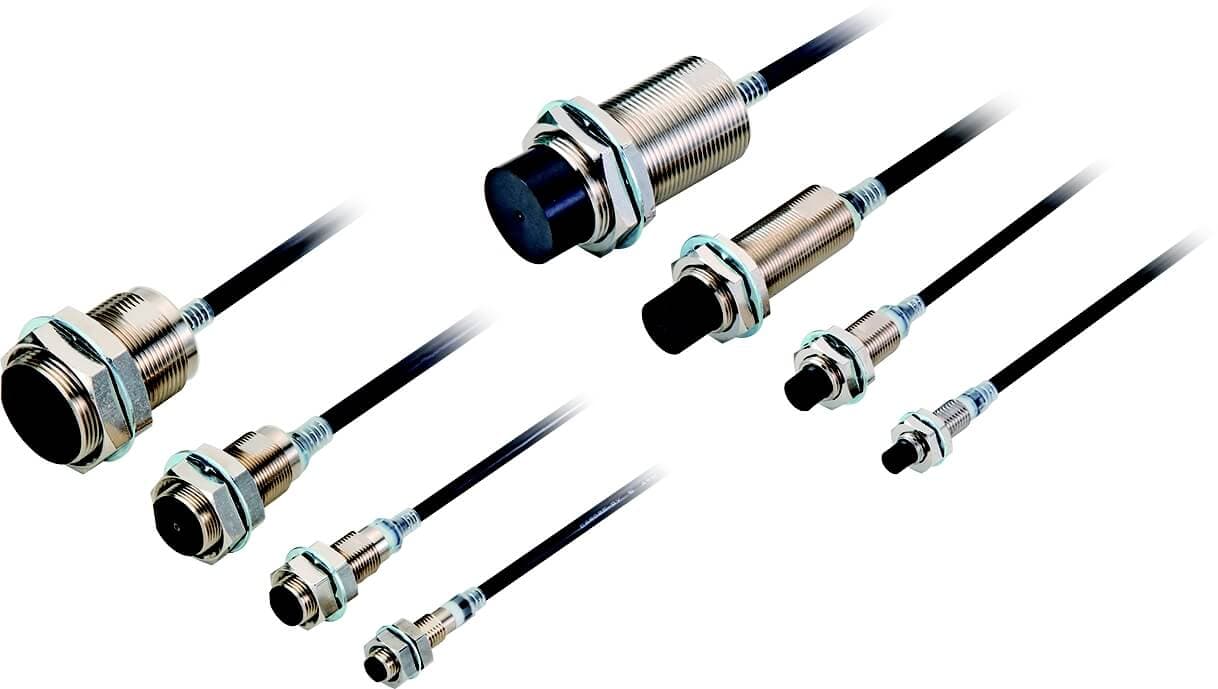
E2E NEXT doubles-to-triples the standard sensing distance in the same M8 / M12 / M18 / M30 housing (e.g. 10…
Omron variants
Competitor lineup
Key specifications
24 rowsColumns compared: Omron E2E NEXT / E2B (PNP variants) vs Keyence EM (PNP variants) / EX-V (PNP, for reference)
Sensing distance — Ø3–Ø5 mm class
Tie- Omron E2E NEXT / E2B
- Omron E2E smallest shielded: 0.8 mm on Ø3 mm (E2E µPROX small-diameter family)
- Keyence EM (PNP variants) / EX-V
- 0.6 mm on EM-030 (Ø3 mm) / 1 mm on EM-005 (M5)
Tie on Ø3; EM slight edge on M5
Sensing distance — M8 / Ø8 class
Omron- Omron E2E NEXT / E2B
- E2B-M8: 1.5 mm (shielded) / 4 mm (unshielded). E2E NEXT-M8: up to 4 mm shielded (extended-range claim)
- Keyence EM (PNP variants) / EX-V
- EM-080P (Ø8 mm unshielded): 2 mm
Omron (E2E NEXT 2× on shielded, E2B ≥ on unshielded)
Sensing distance — M12 class
Omron- Omron E2E NEXT / E2B
- E2B-M12 shielded: 4 mm. E2E NEXT M12 shielded: 5–10 mm (E2E-X5B1T12 / E2E-X10B1T12)
- Keyence EM (PNP variants) / EX-V
- No direct M12 in EM range — EM family stops at M14 threaded
Omron (no like-for-like from EM)
Sensing distance — M18 class
Omron- Omron E2E NEXT / E2B
- E2B-M18 shielded: 8 mm. E2E NEXT M18 shielded: 10 / 15 / 16 mm
- Keyence EM (PNP variants) / EX-V
- Not in EM range
Omron (decisive)
Sensing distance — M30 class
Omron- Omron E2E NEXT / E2B
- E2B-M30 shielded: 15 mm. E2E NEXT M30 shielded: 30 mm, unshielded up to 40 mm
- Keyence EM (PNP variants) / EX-V
- Not in EM range (EX-V sensor heads cover 1–10 mm measuring range, not 30+ mm switching)
Omron
Response frequency (switching)
Tie- Omron E2E NEXT / E2B
- E2E NEXT: up to 2.5 kHz depending on housing; E2B: 500 Hz – 1 500 Hz per housing (M8 higher, M30 lower). µPROX E2E small-diameter: up to 5 kHz
- Keyence EM (PNP variants) / EX-V
- EM: 1.2 kHz across the PNP range. EX-V: 40 000 samplings / s (displacement), 0.075 ms control-output response
EX-V is faster on sampling (not switching) — Tie / Keyence narrow edge on EM for mainstream switching; Omron (µPROX E2E) on small-diameter
Supply voltage
Tie- Omron E2E NEXT / E2B
- E2E NEXT: 10–30 VDC ±10 %. E2B: 10–30 VDC ±10 %, ripple ≤10 % peak-to-peak
- Keyence EM (PNP variants) / EX-V
- EM: 10.8–30 VDC, ripple ≤10 % peak-to-peak. EX-V amplifier: 24 VDC ±10 % only
Omron E2E / E2B (wider window than EX-V; tie vs EM)
Current consumption
Omron- Omron E2E NEXT / E2B
- E2B: typically ≤10 mA (DC 3-wire). E2E NEXT: ≤13 mA on standard PNP variants (verify per SKU in datasheet)
- Keyence EM (PNP variants) / EX-V
- EM: ≤20 mA. EX-V amplifier: ≤240 mA
Omron (roughly 2× lower on EM; ~20× lower than EX-V system)
Output type
Tie- Omron E2E NEXT / E2B
- Open collector, PNP-sourcing. NO / NC selectable via model suffix (E2B) or IO-Link parameter (E2E NEXT)
- Keyence EM (PNP variants) / EX-V
- Open collector, PNP-sourcing. NO only on EM-P range. EX-V: PNP 3-level (HIGH / GO / LOW) + analog ±5 V
Tie on switching; EX-V has richer output set (at system-level cost)
Output ratings
Competitor- Omron E2E NEXT / E2B
- E2B / E2E: load current ≤100 mA, residual voltage ≤1 V (<10 mA) / ≤2 V typical at full load
- Keyence EM (PNP variants) / EX-V
- EM-P: 200 mA (30 V) max, residual voltage ≤1 V. EX-V control outputs: 100 mA max (30 V)
Keyence EM (200 mA headroom)
IO-Link (IEC 61131-9)
Omron- Omron E2E NEXT / E2B
- E2E NEXT: built-in COM2 (38.4 kbit/s) and COM3 (230.4 kbit/s) on most SKUs. E2B: not in standard PNP SKUs (IO-Link on separate E2E-X*IL family)
- Keyence EM (PNP variants) / EX-V
- EM: none. EX-V: none (proprietary RS-232C / BCD on amplifier)
Omron (decisive on E2E NEXT)
Ingress Protection (IP) rating
Omron- Omron E2E NEXT / E2B
- E2B: IEC IP67. E2E NEXT: IEC IP67 / IP67G (oil-resistant) / DIN IP69K (high-pressure washdown) per variant. E2A-S: IEC IP67 / IP69K
- Keyence EM (PNP variants) / EX-V
- EM: IEC IP67. EX-V: Not specified in captured source for the sensor heads/amplifier
Omron E2E NEXT / E2A-S (IP69K available)
Operating temperature
Omron- Omron E2E NEXT / E2B
- E2B: −25 to +70 °C. E2E NEXT: per-variant, typically −25 to +70 °C (some high-temp variants extended). E2A-S: −40 to +85 °C on selected stainless-body SKUs
- Keyence EM (PNP variants) / EX-V
- EM: −25 to +80 °C (no-freezing). EX-V amplifier: −10 to +60 °C
Omron E2A-S on low end; Keyence EM slightly higher on upper bound; EX-V amplifier is the bottleneck of its own system
Humidity
Tie- Omron E2E NEXT / E2B
- E2B / E2E NEXT: 35–95 % relative humidity (RH), no condensation
- Keyence EM (PNP variants) / EX-V
- EM: 35–95 % RH. EX-V: 35–85 % RH
Tie EM; Omron vs EX-V
Vibration resistance
Tie- Omron E2E NEXT / E2B
- E2B: tested per IEC 60947-5-2. E2E NEXT: 10–55 Hz, 1.5 mm double amplitude, 2 h each axis (per datasheet per SKU)
- Keyence EM (PNP variants) / EX-V
- EM: Not specified in captured source. EX-V: 10–55 Hz, 1.5 mm double amplitude, 2 h each axis
Tie / Omron (documented)
Shock resistance
Omron- Omron E2E NEXT / E2B
- Per-SKU in datasheet; standard values ~500 m/s², 3 shocks per axis
- Keyence EM (PNP variants) / EX-V
- Not specified in captured source for EM / EX-V
Omron (documented)
Housing material
Tie- Omron E2E NEXT / E2B
- E2B: nickel-plated brass. E2E NEXT: nickel-plated brass / stainless steel / high-grade stainless steel per SKU. E2A-S: SUS303 or SUS316L stainless
- Keyence EM (PNP variants) / EX-V
- EM: stainless steel (Ø3 / Ø3.8 / M5 / Ø5.4 / Ø8) and chrome-plated brass (M10 / M14). EX-V heads: aluminium / stainless per SKU
Tie (both offer stainless)
Connection
Omron- Omron E2E NEXT / E2B
- E2B / E2E NEXT: 2 m pre-wired PVC or polyurethane (PUR), M8 3-pin connector, M12 4-pin connector
- Keyence EM (PNP variants) / EX-V
- EM: 2 m pre-wired cable only (amplifier is integrated into the cable, not the sensor body)
Omron (connector options for field-replacement)
Functional safety — mean time to dangerous failure (MTTFd)
Omron- Omron E2E NEXT / E2B
- Published per variant in the E2E NEXT datasheet (for Safety Integrity Software Tool for the Evaluation of Machine Applications / SISTEMA input to ISO 13849-1 performance-level (PL) or IEC 62061 safety integrity level (SIL) assessment) — exact figures Not specified in this summary; verify per SKU in the datasheet
- Keyence EM (PNP variants) / EX-V
- EM / EX-V: Not specified in captured source
Omron (ready for SISTEMA)
Certifications
Omron- Omron E2E NEXT / E2B
- CE, RoHS (Restriction of Hazardous Substances) per datasheet; UL / cULus (Underwriters Laboratories) per SKU on E2B, E2E NEXT
- Keyence EM (PNP variants) / EX-V
- Not specified in captured source
Omron (documented)
Amplifier architecture
Omron- Omron E2E NEXT / E2B
- Integrated in sensor body on E2E / E2B / E2A. Head-only on E2E-C (µPROX small-diameter)
- Keyence EM (PNP variants) / EX-V
- EM: amplifier inside the cable assembly — replacing the sensor means replacing the cable. EX-V: separate amplifier unit in cabinet
Omron E2B / E2E (field-replace head without pulling cable); Keyence EM for Ø3-class miniature (amp in cable frees the head to fit into tight pockets)
Weld-field immunity
Omron- Omron E2E NEXT / E2B
- E2E-NEXT-W / E2EW family published with weld-field immunity and factor-1 sensing (equal range on steel / stainless / aluminium / brass)
- Keyence EM (PNP variants) / EX-V
- Not specified in captured source for EM / EX-V
Omron
Displacement / measurement capability
Competitor- Omron E2E NEXT / E2B
- Switching only on E2E / E2B / E2A. Omron's analog measurement alternative is the E2C-EDA separate-amplifier family (not the E2E / E2B / E2A line)
- Keyence EM (PNP variants) / EX-V
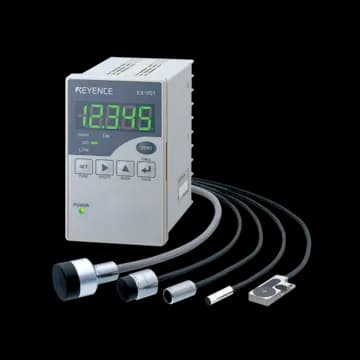
- EX-V is a displacement measurement system (0.4 μm resolution on EX-305V, ±0.3 % full-scale linearity, 40 kHz sampling, ±5 V analog + 3-level switching)
Keyence EX-V (decisive on precision-measurement use case — not a like-for-like battle)
At a glance
- Category: Three-family cylindrical inductive proximity sensor line. E2B is the standard-environment workhorse (M8 / M12 / M18 / M30, nickel-plated brass body, pre-wired or M12 connector). E2A / E2A-S is the rugged / stainless-body step-up for machine tools, welding cells, and wet environments. E2E NEXT is the long-distance flagship (claim: world's longest sensing distance in class) with built-in IO-Link (IEC 61131-9) for process visibility and remote parameter setting.
- Typical applications: part-present on conveyors, end-of-stroke on pneumatic cylinders, tool-breakage detection on machining centres, cam / trigger detection on rotating shafts, pallet positioning in intralogistics, weld-cell fixture confirmation, packaging machine home-position, bottle-cap / can-lid presence.
- Price positioning: E2B is at or below Keyence EM on like-for-like M12 / M18 PNP models in DACH. E2E NEXT sits above E2B but usually below Keyence's separate-amplifier EX-V head + amplifier combined cost. Keyence EX-V is in a different price class (eddy-current displacement measurement, not simple switching) — the comparison against it is only honest for the narrow high-precision-measurement slice of the E2E NEXT use case.
- Headline selling point: E2E NEXT doubles-to-triples the standard sensing distance in the same M8 / M12 / M18 / M30 housing (e.g. 10 mm shielded on M12, 16 mm shielded on M18, 40 mm unshielded on M30), with built-in IO-Link COM3 (230.4 kbit/s) for parameter setting, event logging, and condition monitoring — all without moving to a separate-amplifier architecture. Keyence's answer is either the EM in-cable-amplifier miniature line (short range) or the EX-V amplifier + head system (much higher cost). Neither directly replicates the "long-distance plus IO-Link, in one M12 body" envelope.
Key specifications
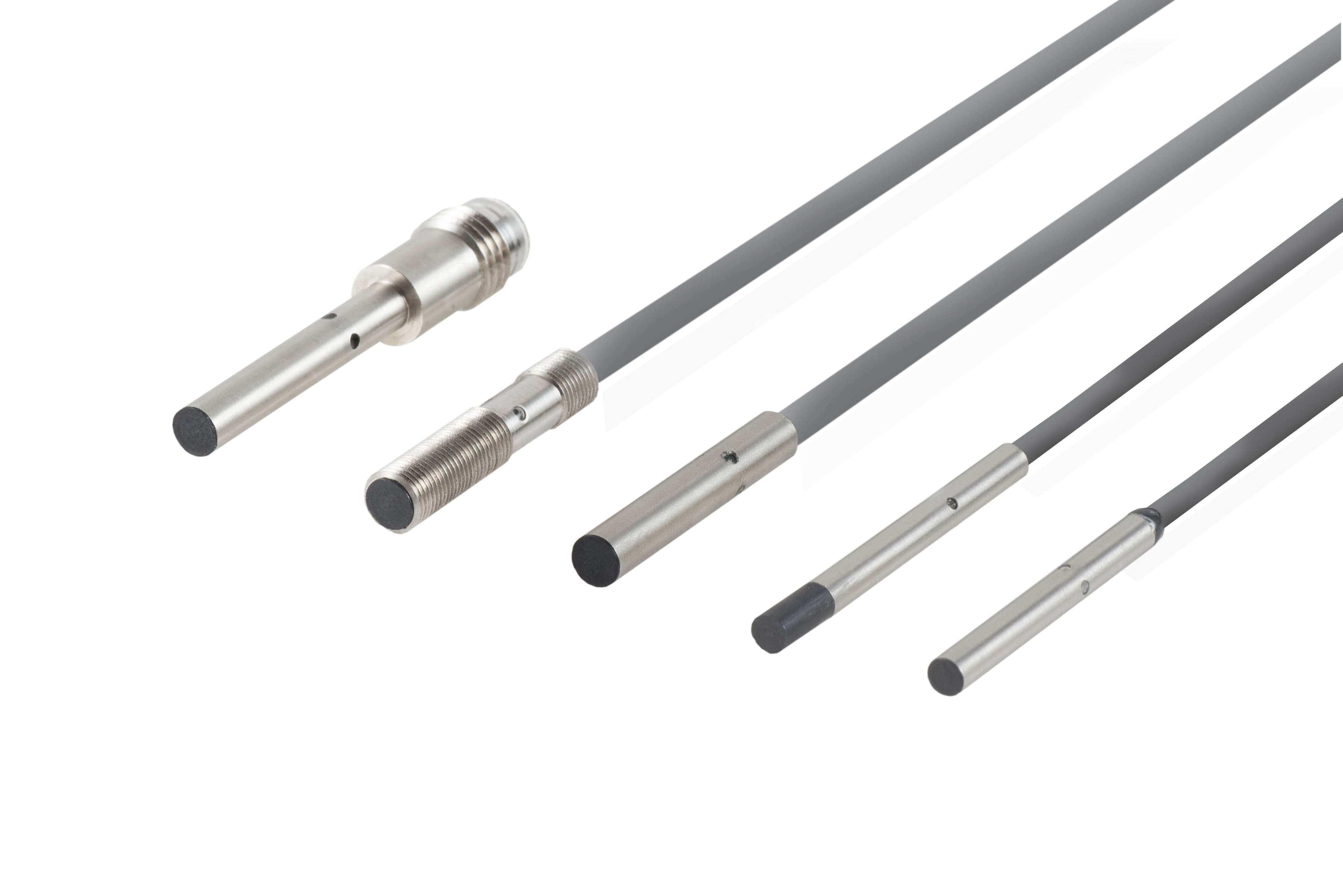
DACH-standard output is PNP (positive-switching). The primary comparison for general-purpose switching is Omron E2E NEXT M12 shielded PNP (E2E-X5B1T12-2M and longer-distance E2E-X10B1T12-2M-family) and Omron E2B M12 shielded PNP (E2B-M12KS04-WP-B1) vs Keyence EM-080P (Ø8 mm cylindrical unshielded PNP, 2 mm sensing, in-cable amplifier) and EM-010P (M10 threaded unshielded PNP, 2 mm sensing). Keyence EX-V is discussed separately — it is an eddy-current displacement measurement system with sub-micron resolution, not a direct analogue of a switching proximity sensor. Footprints are not identical (EM has the amplifier in the cable, E2E / E2B has it in the head), so read the table with that in mind.
Where Omron wins
- Long-distance switching in one housing, with IO-Link. The E2E NEXT claim — up to 2-3× the standard sensing distance in the same M8 / M12 / M18 / M30 body — is structural, not marketing. On M18 shielded, E2B is 8 mm and E2E NEXT stretches to 15–16 mm in the identical footprint. With built-in IO-Link COM3, the customer gets position history, event logging, switch-count metrics, and temperature-drift diagnostics from the same sensor. Keyence EM cannot answer this — EM stops at M14 threaded (4 mm) and has no IO-Link. The customer would have to jump to Keyence's separate-amplifier families to get anything comparable, at significantly higher system cost.
- DC 3-wire M12 connector ecosystem. E2B and E2E NEXT ship with standard DACH 3-pin M8 or 4-pin M12 connectors. Replacing a head at maintenance is a ten-second job, cable stays in the drag chain. Keyence EM's amplifier-in-the-cable architecture means a head failure or cable damage forces a full cable pull — the amplifier is inseparable from the cable. On a packaging line with 40 proximity sensors in trays that get cleaned weekly, this matters.
- Factor-1 / weld-field-immune variants in the same family. For welding-cell fixture detection, the E2EW / E2E-weld-immune variants sense steel, stainless, aluminium, and brass at the same nominal distance (factor 1), and tolerate magnetic weld fields without false switching. Keyence's EM sensing distance is calibrated for iron only (see Keyence datasheet: "Ferrous metals — see Characteristics for non-ferrous metals"), so a mixed-metal cell needs per-target calibration.
- Stainless and cold-environment depth. E2A-S covers stainless-steel-body SUS303 / SUS316L for food, pharma, and wet environments, rated to −40 °C on selected variants. EM's temperature window is −25 to +80 °C, which covers most but not the sub-arctic Swiss cold-storage case.
- Published functional-safety numbers. E2E NEXT datasheet prints MTTFd for feeding into a SISTEMA file, the same argument as on E3Z — machine builders running their own ISO 13849-1 file get the number they need without a Keyence factory letter.
- IP69K washdown on E2E NEXT / E2A-S. High-pressure, high-temperature caustic washdown in dairy, meat processing, and pharma is a disqualifier for the IP67-only EM. Omron's E2E NEXT with IP69K variants and E2A-S stainless step in directly.
- Replacement depth in DACH. E2B and E2E NEXT are stocked at Distrelec, RS Components, Farnell, Conrad, and every main Swiss industrial distributor. Next-day on standard M12 / M18 PNP is realistic.
Where Keyence wins
- Miniature sizes (Ø3 / Ø3.8 / Ø5.4) with in-cable amplifier. The Keyence EM-030P and EM-038P put a working inductive head at Ø3 mm with the amplifier out of the way in the cable. For wafer-handling fixtures, tiny gripper fingers, small-parts feeders, and confined-space tool-breakage detection, this physical form factor wins. Omron's µPROX E2E covers Ø3 and Ø4 but the amplifier is in the head, which is a slightly larger overall pocket. On genuinely confined-space applications, concede.
- Output current headroom on EM. EM-P drives 200 mA (30 V). E2B / E2E NEXT drive 100 mA. Rare to actually matter on modern PLC 24 V logic inputs, but if the customer is switching a small solenoid or a pilot lamp directly from the sensor, EM has the headroom.
- EX-V for displacement measurement. If the actual requirement is measurement — thickness variation, runout, shaft deflection, cam profile — not switching, then EX-V's 0.4 μm resolution, 40 kHz sampling, ±0.3 % full-scale linearity, and ±5 V analog output are class-leading in eddy-current. Do not pretend E2E NEXT is comparable here. Omron's displacement answer is ZX2 laser or E2C-EDA for inductive measurement — separate conversation.
- Operating temperature upper bound on EM. EM goes to +80 °C on the sensor head; E2B stops at +70 °C. For hot applications (drying ovens, near-furnace positions, hot-forming machines) this matters, though E2A high-temperature variants close the gap.
- Sales-engineering cadence in DACH. Same pattern as on photoelectrics: Keyence's DACH field presence is historically aggressive, demo hardware same-week, data-sheet in your inbox before you hang up the phone. Omron's response can feel slower from a former Keyence customer's perspective even when the technical support is equivalent.
Typical objections & responses
Researched from PLCtalk, Glassdoor Keyence sales-culture reviews, and Keyence product forums. Each objection is tied to a source type so you know it's real, not invented.
- "Keyence support is better post-sale." (Most common pro-Keyence statement across PLCtalk.) → Half-true and softening. On PLCtalk, users reported post-purchase behavior ranging from attentive to "right there with the car warranty people — logging into the website to download manuals triggers calls and emails for the next two weeks." Glassdoor Keyence-employee reviews corroborate a quota-driven sales culture focused on volume of contacts ("quantity over quality" in employee words) with high rep turnover (<50 % retained after 2–3 years). Response: "Pre-sales, Keyence is aggressive and that's visible. Post-install, the rep you know often leaves within two years. Ask them to commit to an account plan in writing. We'll commit Omron Swiss applications engineering on a quarterly cadence, 24 h email SLA, and you keep the named engineer — write it into the PO."
- "Keyence EM has the amplifier in the cable, which gives us a smaller head in tight pockets." → Valid for the Ø3 / Ø3.8 / Ø5.4 form factor — genuine advantage. Response: "Agreed for wafer handling, small-parts grippers, and tool-breakage detection below Ø6. For anything M8 and above, the 'amp in cable' becomes a liability: cable damage = full replacement, no field head swap. Most mainstream conveyor and machine-guarding applications are M12 / M18, where E2B lets you replace the head in ten seconds with the cable still in the drag chain."
- "EM is faster — 1.2 kHz response." → True at the 1.2 kHz level, but E2E NEXT hits 2.5 kHz on smaller housings and the µPROX E2E small-diameter line reaches 5 kHz. Response: "EM's 1.2 kHz is solid for up to ~70 000 parts per minute in a binary switch sense. We match or beat that on the small-diameter line and on E2E NEXT M12. If the application genuinely needs >5 kHz switching, we are not selling you proximity — we are selling you laser displacement, and so is Keyence."
- "We're already standardized on Keyence." → Valid on inventory logic. Response: "Standardisation is real value, so let's scope the switch by pain point: which applications are failing, which Keyence SKUs are on extended lead time, and which ones are coming up for ISO 13849 re-validation. E2E NEXT's IO-Link gives you predictive-maintenance data Keyence's EM cannot — that's worth a parallel-standard on the next-gen lines, not a forced rip-and-replace."
- "EX-V measures; your E2E NEXT only switches." → Entirely correct, do not bluff. Response: "Confirmed — EX-V is a displacement system and E2E NEXT is a switching sensor. If the application needs sub-micron displacement we bring in Omron ZX2 laser or E2C-EDA. If the application is switching with some drift monitoring — runout trend, wear-prediction — that's exactly where E2E NEXT's IO-Link process data lives, at 10 % of the EX-V system cost."
- "Price is higher on Omron." → Usually the reverse in DACH on mainstream M12 / M18 PNP. Response: "Against EM direct we're at or below. Against EX-V system cost we're a fraction — but they aren't comparable. The Omron premium, where it exists, is on E2E NEXT long-distance SKUs where we're selling you sensing range EM doesn't have and IO-Link EM doesn't offer."
- "Your Keyence rep is always on-site; Omron isn't." (DACH-specific, real customer irritation — also a source of fatigue. Glassdoor employee reviews describe cold-call and site-visit quotas as "relentless".) → "Two parts: (1) that cadence is not universally welcomed — a PLCtalk thread literally titled 'Overly Persistent Sales People' is mostly about Keyence. (2) We commit to a concrete site cadence: quarterly on-site with a Swiss applications engineer, named contact, 24 h email turnaround. Put it in the account plan."
The switch story
Most Keyence inductive-proximity installs in DACH use EM for miniature (Ø3–Ø8) tool-break, small-part, and confined-space detection and jump to the EX-V separate-amplifier system when the customer asks for longer range, analog output, or higher switching performance. That jump is the commercial opening. EM stops at Ø14 and 4 mm sensing; the moment a customer says "I need M12 or M18 with longer range, or IO-Link diagnostics on that conveyor," Keyence has to either quote EX-V (amplifier + head + cabinet space) or push the customer into a completely different series. E2E NEXT fills exactly that gap: M8 / M12 / M18 / M30, 2-3× the standard sensing distance, and IO-Link built-in to the head.
Second, the welding-cell and mixed-metal-fixture case. E2EW / E2E weld-immune variants sense aluminium, stainless, brass, and steel at the same nominal distance (factor 1) and tolerate weld-field noise without false trips. Keyence EM's sensing distance is iron-calibrated — per the Keyence datasheet table literally saying "Ferrous metals (see Characteristics for non-ferrous metals)". On an automotive body-shop welding cell in Ingolstadt or Sindelfingen, the Omron answer is dropped in; the Keyence answer needs per-target calibration and margin.
Third, the IO-Link / smart-factory angle. Swiss and German machine builders increasingly have IO-Link masters standard on machine controllers (Bosch Rexroth, Beckhoff, Siemens). Built-in IO-Link on a mainstream proximity sensor at E2E NEXT price is an expected feature by 2026. Keyence EM has no IO-Link. Machine builders writing tenders for Industry 4.0 / condition-monitoring lines filter EM out automatically.
Where a customer genuinely needs displacement measurement (runout, thickness, cam profile), be honest: EX-V is better than any E2E NEXT configuration because E2E NEXT is not a measurement sensor. Pivot to Omron ZX2 or E2C-EDA, or concede the sensor slot to EX-V and win the rest of the cell on E2B for the switching slots.
Where the customer needs a genuinely miniature head (Ø3 / Ø3.8) in a tight gripper pocket and the cable length is manageable, EM is a reasonable pick — concede and sell E2B around it for the M12 / M18 slots.
Application examples
- Conveyor part-present, standard industrial (most common slot). E2B-M12KS04-WP-B1 (M12 shielded, 4 mm sensing, PNP output, 2 m pre-wired cable). Direct replacement target for Keyence EM-014P (M14 threaded unshielded, 4 mm). Most packaging, filling, and assembly lines in DACH run on M12 shielded PNP; this is the 50-60 %-of-volume case.
- End-of-stroke confirmation on pneumatic cylinder (home / extended positions). E2B-M8 shielded (1.5 mm) or E2B-M12 shielded (4 mm), PNP. Pair with 3-pin M8 pigtails into distributed I/O. Keyence equivalent is EM-005P (M5) or EM-014P — Keyence wins on Ø only if the bore fitting is genuinely M5.
- Long-range part detection on palletiser / depalletiser infeed (non-contact, tolerant of pallet jitter). E2E-X30MB1TL30-2M (M30 shielded, 30 mm sensing, PNP) or unshielded 40 mm. Keyence EM has no equivalent in this range — customer forced into EX-V system or Keyence's GA / GH series.
- Tool-breakage detection on CNC (computer numerical control) machining centre. Keyence EM-030P (Ø3 mm, 0.6 mm sensing) or EM-038P — historically strong here because the amp-in-cable form factor fits the tool holder pocket. Omron answer is µPROX E2E E2E-C03SR8-WC-B1 (Ø3 mm, 0.8 mm). Concede on "amp in cable" advantage in the tightest pockets; win on factor-1 sensing of mixed-metal tool shanks.
- Cam / trigger detection on a rotary indexer. E2B-M18KS08-WP-B1 (M18 shielded, 8 mm, PNP), or E2E NEXT M18 long-range for more mounting tolerance. Keyence EM-014P at 4 mm has half the range.
- Pallet height / stack presence in intralogistics. E2E-X15B1T18-2M (M18 shielded, 15 mm). Gives ample mounting tolerance for pallet skew; EM has no M18.
- Fixture confirmation in a robotic welding cell (mixed-metal targets, weld-field noise). E2EW M12 or M18 weld-immune PNP (factor-1 across steel / stainless / aluminium / brass). Decisive against EM, which is iron-calibrated.
- Bottle-cap / can-lid presence on a high-speed filler (ferrous closures). E2B-M12 shielded 4 mm PNP, 500 Hz – 1 500 Hz response is sufficient up to ~60 000 caps/h. If the line runs higher, µPROX E2E at 5 kHz is the next step. EM-080P (2 mm, 1.2 kHz) is comparable but shorter range — tighter mounting required.
- Hot-forming / die-position detection near an induction heater. Keyence EM up to +80 °C is an honest advantage on the sensor head. Omron response: E2A high-temperature variants (+100 °C variants in the E2A catalogue), or move the sensor upstream of the heat zone and use E2E NEXT with longer range.
- Food-grade washdown line (IP69K washdown requirement, stainless body). E2A-S SUS316L stainless, IP69K, −40 to +85 °C selected variants. Direct disqualifier against EM (IP67 only).
- Safety-adjacent monitoring cascade (non-output signal switching device (OSSD), non-safety category). E2E NEXT PNP with published MTTFd — feeds SISTEMA file without a factory letter. Keyence EM public data does not support this today.
- Machine-tool door / guard-closed detection with IO-Link diagnostics. E2E-X16MB1T18-2M (M18 shielded, 16 mm, IO-Link COM3). Customer gets switch-count, temperature, and proximity-distance history via IO-Link master. EM cannot do this.
- Pick-and-place end-of-arm small-part confirmation. Keyence EM-030P if the head must be Ø3 mm in the gripper finger; Omron E2E-C03SR8-WC-B1 if factor-1 / mixed-metal target is relevant.
Sources
- Omron E2E NEXT datasheet — local file
pdfs/omron/e2e-next.pdf, downloaded 2026-04-20 fromhttps://assets.omron.eu/downloads/latest/datasheet/en/d121_e2e_next_datasheet_en.pdf?v=6(document D121).- Per-SKU PNP ratings & sensing distances: main Ratings & Specifications tables
- IO-Link parameters (COM2 38.4 kbit/s, COM3 230.4 kbit/s): IO-Link section
- Housing / IP / certifications: Common specs section
- Omron inductive proximity sensors brochure — local file
pdfs/omron/e2b.pdf, downloaded 2026-04-20 fromhttps://files.omron.eu/downloads/latest/brochure/en/proximity_sensors_brochure_en.pdf. Used for E2B positioning (standard environment, −25 to +70 °C, IP67), E2A-S positioning, and E2E NEXT headline claims. - Omron E2A-S datasheet — local file
pdfs/omron/e2a.pdf, downloaded 2026-04-20 fromhttps://assets.omron.eu/downloads/latest/datasheet/en/d123_e2a-s_-_inductive_proximity_sensor_with_stainless_steel_body_datasheet_en.pdf(document D123). Used for stainless / IP69K / cold-environment claims. - Omron E2E NEXT product page —
https://industrial.omron.eu/en/products/e2e-next. Used for product image URL and headline claim ("world's longest sensing distance"). - Omron E2B product page —
https://industrial.omron.eu/en/products/e2b. Used for M8 / M12 / M18 / M30 ranges and IP / temperature. - Omron µPROX E2E product page —
https://industrial.omron.eu/en/products/uprox-e2e. Used for Ø3 / Ø4 / Ø5.4 / M4 / M5 small-diameter SKU coverage and 5 kHz response claim. - Keyence EM public spec HTML — local file
pdfs/keyence/em-specs.html, snapshot 2026-04-20 ofhttps://www.keyence.com/products/sensor/proximity/em/specs/. - Keyence EX-V public spec HTML — local file
pdfs/keyence/ex-specs.html, snapshot 2026-04-20 ofhttps://www.keyence.com/products/sensor/proximity/ex-v/specs/. Noted as eddy-current displacement system, not a direct switching analogue. - Objections research — PLCtalk thread "OT: Overly Persistent Sales People" (https://www.plctalk.net/forums/threads/ot-overly-persistent-sales-people.130954/); Glassdoor Keyence Technical Sales Representative and Sales Representative review pages; general Keyence sales-culture discussion in PLCtalk "Keyence, Omron, Mitsubishi" thread (https://www.plctalk.net/threads/keyence-omron-mitsubishi.60193/). Used for post-sale support, rep cadence, and culture claims. Snapshots not stored — cited so Julian can re-verify before a specific meeting.
Open questions
- Exact DACH list-price delta E2B-M12KS04-WP-B1 vs EM-014P, and E2E-X15B1T18-2M vs Keyence GA / GH M18 long-distance — pull from internal Omron price matrix on day 1.
- Per-SKU MTTFd, safety-integrity level (SIL) / performance-level (PL) capability, and vibration / shock numbers for the specific E2E NEXT PNP SKUs to be quoted — verify in the local e2e-next.pdf rather than rely on the 2-page summary.
- Per-variant UL / cULus status on E2E NEXT — datasheet lists CE and RoHS explicitly; UL status per SKU to confirm with product management.
- Swiss next-day availability depth (Servostar, DSE, Distrelec, RS, Farnell) per E2E NEXT variant, especially IO-Link SKUs — map in a separate sheet.
- The E2B datasheet fetch returned a non-downloadable page from the Omron EU portal (redirected to brochure only). The full per-SKU E2B PDF (document D116) is available via
https://www.ia.omron.com/data_pdf/cat/e2b_d116-e1_1_6_csm1012652.pdf— confirm this is the current revision for DACH and replace the local copy. - Confirm whether Omron now publishes a direct E2E NEXT IP69K SKU table in one place, or whether IP69K is currently only on E2E-NEXT with specific connector types — the product page implies per-connector variation.
- Does Omron Swiss support offer a contractual response-time service-level for SSC customers on inductive sensors? Same objection pattern as photoelectric — need a concrete counter-promise.
- Keyence EX-V is technically an eddy-current displacement sensor and not a like-for-like competitor to a switching proximity sensor. Confirm with the hiring manager whether the briefing truly wanted EX-V in the comparison, or whether the intended Keyence high-precision inductive was the EH series (high-precision inductive) or GA / GH long-distance switching families — adjust on revision 2 if needed.
- Keyence EM datasheet lists iron-target-only calibration; need a side-by-side factor-1 demo for a DACH automotive-body-shop meeting to make the welding-cell story concrete.
Before you leave — retrieval check
Customer says
“Keyence support is better post-sale.”
Source battlecards/sensors/e2e.md