Omron E3AS
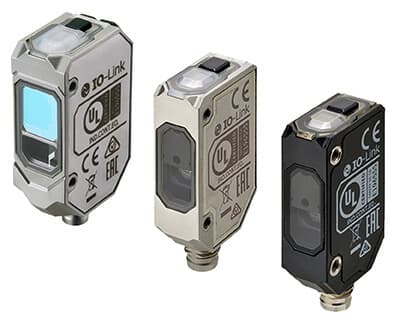
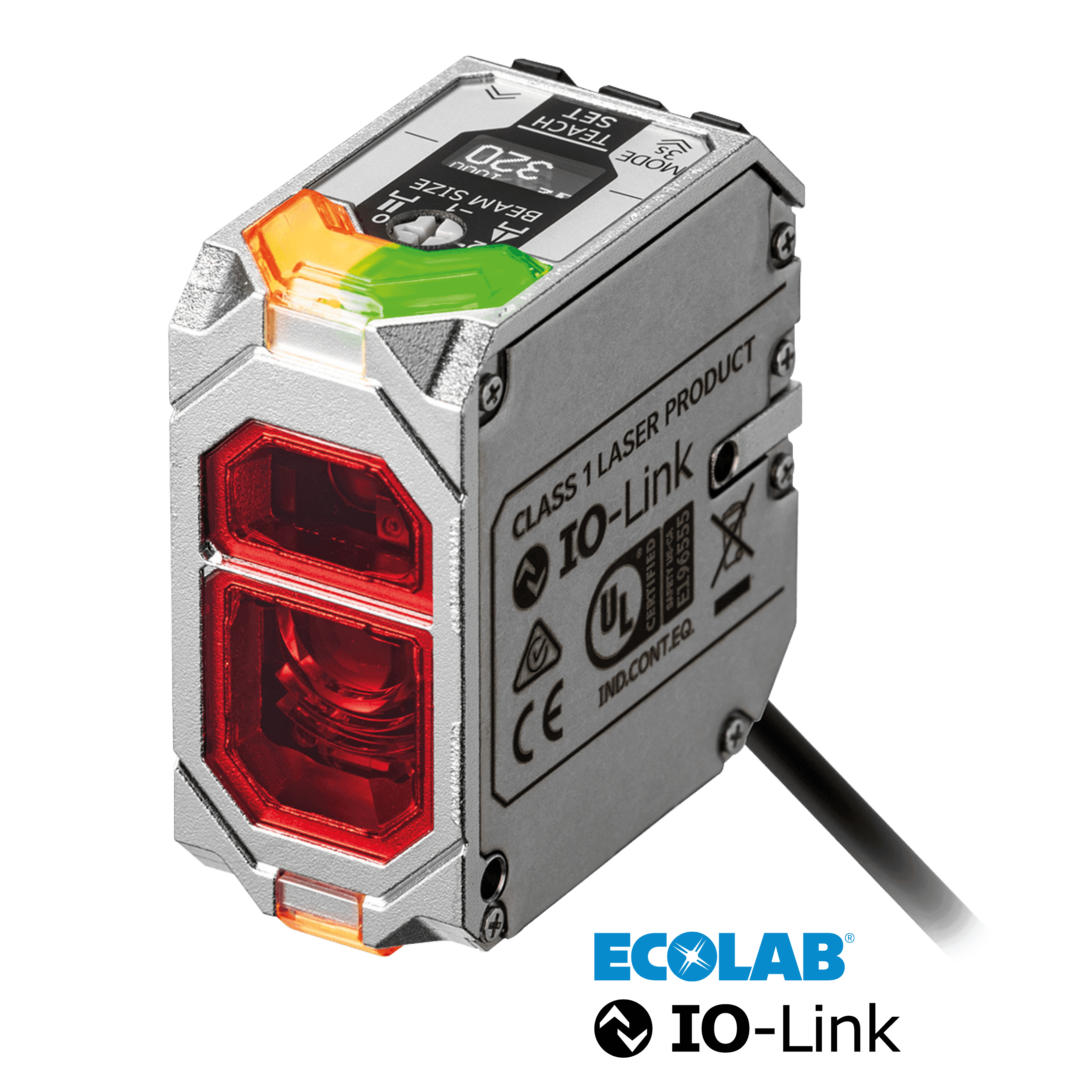
Long-range laser photoelectric family (TOF + CMOS triangulation) with built-in amplifier
Reference mode — everything visible. Use for live calls.
Three things to remember
Sensing distance — long-range TOF
50–6000 mm (E3AS-HF6000SMT)
Omron (in-family 6 m)
Supply voltage
10 to 30 VDC, ripple 10 % peak-to-peak, Class 2 (both E3AS-HL and E3AS-HF)
Omron (E3AS vs LR-X wider window — down to 10 V)
Headline
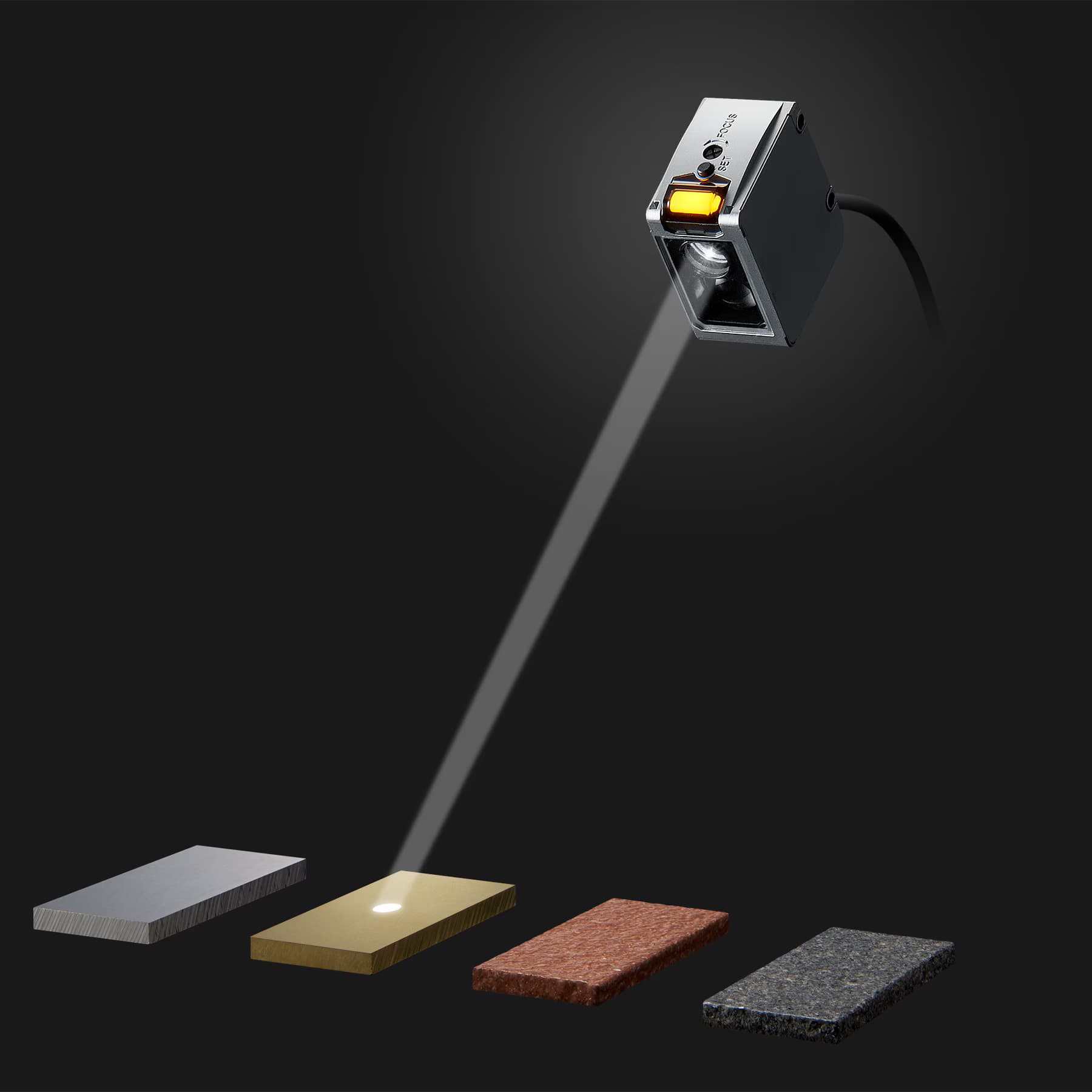
TOF and CMOS-triangulation reflective sensing that works without reflectors.
Competitor lineup
Key specifications
23 rowsColumns compared: Omron E3AS (PNP variants) vs Keyence LR-W / LR-X (PNP variants)
Sensing distance — mainstream "middle" model
Tie- Omron E3AS
- 35–500 mm (E3AS-HL500MT, spot)
- Keyence LR-W / LR-X
- 30–500 mm (LR-W500)
Tie
Sensing distance — long-range TOF
Omron- Omron E3AS
- 50–6000 mm (E3AS-HF6000SMT)
- Keyence LR-W / LR-X
- LR-W / LR-X do not reach this range — customer is pushed to LR-TB2000 or LR-TB5000 at a price step
Omron (in-family 6 m)
Sensing distance — compact short-range
Competitor- Omron E3AS
- 25–100 mm (Keyence LR-X100) / 25–50 mm (LR-X50)
- Keyence LR-W / LR-X
- See left — Keyence wins the very-short-range, high-precision slot with a laser spot
Keyence (LR-X50 short-range)
Response time
Competitor- Omron E3AS
- E3AS-HL: 1.5 ms / 10 ms / 50 ms selectable. E3AS-HF: 2 ms / 10 ms / 50 ms / 200 ms selectable
- Keyence LR-W / LR-X
- LR-W500: 200 µs / 1 ms / 10 ms / 100 ms / 500 ms selectable. LR-X: 500 µs / 1 ms / 3 ms / 10 ms / 200 ms selectable (500 µs mode has calibration and Output 2 restrictions)
Keyence (200 µs on LR-W; 500 µs on LR-X with caveats)
Supply voltage
Omron- Omron E3AS
- 10 to 30 VDC, ripple 10 % peak-to-peak, Class 2 (both E3AS-HL and E3AS-HF)
- Keyence LR-W / LR-X
- LR-W: 10 to 30 VDC, ripple 10 %, Class 2 or LPS. LR-X: 16 to 30 VDC, ripple 10 %, Class 2
Omron (E3AS vs LR-X wider window — down to 10 V)
Current consumption
Competitor- Omron E3AS
- E3AS-HL: 100 mA max. E3AS-HF: 65 mA max at 24 V, 155 mA max at 10 V (125 mA max sub-zero)
- Keyence LR-W / LR-X
- LR-W500: 65 mA max at 24 V / 120 mA max at 12 V. LR-X: 38 mA max at 24 V, 53 mA max at 16 V (970 mW typical)
Keyence LR-X (lowest)
Output (PNP variants)
Omron- Omron E3AS
- Open-collector PNP, 30 VDC Class 2 max, load current 100 mA per output (200 mA combined across two outputs), residual voltage ≤1 V (<10 mA) / ≤2 V (10–100 mA), N.O. (normally open) / N.C. (normally closed) selectable. 4–20 mA analogue output on E3AS-HF (max load 500 Ω).
- Keyence LR-W / LR-X
- PNP open-collector, 30 VDC max, 50 mA max per output, residual voltage ≤2 V, N.O. / N.C. selectable. No 4–20 mA documented on public LR-W / LR-X spec pages.
Omron (2× load current headroom + analogue 4–20 mA on HF)
IO-Link
Omron- Omron E3AS
- Every PNP E3AS-HL / E3AS-HF model is IO-Link v1.1, COM3 (230.4 kbps), Smart Sensor Profile SSP4.1.1
- Keyence LR-W / LR-X
- LR-W and LR-X are IO-Link v1.1 COM2 (38.4 kbps)
Omron (6× IO-Link baud rate)
Ingress Protection (IP) rating
Omron- Omron E3AS
- IP67 (IEC 60529 — International Electrotechnical Commission), IP69K (ISO 20653 — high-pressure / high-temperature washdown), IP67G (JIS C 0920 Annex 1 — oil resistance). Ecolab certified.
- Keyence LR-W / LR-X
- LR-W: IP65 / IP67 (IP65 on fibre-head type). LR-X: IP65 / IP67. No IP69K on either. No Ecolab certification stated on the captured LR-W / LR-X public spec pages.
Omron (IP69K + Ecolab)
Operating temperature
Omron- Omron E3AS
- E3AS-HL: −10 to +50 °C. E3AS-HF: −30 to +55 °C (below −10 °C requires 10 min warm-up).
- Keyence LR-W / LR-X
- LR-W: −20 to +50 °C (−20 to +45 °C on fibre type). LR-X: −10 to +50 °C.
Omron E3AS-HF (−30 °C) / LR-W beats E3AS-HL at the low end
Storage temperature
Omron- Omron E3AS
- E3AS-HL: −25 to +70 °C. E3AS-HF: −30 to +70 °C.
- Keyence LR-W / LR-X
- Not stated on the captured LR-W / LR-X public spec page
Omron (documented)
Humidity
Tie- Omron E3AS
- Operating 35–85 % relative humidity (RH); storage 35–95 % RH, no condensation
- Keyence LR-W / LR-X
- 35–85 % RH, no condensation
Tie
Vibration resistance
Competitor- Omron E3AS
- 10–55 Hz, 1.5 mm double amplitude, 2 h each on X/Y/Z (both E3AS-HL and E3AS-HF)
- Keyence LR-W / LR-X
- LR-W: 10–55 Hz, 1.5 mm double amplitude, 2 h per axis. LR-X: 10 to 500 Hz, power spectral density 0.816 G²/Hz on X/Y/Z.
Keyence LR-X (broader spectrum rating)
Shock resistance
Competitor- Omron E3AS
- 500 m/s², 3 shocks per axis
- Keyence LR-W / LR-X
- LR-W: 1 000 m/s², 6 shocks per axis. LR-X: 1 000 m/s² (100 G), 6 shocks per axis.
Keyence (2× on both count and magnitude)
Housing material
Omron- Omron E3AS
- E3AS-HL: SUS316L stainless steel case with methacrylic resin (PMMA — polymethyl methacrylate) lens cover, antifouling coating on lens. E3AS-HF: aluminium die-cast with chrome plating, SUS304 cover, PMMA lens with antifouling.
- Keyence LR-W / LR-X
- LR-W: zinc die-cast with nickel-chrome plating, PMMA lens, PBT (polybutylene terephthalate) cable bushing, PVC (polyvinyl chloride) cable. LR-X: SUS316L head, PSU (polysulfone) head lens cover, FKM (fluoroelastomer) gasket, PBT amplifier case, PVC cable.
Omron E3AS-HL vs LR-W (stainless vs plated zinc) — LR-X matches on stainless for the head
Connection
Omron- Omron E3AS
- Pre-wired 2 m or 5 m, M8 connector, M12 pre-wired Smartclick connector (0.3 m), M12 horizontal / vertical connector on E3AS-HF
- Keyence LR-W / LR-X
- LR-W: 2 m PVC cable or M12 4-pin connector. LR-X: 2 m cable or M8 connector (separate amplifier form factor, so cable runs head→amplifier→I/O)
Omron (wider connector catalogue, M12 Smartclick)
Weight
Tie- Omron E3AS
- E3AS-HL pre-wired 2 m: ~110 g sensor / 180 g packed. M8 connector: ~50 g sensor. E3AS-HF pre-wired 2 m: ~167 g sensor / 280 g packed.
- Keyence LR-W / LR-X
- LR-W500 cable: ~170 g with cable. LR-W500C M12 connector: ~110 g. LR-X head: ~90 g (separate amplifier adds weight not stated in the captured spec).
Roughly equal on E3AS-HL; LR-W is heavier than a comparable E3AS-HF on the connector model
OLED display on sensor
Omron- Omron E3AS
- Yes, 5-language OLED display (English, German, Japanese, Italian, Spanish) on both E3AS-HL and E3AS-HF.
- Keyence LR-W / LR-X
- LR-W has a display on the body. LR-X display is on the separate amplifier, not the sensor head.
Omron (self-contained OLED on the sensor body for HF and HL)
Light source / laser class
other- Omron E3AS
- E3AS-HL: red laser 660 nm, Class 1 (JIS, IEC/EN, FDA (Food and Drug Administration), GB/T). E3AS-HF: red laser 660 nm, Class 1. Line-beam geometry on E3AS-HL "L" suffix.
- Keyence LR-W / LR-X
- LR-W: white LED (not a laser — no laser class). LR-X: green laser 505 nm, Class 1 (IEC 60825-1, FDA CDRH Part 1040.10).
Different principles — LR-W wins on safety simplicity (LED)
Functional safety — MTTFd (mean time to dangerous failure)
Omron- Omron E3AS
- E3AS-HF: 340 years published on the datasheet. E3AS-HL: not stated in the captured datasheet — flagged in Open questions.
- Keyence LR-W / LR-X
- Not stated on the captured LR-W / LR-X public spec page.
Omron E3AS-HF (published)
Certifications
Omron- Omron E3AS
- CE (Conformité Européenne), UL/CSA (Underwriters Laboratories / Canadian Standards Association), RCM (Regulatory Compliance Mark, Australia), UKCA (UK Conformity Assessed), RoHS2 (Restriction of Hazardous Substances), WEEE2 (Waste Electrical and Electronic Equipment), Ecolab, various laser standards — all confirmed on E3AS-HF datasheet.
- Keyence LR-W / LR-X
- Not stated explicitly on the captured LR-W / LR-X public spec pages.
Omron (documented breadth)
At a glance
- Category: High-end reflective photoelectric sensors with laser or full-spectrum light sources and a built-in amplifier (E3AS) or built-in amplifier with remote head (Keyence LR-X). This is the segment a Keyence rep pushes a DACH customer into when the application outgrows a standard photoelectric — transparent PET bottles, black rubber, multi-lane conveyors without reflectors, curved cans, reflective stainless steel (SUS — Stahl Unrostend / stainless), colour-varying packaging. Omron's counter-family is E3AS: the E3AS-HL uses a laser line-beam with CMOS (complementary metal-oxide semiconductor) triangulation and built-in lens alignment, the E3AS-HF uses TOF (time-of-flight) for 0.05–6 m stand-off, and an E3AS-L LED background-suppression variant fills in the short range.
- Typical applications: multi-lane bottle / can detection without retroreflectors, level and presence on curved glossy surfaces, depalletiser and palletiser gap sensing up to 6 m, colour-independent part-present on primary and secondary packaging, black rubber or EPDM (ethylene propylene diene monomer) part detection on automotive tier-1 lines, machining-centre part-in-fixture check through oil mist, shuttle and ASRS (automated storage and retrieval system) tote-height detection in intralogistics.
- Price positioning: Premium tier in the Omron photoelectric catalogue, explicitly designed to intercept Keyence LR-W / LR-X deals. Typically lower list than LR-X laser CMOS in DACH, similar to LR-W on a like-for-like sensing range. Not a mainstream-price replacement for E3Z or PZ-G — specify E3AS only where the application justifies it.
- Headline selling point: TOF and CMOS-triangulation reflective sensing that works without reflectors, without colour teaching per SKU, and through oil and washdown, in an IP67 / IP69K / IP67G / Ecolab-rated stainless case, with IO-Link (Point-to-Point single-conductor digital fieldwire, IEC 61131-9) batch parameterisation on every PNP (positive-switching) model. Keyence's LR-W needs a reference teach per surface; LR-X is a laser spot and struggles with dark rubber or very glossy metal. E3AS covers both with one family.
Key specifications
DACH-standard output is PNP (positive-switching). The primary comparisons are Omron E3AS-HL500MT (CMOS triangulation, spot beam, 35–500 mm setting range, PNP + IO-Link) vs Keyence LR-W500 (full-spectrum CMOS, 30–500 mm, PNP/NPN selectable), and Omron E3AS-HF6000SMT (TOF spot beam, 50–6000 mm, PNP + IO-Link) vs Keyence LR-X250 (green-laser CMOS, 30–250 mm, PNP/NPN selectable). LR-X maxes at 250 mm — beyond that Keyence hands the customer an LR-TB2000 distance sensor at a further price step, so both comparisons belong on the card.
Where Omron wins
- True 6 m TOF range in one sensor (E3AS-HF). The LR-W500 tops out at 500 mm and LR-X250 at 250 mm. To cover a 1–6 m depalletiser outfeed, ASRS stacker gap, or warehouse shuttle bay with a Keyence offering, the customer moves to LR-TB2000 (distance sensor) or a different series entirely — three SKUs to service the same application zone E3AS-HF covers with one part number. That is the single clearest technical opening this family has against Keyence.
- Reflective detection that doesn't need colour teaching per SKU. The E3AS-HL's patent-pending lens-alignment CMOS triangulation and the E3AS-HF's TOF with temperature-corrected APD both stay stable across black rubber, glossy SUS (stainless steel), coloured packaging, and curved cans without re-teaching. The LR-W's "full-spectrum" technology is genuinely strong on subtle colour differences (a stated Keyence strength, see "Where Keyence wins"), but it relies on a learned reference — changing packaging art on a bottling line is a re-teach event on LR-W, and a non-event on E3AS.
- IP69K washdown + Ecolab on every PNP variant. LR-W is IP65 / IP67, LR-X is IP65 / IP67. Food and beverage lines, Swiss dairies, pharma bottle-fill, and any high-pressure hot caustic washdown bay require IP69K per the customer's own specs. This disqualifies LR-W / LR-X from a meaningful slice of DACH food and beverage accounts without external protection.
- Cold operation on TOF. E3AS-HF runs to −30 °C ambient (10-minute warm-up below −10 °C documented). LR-W stops at −20 °C, LR-X stops at −10 °C. Deep-freeze warehouses (Migros, Coop, Hilcona, Bell Food Group refrigerated DCs) and frozen-food bottling halls spec −25 to −30 °C for photoelectrics. Direct disqualifier against LR-X.
- IO-Link at COM3 (230.4 kbps) with Smart Sensor Profile. LR-W / LR-X are IO-Link at COM2 (38.4 kbps). On a line with hundreds of sensors pushing data to Sysmac NX or a third-party PLC (programmable logic controller), the 6× baud-rate difference compounds into meaningful cycle-time headroom when doing in-band parameter reads, condition monitoring, and batch-write commissioning. Batch-writing settings to every E3AS on a line from an IO-Link device configuration tool (CX-ConfiguratorFDT or third-party) is one of the stronger commissioning-time arguments for OEM (original equipment manufacturer) machine builders.
- Dual control outputs on E3AS (100 mA each, 200 mA total). LR-W and LR-X are 50 mA per output. For driving small contactors, small signal relays in Swiss control panels (Phoenix Contact PLC-RSC, Finder 38/39 series, small Pilz PNOZ S-series) without an interposer, the E3AS headroom is real. Plus E3AS-HF has a native 4–20 mA analogue output — useful for distance-to-PLC applications that would otherwise require an LR-X dedicated distance sensor.
- Stable, published safety data on E3AS-HF (MTTFd 340 years). Machine builders running SISTEMA (Safety Integrity Software Tool for the Evaluation of Machine Applications) for ISO 13849-1 PL (performance level) calculations get this from the public datasheet. Keyence does not print this on the public LR-W / LR-X spec page. E3AS-HL MTTFd is not in the captured datasheet — see Open questions.
- Teach-without-workpiece (background-reference teaching). E3AS-HL has a patent-pending background-reference teach: correlate 100 % against the empty conveyor or fixture, then drop correlation when the object passes. This is the single biggest commissioning-time saver on clear PET bottle lines, and it does not require running actual bottles through the sensor during setup.
Where Keyence wins
- LR-W colour-change sensitivity. The LR-W's white-LED full-spectrum analysis is genuinely better at detecting subtle colour, finish, or gloss differences between two similar-looking surfaces — quality inspection, presence of a printed label vs. no label, two variants of the same SKU differentiated only by a colour change. E3AS-HL is principally a distance-and-correlation sensor; it will detect presence, but it is not the right answer for "is this lid matte or gloss?" Concede this use-case; propose FQ-M or FH vision if the problem is actually colour discrimination.
- Response time on mainstream-range models. LR-W500 does 200 µs. LR-X does 500 µs (with documented caveats in that mode). E3AS-HL is 1.5 ms minimum, E3AS-HF is 2 ms minimum. Above roughly 1500 parts/min the Keyence sensor wins without argument. On typical DACH conveyor speeds (300–800 parts/min) the PLC scan dominates and it doesn't matter — but don't fight the spec sheet.
- LR-X compact laser spot for short-range precision. 25–50 mm range (LR-X50), 0.2 × 1.5 mm spot, 0.5 mm standard detectable deviation. On a watch-case fixture, medical-device assembly station, or small-connector inspection where the sensor needs to see a 0.5 mm feature from 30–50 mm, LR-X50 is a better pure-laser pick than anything in the E3AS family. E3AS-HL minimum is 35 mm and its spot at that distance is not as fine as LR-X50's.
- Vibration and shock robustness. LR-X rates 10–500 Hz vibration (power-spectral-density spec) and 1 000 m/s² shock, 6 shocks per axis. LR-W is 1 000 m/s², 6 per axis. E3AS is 10–55 Hz and 500 m/s², 3 per axis. For mounts near stamping presses, forges, or vibratory feeders running at resonance, LR-X is the safer spec.
- Gyro monitor on LR-X. LR-X has an onboard gyroscopic misalignment monitor that alerts on impact — legitimately useful on a production line where fork-truck clips and manual adjustment bumps are a real failure mode. Omron's equivalent is "check the OLED display" — not bad, not the same thing.
- LR-W dual-spot / fibre-head flexibility. The LR-W70 dual-spot mode and LR-WF10 fibre-head variants let a Keyence customer adapt one amplifier design to several mechanical constraints. E3AS is one-part-number-per-geometry.
- Sales-engineering cadence in DACH. Same point as on the E3Z card. Keyence field presence is aggressive and will be on-site with demo hardware faster than Omron in most cases. Counter with a written site-cadence commitment — don't try to match the aggression, match the reliability.
Typical objections & responses
Researched from PLCtalk.net, Practical Machinist, and vendor-comparison threads. Each objection below is tied to a source type.
- "Keyence's white-light LR-W is more advanced than a reflective triangulation sensor — it analyses the whole spectrum." (Frequent in Keyence pre-sales pitches; echoed on vendor-comparison blog posts and the manuals.plus summary of the LR-Z series making similar claims.) → Half-true. LR-W is genuinely better at colour-change discrimination. It is not better at range (both cap at 500 mm), not better at washdown (IP65/67 vs IP69K), not better at cold (−20 °C vs −30 °C on E3AS-HF), and its IO-Link runs at 38.4 kbps vs Omron's 230.4 kbps. Response: "Tell me the actual job — presence / distance, or colour discrimination? If it's presence, E3AS-HL covers it with one part number and no re-teach when the packaging changes. If it's colour, I'll put an FH vision system in front of you instead of oversell you a photoelectric."
- "Keyence's post-sales support is unbeatable — we're not switching." (Most common pro-Keyence statement on PLCtalk; see also Practical Machinist "A visit from Keyence to my shop today — it was eye opening" thread, which runs several pages of mixed reactions.) → The reputation is mixed in the long tail. The same Practical Machinist thread — and its page 2 and page 3 — has a subset of posters complaining that Keyence sales trainers are good at the "canned dog & pony show" but lose their footing on customer-specific parts, that replacement parts for discontinued equipment are hard to source, and that demo units are often refused until a PO is in hand. Response: "Pre-sales, Keyence is hard to beat. Post-sales, Practical Machinist has three pages of posts documenting problems with discontinued-equipment support and with getting the right applications answers. Ask them in writing for 3-year support hours on the specific LR-W / LR-X SKUs in your BOM. We quote Omron's Swiss support desk response time contractually."
- "Your LR-X is smaller and faster than E3AS." (True on short-range; cited by Keyence reps consistently and confirmed in the LR-X spec page.) → "On LR-X50 inside 50 mm and on 500 µs response, yes — that's a slot where I will honestly specify an LR-X50 or send you to an Omron ZX1 measurement sensor, not an E3AS. Tell me the actual distance, then we'll pick the right part. What we won't do is push you into an LR-TB2000 because LR-X runs out at 250 mm — E3AS-HF does 6 m in one SKU."
- "Keyence sales are relentless — we're getting calls weekly." (Documented across PLCtalk and Practical Machinist; noted as both a perceived feature and a source of fatigue. Practical Machinist users specifically describe Keyence reps as "polite" but "continuously hounding" even after 'do not contact' comments on download forms.) → "Two-part answer. (1) Some customers like it, some find it exhausting. (2) Omron's DACH model is account-paired with Swiss SSC (Sensor Solutions Competence) applications engineering — quarterly on-site, 24 h email response, no weekly cold calls. Put the cadence in the account plan with dates on it."
- "Keyence pricing is worth the premium on LR-W / LR-X." (Mixed evidence on forums. Keyence Wikipedia article cites operating margins of roughly 50 %, which tracks the customer-side pricing perception. PLCtalk and Practical Machinist posts have the "low cost yes, so I guess you get what you pay for" tone for mainstream product, and the opposite tone for LJ-X8000-class high-end laser, where the premium is earned.) → Don't argue with LJ-X8000 or with top-end Keyence vision — those are class-leading and the price is defensible. On LR-W and LR-X specifically: the Keyence margin structure is the customer's problem, not yours. In DACH, E3AS typically slots in at or below LR-W list on a like-for-like range, and well below LR-X when the laser CMOS premium is applied. Check day-one with internal price matrix.
- "We're standardised on Keyence — changing creates inventory risk." → Valid on inventory logic. Cite the Practical Machinist complaints about discontinued-part support and the "sales rep refused to leave a demo" pattern as the real standardisation risk. Response: "Check your active Keyence SKU list against their current catalogue. Whatever is on the silent-replacement list is already a re-standardisation cost. Moving one sensor type to E3AS at a housing-compatible bracket footprint is a known, bounded change — less risk than waiting for Keyence to retire your existing SKU unannounced."
- "LR-X has a gyro impact monitor — does Omron have that?" (Accurate Keyence feature, confirmed on the LR-X spec page.) → Concede: "No, that feature is LR-X-specific. If fork-truck clips are a real risk on the mount position, spec LR-X. If what you actually want is 'tell me when the sensor drifts', E3AS via IO-Link streams incident-light-level degradation before the sensor fails an output — different mechanism, similar outcome, and it catches lens contamination too, not just physical misalignment."
The switch story
Most Keyence customers running LR-W or LR-X are in one of three boxes. Knowing which box you're in tells you whether to fight for the deal or walk.
Box 1: Genuine colour-discrimination application. LR-W's "full-spectrum" analysis is actually solving the customer's problem (two visually similar parts that differ only by a subtle colour or gloss change). Don't try to force E3AS here. Either concede the photoelectric slot or walk them up to FH vision.
Box 2: Long-range (≥ 500 mm) or washdown / cold application where Keyence sold them LR-W and it's working marginally, or pushed them to LR-TB distance sensor because the range was beyond LR-W/LR-X. This is the single biggest commercial opening. E3AS-HF covers 50–6000 mm with one part, IP69K, Ecolab, −30 °C, IO-Link COM3. The customer's multi-SKU Keyence answer collapses into one Omron SKU per lane. DACH food and beverage (Emmi, Hero, Rivella, Ricola, Nestlé, Rauch, Spitz), deep-freeze logistics (Migros, Coop, Bell), and pharma bottling (Roche, Novartis, Lonza primary and secondary packaging) all live in this box.
Box 3: Short-range, high-precision, sub-50 mm with sub-millisecond response. LR-X50 is the right part, honestly. Specify an LR-X50 yourself, save the political capital, and come back with E3AS on the next line where the range opens up.
The functional-safety angle is lower-impact on E3AS than on E3Z — machine builders running SISTEMA for a safety cascade with a reflective laser sensor are rare. But if the customer does run it, E3AS-HF's published MTTFd of 340 years on the datasheet means SISTEMA input without a factory letter. E3AS-HL's MTTFd is not printed on the captured datasheet and is in Open questions.
Where the customer is genuinely running subtle colour QA, concede to LR-W. Where the customer is running sub-50 mm precision on a watch case, concede to LR-X50. Otherwise — especially on anything beyond 500 mm, anything with washdown, and anything below −10 °C — E3AS wins the technical comparison. Lead with IO-Link COM3, IP69K + Ecolab, and the 6 m in-family TOF range.
Application examples
- Multi-lane PET-bottle detection on a bottling filler (Rivella, Emmi, Hero). E3AS-HL500LMT (line-beam CMOS triangulation, 35–500 mm, PNP, IO-Link COM3). Line beam resolves the multi-lane curved-bottle reflectivity issue without reflectors behind each lane. LR-W500 teach cycle per SKU change is avoided.
- Can-body detection on multi-lane beverage conveyor without retroreflector space (Rauch, Feldschlösschen, beverage lines in general). E3AS-HL500LMT. Direct replacement for Keyence LR-W500 in installations where the customer cannot fit a retroreflector opposite each lane.
- Depalletiser / palletiser outfeed gap-detection up to 6 m (Kühne+Nagel, Migros / Coop DC intralogistics). E3AS-HF6000SMT (TOF spot, 50–6000 mm, PNP, IO-Link, 4–20 mA analogue). Keyence's LR-W / LR-X family does not reach this range — Keyence would split into an LR-TB2000 or LR-TB5000 distance sensor. E3AS-HF keeps it in-family.
- Cold-storage ASRS (automated storage and retrieval system) shuttle-bay position sense at −25 °C (Bell Food Group frozen, Hilcona cold DC). E3AS-HF6000SMT — rated −30 °C with 10-minute warm-up below −10 °C. LR-X is disqualified at −10 °C floor; LR-W is disqualified at −20 °C.
- Black EPDM (ethylene propylene diene monomer) rubber-seal presence on automotive tier-1 assembly (ThyssenKrupp, Stadler Rail suppliers in CH, Freudenberg). E3AS-HF6000SMT — TOF method is insensitive to target colour, detects black rubber at range. LR-X laser struggles with very low reflectance; LR-W is OK but capped at 500 mm.
- Machining-centre part-in-fixture check through coolant mist (GF Machining Solutions, Fraisa, Agathon, Swiss watch-industry micro-machining). E3AS-HF6000DMT (diffused beam) or E3AS-HL150MT. IP69K and IP67G (oil resistance per JIS C 0920) with antifouling lens coating. LR-W PVC cable and zinc-die-cast body not ideal for long oil-mist immersion; LR-X is better on its SUS316L head but amp must live outside the zone.
- Pharma bottle-fill washdown line (Roche Basel, Novartis Stein, Lonza Visp primary packaging). E3AS-HL500MT or E3AS-HF6000SMT. IP69K + Ecolab certification is spec-mandatory here. LR-W / LR-X do not carry IP69K.
- Secondary packaging case-present on a cartoner with variable colour (Lindt, Nestlé, Hero, Ricola). E3AS-HL500MT with background-reference teaching — teach once against empty conveyor, no re-teach when carton art changes. LR-W requires per-SKU re-teach.
- Watch-case or medical-device short-range precision (Rolex, Swatch Group, Ypsomed, Sonova subcontract shops). Concede: Keyence LR-X50 is the right part at 25–50 mm. If the customer's range opens up past 100 mm, bring back E3AS-HL150MT.
- Stacker-crane target detection in a Swisslog or Stöcklin AS/RS. E3AS-HF6000SMT for the long-range target, E3AS-HL150MT for the short-range fine-positioning. Both on IO-Link COM3 to the Sysmac NX or a third-party PLC, batch-commissioned at line startup.
- Sheet-feed printer or high-speed inserter running > 1 500 parts/min. Concede to Keyence LR-W500 in 200 µs mode, or escalate internally to Omron Sysmac-adjacent high-speed fibre photoelectric family. Do not force E3AS at 1.5 ms here.
- Colour-difference quality check between two paint finishes on same-shape parts. Concede: LR-W is the right photoelectric. Or walk the customer up to FH vision and avoid the photoelectric category entirely.
- Toll-booth / rail wagon presence at a siding (SBB Cargo, DB Cargo wagon classification). E3AS-HF6000SMT — 6 m TOF range, IP69K, −30 °C. Outdoor rail applications are the E3AS-HF sweet spot, not Keyence's.
Sources
- Omron E3AS-HL datasheet — local file
pdfs/omron/e3as-hl.pdf, downloaded 2026-04-20 fromhttps://files.omron.eu/downloads/latest/datasheet/en/e621_e3as-hl_distance-settable_photoelectric_sensors_datasheet_en.pdf.- Ratings and Specifications table: p. 22
- Ordering Information (PNP model numbers E3AS-HL500MT / HL150MT / HL500LMT / HL150LMT with M8, M12 Smartclick, pre-wired variants): p. 18
- Engineering data (spot size vs distance, angle characteristics): pp. 23–24
- Omron E3AS-HF datasheet — local file
pdfs/omron/e3as-hf.pdf, downloaded 2026-04-20 fromhttps://files.omron.eu/downloads/latest/datasheet/en/e626_e3as-hf_series_tof_laser_sensor_with_built-in_amplifier_datasheet_en.pdf.- Ratings and Specifications table (including MTTFd 340 years, Ecolab, UL/CSA, CE, UKCA, RCM, WEEE2, RoHS2): p. 19
- Ordering Information (E3AS-HF6000SMT / HF6000DMT spot / diffused, PNP + IO-Link, M12 horizontal/vertical, pre-wired 2 m/5 m, Smartclick 0.3 m): pp. 16–17
- TOF / APD / FPGA measurement-principle explanation: p. 5
- Omron E3AS family overview page —
https://industrial.omron.eu/en/products/e3as(WebFetch 2026-04-20). - Keyence LR-W public spec HTML — local file
pdfs/keyence/lr-w-specs.html, snapshot ofhttps://www.keyence.com/products/sensor/photoelectric/lr-w/specs/. Models LR-W500 / LR-W500C / LR-W70 / LR-W70C / LR-WF10 / LR-WF10C captured in full. - Keyence LR-X public spec HTML — local file
pdfs/keyence/lr-x-specs.html, snapshot ofhttps://www.keyence.com/products/sensor/photoelectric/lr-x/specs/. Models LR-X50 / LR-X100 / LR-X250 cable, LR-X50C / X100C / X250C M8 connector, LR-X50CG / X100CG 3-wire cable variants captured. - Objections research — PLCtalk.net Keyence vs Omron vs Mitsubishi thread (
https://www.plctalk.net/threads/keyence-omron-mitsubishi.60193/); Practical Machinist "A visit from Keyence to my shop today — it was eye opening" thread pp. 1–3 (https://www.practicalmachinist.com/forum/threads/a-visit-from-keyence-to-my-shop-today-it-was-eye-opening.434869/); Practical Machinist "Anyone have a Keyence measuring machine" thread (.../anyone-have-a-keyence-measuring-machine-or-know-about-them.316126/); Practical Machinist "Keyence Consultancy" thread (.../keyence-consultancy.434819/); Keyence corporate profile on Wikipedia for operating-margin context. Snapshots not stored — URLs cited so Julian can re-verify before a specific meeting.
Open questions
- E3AS-HL MTTFd. The captured E3AS-HL datasheet does not print an MTTFd figure. E3AS-HF does (340 years). Confirm whether E3AS-HL has a published MTTFd and, if so, update the key-specs table. This matters for SISTEMA / ISO 13849-1 PL calculations on machine builders' safety files.
- DACH list-price delta, E3AS-HL500MT vs LR-W500, and E3AS-HF6000SMT vs LR-X250 + LR-TB2000 combo. Pull day 1 from internal Omron Swiss price matrix and sanity-check that the "at or below LR-W" positioning actually holds in Swiss francs today.
- Swiss / DACH stock depth per PNP SKU at Distrelec, RS Components, Farnell, and local automation distributors (Servostar, DSE). Map into a separate availability sheet — the "next-day replacement" claim on E3Z does not automatically transfer to E3AS.
- Is Ecolab certification on E3AS-HL the same as on E3AS-HF? The E3AS-HF datasheet explicitly lists Ecolab; E3AS-HL datasheet mentions Ecolab on page 13 but the full approval list for each SKU needs verification with product management before quoting into pharma / food accounts.
- Swiss-specific cold-storage approvals (Coop, Migros, Hilcona spec lists). Confirm whether E3AS-HF is on the approved-vendor list for their −25 °C conveyor transfer applications or whether audit is required per site.
- E3AS-L LED variant. The Omron European product page references E3AS-L (LED-based, short-range background suppression, 80 / 200 mm). Not covered in depth on this card — needs its own comparison against Keyence LR-Z if the use-case demands LED rather than laser safety posture.
- LR-X operating temperature on amplifier-separated head: the captured LR-X spec lists −10 to +50 °C for the amplifier. Verify the head alone temperature rating — it may be wider and may change the "LR-X disqualified at −10 °C" call in cold environments.
- IO-Link cycle-time comparison in a live cell. Claim is 6× baud rate (COM3 vs COM2). Real commissioning-time delta on a 100-sensor line is a number Julian should validate with Omron DACH applications engineering before putting it in a customer slide.
Before you leave — retrieval check
Customer says
“Keyence's white-light LR-W is more advanced than a reflective triangulation sensor — it analyses the whole spectrum.”
Source battlecards/sensors/e3as.md