Omron E3S-DC
Color mark photoelectric sensor (RGB, IO-Link)
Reference mode — everything visible. Use for live calls.
Three things to remember
Spot size
1 × 4 mm at rated distance
Omron (narrow mark-reading spot)
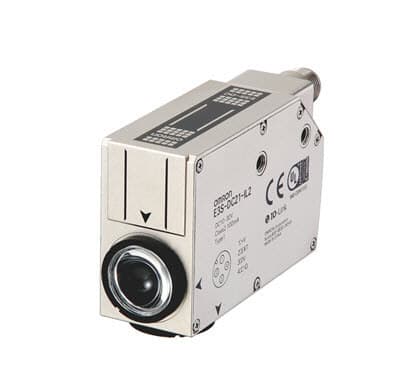
Light source
Red LED 635 nanometres (nm), Green LED 525 nm, Blue LED 465 nm — three-colour RGB for colour discrimination
Different — Omron is the only one of the two that is a colour sensor
Headline
Three-element RGB LED light source with mean time to dangerous failure and protection-circuit set documented…
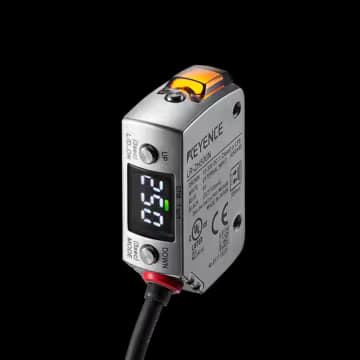
Key specifications
29 rowsColumns compared: Omron E3S-DC (push-pull / PNP-compatible variants) vs Keyence LR-ZH500CP (PNP, long-range, IO-Link)
Sensing distance
Competitor- Omron E3S-DC
- Fixed 10 ± 3 mm (standard test target: white paper 10 × 10 mm)
- Keyence LR-ZH500CP
- 35–500 mm on LR-ZH500CP; 35–100 mm on LR-ZB100CP; 35–250 mm on LR-ZB250CP
Keyence (for long-range apps)
Spot size
Omron- Omron E3S-DC
- 1 × 4 mm at rated distance
- Keyence LR-ZH500CP
- Approximately ø3 mm at LR-ZH500CP maximum; 2 × 1 mm at LR-ZB100CP
Omron (narrow mark-reading spot)
Response time
Omron- Omron E3S-DC
- Operate or reset: 50 µs (microseconds) max each in 2-point teaching mode; 150 µs max each in 1-point teaching mode
- Keyence LR-ZH500CP
- 1.5 ms / 10 ms / 50 ms selectable on LR-Z
Omron (30× faster at 50 µs)
Supply voltage
Tie- Omron E3S-DC
- 10–30 VDC ±10 %, ripple peak-to-peak ≤10 %
- Keyence LR-ZH500CP
- 10–30 VDC
Tie
Power / current consumption
Competitor- Omron E3S-DC
- 960 milliwatts (mW) max. At 24 V, typical 40 mA max
- Keyence LR-ZH500CP
- ≤18 mA at 24 V; ≤34 mA at 12 V
Keyence (lower current)
Output type
Omron- Omron E3S-DC
- Push-pull (usable as PNP or NPN) on IO-Link SKUs; separate NPN SKU E3S-DCN21. Load supply ≤30 VDC, load current ≤100 mA
- Keyence LR-ZH500CP
- PNP open collector
Omron (push-pull flexibility)
Output ratings
Tie- Omron E3S-DC
- Load current ≤100 mA, 30 VDC max
- Keyence LR-ZH500CP
- 30 VDC max, 100 mA max
Tie
IO-Link
Omron- Omron E3S-DC
- v1.1, COM3 (230.4 kbps) on E3S-DCP21-IL3 / COM2 (38.4 kbps) on E3S-DCP21-IL2; 8-byte process data (RGB values), minimum cycle 1.5 ms (COM3) / 4.8 ms (COM2)
- Keyence LR-ZH500CP
- v1.1, COM2 (38.4 kbps) on LR-ZH500CP only; smaller process-data set (distance / output status)
Omron (COM3 speed, RGB data to PLC)
Ingress Protection (IP) rating
Competitor- Omron E3S-DC
- IEC 60529 IP67
- Keyence LR-ZH500CP
- IEC 60529 IP68 + Deutsches Institut für Normung (DIN) 40050-9 IP69K + National Electrical Manufacturers Association (NEMA) 4X / 6P / 13 (LR-ZB250CP, LR-ZH500CP)
Keyence (IP68/IP69K washdown)
Operating temperature
Omron- Omron E3S-DC
- −10 to +55 °C, no icing or condensation
- Keyence LR-ZH500CP
- −10 to +50 °C
Omron (marginal — extra 5 °C upper)
Storage temperature
Competitor- Omron E3S-DC
- −25 to +70 °C
- Keyence LR-ZH500CP
- −25 to +75 °C
Keyence (marginal — extra 5 °C upper)
Humidity
Omron- Omron E3S-DC
- Operating 35–85 % relative humidity (RH); storage 35–95 % RH, no condensation
- Keyence LR-ZH500CP
- Not specified in captured source
Omron (documented)
Vibration resistance
Tie- Omron E3S-DC
- 10–55 Hz, 1.5 mm double amplitude, 2 hours each on X / Y / Z (destruction)
- Keyence LR-ZH500CP
- 10–55 Hz, 1.5 mm double amplitude, 2 hours per axis
Tie
Shock resistance
Competitor- Omron E3S-DC
- 500 m/s², 3 times each on X / Y / Z (destruction)
- Keyence LR-ZH500CP
- 1 000 m/s², 6 times per axis
Keyence (2× shock)
Ambient illumination immunity
Omron- Omron E3S-DC
- Incandescent lamp ≤3 000 lux
- Keyence LR-ZH500CP
- Not specified in captured source
Omron (documented)
Laser safety
Omron- Omron E3S-DC
- Not applicable (LED) — no eye-safety labelling required
- Keyence LR-ZH500CP
- Class 2 laser on long-range variants; requires IEC 60825-1 labelling, interlocks in some jurisdictions
Omron (no laser compliance overhead)
Mean time to dangerous failure (MTTFd)
other- Omron E3S-DC
- Not listed on the captured E3S-DC datasheet
- Keyence LR-ZH500CP
- Not specified in captured source
Neither — flag in Open questions
Certifications
Tie- Omron E3S-DC
- Not specified in captured datasheet body — refer to current Omron declaration of conformity
- Keyence LR-ZH500CP
- Not specified in captured source
Both to verify per SKU
Light source
Omron- Omron E3S-DC
- Red LED 635 nanometres (nm), Green LED 525 nm, Blue LED 465 nm — three-colour RGB for colour discrimination
- Keyence LR-ZH500CP
- Red laser diode 660 nm; Class 1 (IEC 60825-1) on LR-ZB100CP, Class 2 on LR-ZB250CP and LR-ZH500CP
Different — Omron is the only one of the two that is a colour sensor
Insulation resistance
Omron- Omron E3S-DC
- ≥20 MΩ at 500 VDC
- Keyence LR-ZH500CP
- Not specified in captured source
Omron (documented)
Dielectric strength
Omron- Omron E3S-DC
- 1 000 VAC, 50/60 Hz for 1 minute
- Keyence LR-ZH500CP
- Not specified in captured source
Omron (documented)
Teaching / setup
Omron- Omron E3S-DC
- 2-point teach (fast, 50 µs), 1-point teach (150 µs), dynamic teach, auto-threshold; 9-bank memory; IO-Link parameter load
- Keyence LR-ZH500CP
- One-button teach; IO-Link v1.1 COM2 on LR-ZH500CP only
Omron (richer teach options for colour)
Protection circuits
Omron- Omron E3S-DC
- Supply reverse-polarity, output short-circuit, output mis-wiring
- Keyence LR-ZH500CP
- Not specified in captured source
Omron (documented)
At a glance
- Category: The Omron E3S-DC is a color mark photoelectric sensor — an RGB (red-green-blue) three-LED sensor tuned for registration-mark detection on printed packaging at a fixed sensing distance of 10 ± 3 mm. The Keyence LR-Z is a long-range self-contained complementary metal-oxide semiconductor (CMOS) laser sensor covering 25–500 mm ranges across several models, aimed at clear / metallic / dark target detection and position-based discrimination.
- Honest positioning note up front: these are not like-for-like products. The E3S-DC is a short-range color-mark specialist; the LR-Z is a general-purpose long-range laser. This card exists because Keyence reps in DACH (Deutschland, Österreich, Schweiz — Germany, Austria, Switzerland) routinely try to replace Omron color-mark sensors with LR-Z plus a teach-in workaround, and Julian needs to know when to defend E3S-DC, when to concede, and which Omron product to pivot to. If the customer's real need is long-range distance detection rather than print-mark detection, pivot to E3S-CL (distance-settable metal case), E3G (long-distance), or E3AS (time-of-flight laser). See Open questions.
- Typical applications for E3S-DC: registration-mark reading on flexible packaging film (chocolate bars, coffee bags, blister packs), pharmaceutical print-mark detection on glossy aluminium vapor-deposition film, cut-to-mark control on form-fill-seal machines, lot-code position verification, bank-note and label colour verification on printing presses.
- Price positioning: The E3S-DC is a mid-to-upper-tier dedicated colour-mark sensor. Against an LR-Z used as a crude colour-contrast detector it typically wins on total installed cost and on colour reliability — the LR-Z distance-based U.C.D. (Ultimate Contrast Detection) function is not a true colour discriminator. Where Keyence pushes the customer to a dedicated colour sensor such as their LR-W or CZ family, that is the correct fight.
- Headline selling point: Three-element RGB LED light source with mean time to dangerous failure and protection-circuit set documented per variant, a 50 µs response time in 2-point teach mode, Input/Output-Link (IO-Link) version 1.1 COM3 (230.4 kilobits per second) with 8-byte process data delivering live RGB ratios to the programmable logic controller (PLC), and a diecast-zinc nickel-plated brass housing with methacrylic resin (polymethyl methacrylate, PMMA) lens rated International Electrotechnical Commission (IEC) IP67. Keyence's LR-Z does not publish an equivalent colour-mark spec because LR-Z is not a colour-mark sensor — it uses laser distance plus received-light-quantity contrast, which is a different physical principle.
Key specifications
DACH-standard output is PNP (positive-switching, sourcing). The E3S-DC PNP family is sold as push-pull on the IO-Link SKUs (COM2 and COM3), configurable as PNP in the application — there is no separate PNP-only E3S-DC part number in the current European catalogue, only push-pull (E3S-DCP21-IL2, E3S-DCP21-IL3) and NPN (E3S-DCN21). Per the briefing rule, only the push-pull variants are in scope here because they cover PNP behaviour. The direct LR-Z comparator for a 25–500 mm long-range position-detection application is LR-ZH500CP (PNP, M8 4-pin connector, IO-Link capable). For shorter-range LR-Z models the comparison is documented in the narrative.
Where Omron wins
- Colour-mark detection is the job this sensor was designed for. E3S-DC uses three-element RGB LED plus an RGB-ratio comparison algorithm, which is the physically correct approach for reading a printed registration mark against a printed background — especially on glossy aluminium vapor-deposition film, which saturates most sensors. LR-Z uses laser intensity plus distance; on a flat-film target, there is no distance delta between mark and background, so LR-Z falls back to reflected-light quantity, which is unreliable when the printed substrate is glossy or varies batch-to-batch. This is the core technical fight and E3S-DC wins it on first principles.
- Response time. 50 µs in 2-point teach mode on E3S-DC against 1.5 ms minimum on LR-Z — a 30× advantage. On a high-speed form-fill-seal packaging machine running at 120 cycles per minute, the difference is academic. On a flexo printing press running at 400 m/min or a bank-note press at 600 m/min with a 2 mm registration mark, the LR-Z's minimum 1.5 ms response means the mark has moved 10 mm past the sensor before the output triggers — that's a real positional error.
- No laser-class compliance overhead. E3S-DC uses visible LEDs. LR-Z long-range variants (LR-ZB250CP, LR-ZH500CP) are IEC 60825-1 Class 2 laser, which triggers German / Swiss / Austrian workplace-laser-safety documentation (laser-safety officer, Gefährdungsbeurteilung under the Ordinance on Artificial Optical Radiation / Arbeitsschutzverordnung zu künstlicher optischer Strahlung — OStrV). Not a showstopper for most customers, but it is paperwork and it does get raised in EHS (Environment, Health, Safety) reviews in DACH.
- IO-Link bandwidth and data content. E3S-DCP21-IL3 runs COM3 at 230.4 kbps with 8-byte process data carrying live RGB values, enabling remote threshold management, lot-change recipes, and direct database logging of the RGB signature of every mark and every background — useful for lot-change SPC (Statistical Process Control) and for root-cause analysis of colour drift on the print line. LR-ZH500CP is COM2 only (38.4 kbps), sufficient for on/off status but not for colour-data streaming.
- Protection circuits and environmental tolerance are documented. Reverse-polarity, output short-circuit and output mis-wiring protection are all printed on the E3S-DC datasheet. So are the ambient-illumination limit (3 000 lux incandescent), insulation resistance (20 MΩ at 500 VDC), and dielectric strength (1 000 VAC for 1 min). The captured LR-Z public spec page lists the headline ratings but not this level of detail — customers doing CE (Conformité Européenne) technical files for OEM (Original Equipment Manufacturer) machine builds will notice.
- Push-pull output. On the IO-Link SKUs the output stage is push-pull, so the same part behaves as PNP or NPN depending on load wiring. Useful in mixed-ecosystem machine builds where some legacy I/O is still NPN.
Where Keyence wins
- Range. If the customer's real application is a long-distance position-detection task — pallet presence at 400 mm, robot-cell target at 300 mm, ingot tracking on a steel line at 250 mm — E3S-DC at a fixed 10 ± 3 mm is not the answer. LR-Z covers 35–500 mm. Concede fast, pivot to Omron E3S-CL (distance-settable, 50–500 mm), E3G (long-distance up to 10 m), or E3AS time-of-flight (laser, up to 1.5 m). Trying to force E3S-DC into a long-range role is how you lose the account.
- IP69K washdown. LR-Z carries IEC IP68 plus DIN 40050-9 IP69K plus a stainless-steel SUS316L housing. E3S-DC is IP67 only, diecast zinc. On food-packaging washdown lines with hot high-pressure caustic the LR-Z is the safer spec. Note however that the core E3S-DC application — reading a print mark on closed packaging film — is usually on the dry side of the washdown boundary, so this advantage often does not matter in practice.
- Shock resistance. 1 000 m/s² with 6 shocks per axis on LR-Z versus 500 m/s² with 3 shocks per axis on E3S-DC. Relevant near high-speed cams, vibratory mark-reading stations, or mounting on a moving form-fill-seal frame.
- Weight and footprint. Roughly 55 g on LR-Z versus 320 g (sensor only) / 370 g (packed) on E3S-DC. Matters on any moving-gantry or robot-tool-end mounting.
- Laser-class-1 option. LR-ZB100CP (short range) is IEC 60825-1 Class 1, which removes the laser-safety paperwork. Relevant if the customer needs laser distance detection but wants to avoid Class 2 documentation.
- Sales-engineering cadence in DACH. Keyence's DACH field presence is historically strong — same-week demo hardware, aggressive account coverage. Customers accustomed to that cadence may experience Omron response as slower, even when the actual technical support is comparable.
Typical objections & responses
Researched from PLCtalk threads on Keyence vs alternatives, Practical Machinist discussions on Keyence sales culture, Glassdoor employee reviews of Keyence sales cadence, Trustpilot Keyence Corporation reviews, and Reddit /r/PLC references inside Glassdoor reviews. Each objection is tied to a source type so Julian knows it is real, not invented.
- "LR-Z can do colour-mark detection too — Keyence teaches it in as a contrast target." (Most common Keyence counter-pitch when they know the customer is considering an Omron colour-mark sensor.) → Technically true that LR-Z can be taught on a mark, but LR-Z's U.C.D. function discriminates on distance plus received-light quantity, not on colour. On a flat printed film the distance delta between mark and substrate is zero, so LR-Z is forced to operate on intensity alone. That breaks the moment the substrate changes batch (different gloss level on a new film supplier), the ink density drifts, or the film has metallised vapor-deposition regions. E3S-DC's RGB-ratio algorithm is robust across those variations by design. Response: "Ask the Keyence rep for a 24-hour trial with three different film batches in sequence, including one aluminium vapor-deposition batch, with no re-teach between. That is the realistic production test. We will do the same trial on E3S-DC and share both results."
- "Keyence is a higher-quality brand overall." (Frequent on PLCtalk — sometimes accurate for their laser-displacement and vision products, often overstated for general-purpose sensors.) → PLCtalk has repeated threads where users specifically flag that Keyence's general-purpose sensor pricing is not matched by proportional quality gains — one discussion noted Banner and IFM as genuinely cheaper with comparable IP and warranty terms (IFM often with a five-year warranty). Response: "On laser-displacement or vision, the Keyence premium is sometimes defensible. On a colour-mark sensor specifically, the Keyence approach is a workaround; ours is purpose-built. The quality comparison has to be measured on the actual KPI — missed marks per million packages — not on brand generalities."
- "Keyence support is excellent — we get same-week visits." (Real — documented on Glassdoor Keyence sales reviews and on Practical Machinist threads.) → Half-true. The same Glassdoor and RepVue reviews describe Keyence's outbound sales cadence as "relentless" with weekly unsolicited calls, and one Practical Machinist user describes Keyence reps "hounding you through your funeral and beyond". Customers appreciate pre-sales engineering attention; post-sales support is more mixed — separate PLCtalk threads describe months-long waits on technical issues while continuing to receive weekly sales invitations for new demos. Response: "For the first 90 days Keyence will outwork us on visits. That is true. For the next three years it flips — ask a current Keyence customer for their post-install ticket turnaround. We'll contract a Swiss Omron applications-engineer cadence in writing for this account."
- "We're already standardised on Keyence." → Valid on inventory logic, weak on lock-in for this specific application. Keyence's catalogue churn has been called out on PLCtalk and Practical Machinist — older SKUs discontinued, replacement documentation hard to find. The E3S-DC housing and wiring have been stable in the current form for years and the IO-Link interface is a true open standard. Response: "Standardisation is real value. But check whether the Keyence SKU you are standardised on is still current-catalogue. If it's been quietly replaced, you are already paying a re-standardisation cost. E3S-DC drops in on an M12 4-pin and speaks IO-Link — the integration layer is portable."
- "Keyence is cheaper once we count the LR-Z doing two jobs." (Comes up when a Keyence rep is bundling one LR-Z to do both presence and mark detection.) → Two counters. (1) Using LR-Z for colour-mark reading when the customer's film range is known to be variable will produce false-reject rates that dwarf the sensor price difference within weeks. (2) PLCtalk users comparing Keyence against Banner and Automation Direct for comparable photoelectric tasks have called out Keyence pricing as the outlier. IFM is frequently cited as "decently priced with a 5-year warranty, IP67 rated" — Banner laser distance in the USD 200 range. Response: "One sensor, two jobs works if both jobs are easy. Colour-mark on printed film is not an easy job for a laser distance sensor. Do the batch-variation test before committing."
- "We need laser precision for this job, not an LED." (Comes up when the customer has been sold on laser-beam marketing language.) → On a colour-mark job you do not need a laser — you need spectral discrimination. LR-Z's laser is monochromatic red at 660 nm: it literally cannot see the difference between two blues or between a red mark and a red-orange background. E3S-DC's three-LED RGB source is a colour tool. Response: "Laser and colour are orthogonal. What is the actual target? If it's a printed coloured mark, laser is a downgrade. If it's a metal edge position, we pivot you to E3AS time-of-flight or E3S-CL — those are the right Omron answers for that job, not E3S-DC."
The switch story
Most Keyence long-range laser installs in DACH use LR-Z for position detection on robot cells, pallet handling, CNC (computer numerical control) part-loaders, and intralogistics conveyors. That is LR-Z's correct use case. The commercial opening is narrow but sharp: the moment a DACH packaging or printing customer tries to stretch LR-Z onto a registration-mark or print-mark reading task — typically because the Keyence rep bundled it as a two-job sensor — the physics breaks. LR-Z is a distance / intensity sensor with a monochromatic red laser; a printed colour mark is a spectral target on a flat substrate. E3S-DC is purpose-built for that spectral target with a three-LED RGB source and an RGB-ratio algorithm, and it responds in 50 µs versus LR-Z's 1.5 ms minimum.
Second, the print-press and flexible-packaging segment in DACH is structurally important. Switzerland and southern Germany host a dense cluster of pharmaceutical-packaging converters (Hoffmann Neopac, Constantia Flexibles, Amcor Zurich), chocolate and coffee packaging lines (Lindt, Läderach, Nestlé, Jura), and bank-note / security-print houses (Orell Füssli, Bundesdruckerei) — all of which use mark-detection on glossy or metallised substrates at line speeds where the E3S-DC colour algorithm and 50 µs response are genuinely differentiating. That is the target list.
Third, the IO-Link angle. E3S-DCP21-IL3 runs COM3 at 230.4 kbps with 8-byte RGB process data; LR-ZH500CP is COM2 at 38.4 kbps. For customers building Industry 4.0 / OT (Operational Technology) telemetry stacks who want to log colour data per-unit into a database for SPC, Omron's data content is a real technical differentiator — not just a marketing line.
Where a customer is genuinely running a long-range position-detection application at 100–500 mm, be honest: LR-Z is the right tool, and E3S-DC is not the Omron answer. Pivot to E3S-CL (distance-settable metal case, 50–500 mm), E3G (long-distance photoelectric up to 10 m), or E3AS (time-of-flight laser). Trying to force E3S-DC there is how you lose the next three deals.
Application examples
- Registration-mark reading on flexible-packaging form-fill-seal (FFS) machines (most common slot). E3S-DCP21-IL3 on a Bosch / Syntegon FFS line running chocolate bar wrappers — colour mark on glossy printed film, line speed up to 400 m/min. Direct competition with an LR-Z that was sold in as a two-job position-plus-mark sensor. This is the 50 %-of-use-case opportunity.
- Print-mark detection on aluminium vapor-deposition film (pharmaceutical blister backing, coffee capsules). E3S-DCP21-IL3, using the Super High Dynamic Range setting on the Omron IO-Link parameter set to suppress specular saturation. LR-Z struggles here because the metallised regions saturate the photodiode.
- Cut-to-mark control on a bag-maker or pouch machine. E3S-DCP21-IL2 (COM2 sufficient for binary cut trigger) — 50 µs response gives positional accuracy at 300 bags/min that LR-Z cannot match.
- Bank-note / security-print inspection on a gravure press. E3S-DCP21-IL3 for line-side lot-change recipe (9-bank memory + IO-Link threshold management), reading the colour signature of a print test-mark. Orell Füssli and Bundesdruckerei are the DACH target accounts.
- Lot-code / date-code position verification on pharmaceutical blister lines. E3S-DCP21-IL3, PNP-configured push-pull into a Siemens S7-1500 IO-Link master, logging RGB per-blister for batch records. Compliant with the documentation needs of ISO 13485 (medical devices) quality systems.
- Colour-mark on glossy chocolate wrappers (Lindt, Läderach, Frey). E3S-DCP21-IL3. The glossy-wrapper problem is exactly what the E3S-DC was optimised for; this is a textbook win against LR-Z.
- Label-presence-plus-colour verification on a bottle-labeller infeed (Ricola, Rivella, Sinalco bottling). E3S-DCP21-IL3 reading the colour block on the label edge.
- Coffee-capsule foil lid colour verification (Nespresso / Jura / Café Royal). E3S-DCP21-IL3 — colour per capsule flavour variant, logged via IO-Link into the track-and-trace database.
- Registration-mark on cold-seal flexible packaging for confectionery. E3S-DCP21-IL3 where cold-seal laminate introduces a shiny / matte variation LR-Z cannot handle via intensity alone.
- Colour-coded cap verification on a pharma bottling line. E3S-DCP21-IL3 — nine-bank memory supports nine cap colours without re-teach for a multi-product line.
- Chocolate moulded-tray registration on a Bühler / Sollich moulding line. E3S-DCP21-IL3 reading the mould-edge printed mark at high throughput — a Swiss confectionery-equipment classic.
- Flexo-printing mark verification on corrugated board (SIG Combibloc, Model AG). E3S-DCP21-IL3 on the folding / gluing infeed; 50 µs response allows per-blank mark reading at 15 000 blanks/hour.
- Long-range positional detection tasks where LR-Z was bundled in. Do not force E3S-DC here. Pivot the Omron offer to E3S-CL, E3G, or E3AS. Flag in account plan and offer the right Omron SKU; do not pretend the E3S-DC fits.
Sources
- Omron E3S-DC datasheet — captured via WebFetch 2026-04-20 from
https://files.omron.eu/downloads/latest/datasheet/en/e104e_e3s-dc_color_mark_photoelectric_sensor_datasheet_en.pdf(document IDe104e). Local extraction saved as/tmp/e3s-dc.txtduring preparation; no permanent local PDF stored atpdfs/omron/e3s-dc.pdf(flag in Open questions to archive a copy).- Ordering Information and PNP / push-pull / NPN variants: p. 1
- Ratings and Specifications: p. 2 (sensing distance, spot size, wavelengths, response time, supply voltage, power consumption, output ratings, indicators, protection circuits, ambient illumination, environmental ratings, IP rating, connection, weight, materials)
- IO-Link communication specifications (version, baud rate, process-data size, minimum cycle): p. 2
- Standard Sensing Object / Munsell colour reference: p. 2
- Engineering-data colour-vs-detection plots: p. 3
- Omron E3S-DC product page —
https://industrial.omron.eu/en/products/e3s-dc, accessed 2026-04-20. Source of product image URL and the "colour mark detection for standard as well as challenging applications" positioning language. - Keyence LR-Z public spec HTML — local file
pdfs/keyence/lr-z-specs.html, snapshot date not independently verified (repo file). Source for LR-Z model-number list (LR-ZB100CP, LR-ZB250CP, LR-ZH500CP, LR-ZB90CB, LR-ZB240CB, LR-ZH490CB, etc.). Keyence gates their PDFs behind registration — the public HTML spec page is the authoritative public source. - Keyence LR-Z public spec page —
https://www.keyence.com/products/sensor/photoelectric/lr-z/specs/, accessed via WebFetch 2026-04-20. Source of LR-Z PNP variant specs (sensing range, laser class, response time, supply voltage, current, IP, temperature, vibration, shock, housing, weight). - Keyence LR-Z product overview page —
https://www.keyence.com/products/sensor/photoelectric/lr-z/, accessed via WebFetch 2026-04-20. Source of positioning language (U.C.D., long-range, metal / dark / transparent target). - Objections research:
- PLCtalk thread "Keyence, Omron, Mitsubishi" — general Keyence vs alternative discussion, users comparing post-sales support and standardisation lock-in:
https://www.plctalk.net/threads/keyence-omron-mitsubishi.60193/. - PLCtalk thread "Laser Sensor" — users flagging IFM five-year warranty and Banner pricing vs Keyence:
https://www.plctalk.net/forums/threads/laser-sensor.40677/. - Practical Machinist thread "A visit from Keyence to my shop today... It was eye opening!" — Keyence sales-cadence commentary ("relentless", "polite but constant contact"):
https://www.practicalmachinist.com/forum/threads/a-visit-from-keyence-to-my-shop-today-it-was-eye-opening.434869/page-2. - Glassdoor Keyence Sales Engineer reviews — confirms aggressive call / visit cadence described by customers; references /r/PLC:
https://www.glassdoor.com/Reviews/Keyence-Sales-Engineer-Reviews-EI_IE40752.0,7_KO8,22.htm. - RepVue Keyence reviews —
https://www.repvue.com/companies/Keyence. - Trustpilot Keyence Corporation —
https://www.trustpilot.com/review/keyence.com. Snapshots not stored locally; URLs listed so Julian can re-verify before a specific meeting.
- PLCtalk thread "Keyence, Omron, Mitsubishi" — general Keyence vs alternative discussion, users comparing post-sales support and standardisation lock-in:
Open questions
- Product-family mismatch in the briefing. The task brief describes E3S-DC as "long-range / distance-settable photoelectric". The actual Omron E3S-DC is a short-range (10 ± 3 mm) colour-mark sensor. The long-range / distance-settable Omron equivalents to Keyence LR-Z are E3S-CL (distance-settable, metal case, up to ~500 mm), E3G (long-distance, up to ~10 m), and E3AS (time-of-flight laser). Confirm with hiring manager whether Julian needs a separate E3S-CL-vs-LR-Z card, an E3AS-vs-LR-Z card, or both — the colour-mark fight in this card is only part of the LR-Z competitive story.
- No local PDF archive of the E3S-DC datasheet. Ref card's convention expects
pdfs/omron/e3s-dc.pdf; need to download and commit a static copy for long-term traceability. - MTTFd for E3S-DC not on public datasheet. For customers running SISTEMA (Safety Integrity Software Tool for the Evaluation of Machine Applications) / ISO 13849-1 analysis, confirm whether Omron product management can supply a factory MTTFd letter.
- UL / cULus (Underwriters Laboratories) certification status per SKU. The captured E3S-DC datasheet does not explicitly confirm UL status — verify internally with Omron SSC (Switzerland / Supply Chain) product management.
- DACH list-price delta E3S-DCP21-IL3 vs LR-ZH500CP today. Pull from internal Omron price matrix. Without this, the "price" objection is anecdotal.
- Lindt, Läderach, Bühler, Jura account statuses. The application list references Swiss industrial accounts that may already be Omron customers, Keyence customers, or split; need the SSC account-master view before walking in.
- Contractual response-time service-level for Omron Switzerland support. The "Keyence support" objection is where Keyence concedes least. Need a concrete counter-promise (e.g. 24-hour email turnaround, quarterly on-site cadence) codified per account.
- LR-Z catalogue-churn status. Several older LR-Z part numbers appear in the HTML snapshot. Confirm which are actively produced versus which Keyence has silently replaced — useful ammunition for the "standardisation" objection.
- Laser-safety regulatory burden in Switzerland specifically. Class 2 laser products in Swiss workplaces trigger documentation under the Verordnung über die Sicherheit technischer Einrichtungen und Geräte (STEV); confirm whether DACH customers treat this as a genuine disqualifier for LR-Z or as a routine tick-box.
Before you leave — retrieval check
Customer says
“LR-Z can do colour-mark detection too — Keyence teaches it in as a contrast target.”
Source battlecards/sensors/e3s-dc.md