Omron E3X-HD and E3X-ZV
Digital fiber-optic amplifiers
Reference mode — everything visible. Use for live calls.
Three things to remember
Minimum detectable object
Not specified in captured source
Omron E3X-ZV (documented)

Current consumption (normal mode, 24 V, single main unit)
30 mA max. (720 mW)
Omron (lowest on 1-channel) / Keyence FS-V close
Headline
Omron ships a tiered fiber-amplifier story in a single.
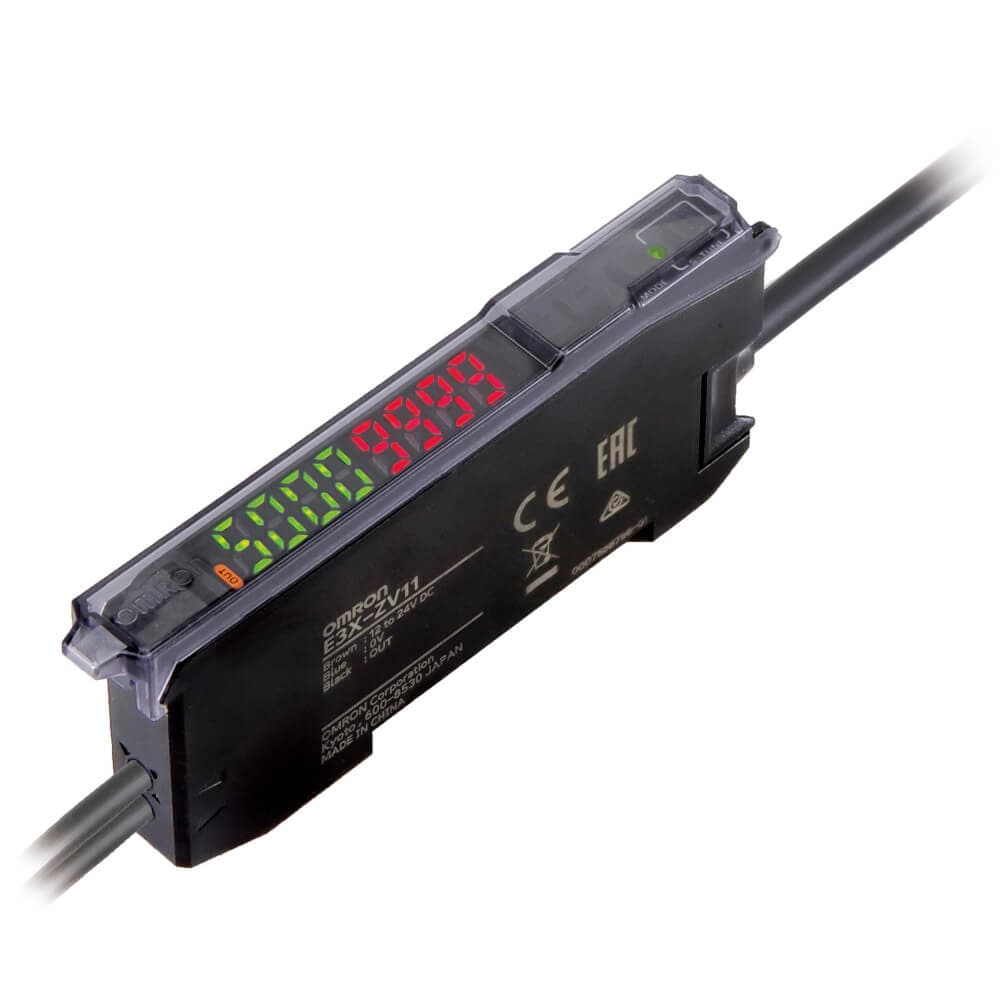
Competitor lineup
Key specifications
28 rowsColumns compared: Omron E3X-HD (PNP) vs Omron E3X-ZV (PNP)
Response time — fastest mode
Competitor- Omron E3X-HD
- Super-high-speed mode (SHS), PNP: 55 μs operate or reset
- Omron E3X-ZV
- Super-high-speed mode (SHS): 50 μs (1-channel); 100 μs (2-channel E3X-MZV)
Keyence FS-N40 (23 μs)
Response time — "normal" detection mode
Tie- Omron E3X-HD
- High-speed mode (HS): 250 μs (default) / Standard mode: 1 ms / Giga-power mode: 16 ms
- Omron E3X-ZV
- HS: 250 μs / Standard: 1 ms / Giga: 16 ms
Tie at 250 μs / 1 ms; Keyence has more selectable steps
Minimum detectable object
Omron- Omron E3X-HD
- Not specified in captured source
- Omron E3X-ZV
- 3 μm (micrometres)
Omron E3X-ZV (documented)
Supply voltage
Competitor- Omron E3X-HD
- 12 to 24 VDC ±10 %, ripple peak-to-peak ≤10 %
- Omron E3X-ZV
- 12 to 24 VDC ±10 %, ripple p-p ≤10 %
Keyence FS-N40 (wider window)
Current consumption (normal mode, 24 V, single main unit)
Omron- Omron E3X-HD
- 30 mA max. (720 mW)
- Omron E3X-ZV
- 30 mA max. (720 mW) — 1-channel; 35 mA max. (820 mW) — 2-channel MZV
Omron (lowest on 1-channel) / Keyence FS-V close
Eco / low-power modes
Tie- Omron E3X-HD
- Eco ON: 22 mA max. @ 24 V (530 mW); Eco LO: 26 mA max. (640 mW) on Sensor Comm variant
- Omron E3X-ZV
- Eco ON: 22 mA max. (530 mW); Standby (emission stop) on external-input models: 16 mA (390 mW)
Roughly equal on Eco; Omron E3X-ZV only with Standby mode
Output type / ratings
Omron- Omron E3X-HD
- Open-collector PNP. Load supply ≤26.4 VDC; load current 100 mA max. (groups of 1–3 units), 20 mA max. (groups of 4–16 units). Residual voltage ≤1 V below 10 mA, ≤2 V at 10–100 mA. OFF-current ≤0.1 mA.
- Omron E3X-ZV
- Open-collector PNP. Load supply 26.4 VDC; 100 mA max. Residual voltage same as HD.
Omron (lower residual voltage)
IO-Link (input-output link per IEC 61131-9)
Omron- Omron E3X-HD
- Not on stand-alone E3X-HD; E3X-ECT / CRT Sensor Communications Unit variant is EtherCAT / CompoNet (discontinued Oct 2024)
- Omron E3X-ZV
- Not specified in captured source
Neither has clean native IO-Link on the amplifier itself — IO-Link customers go to Omron E3NX-FA Platinum line
Dynamic Power Control (DPC) / Auto Power Control (APC) — auto-compensation of LED ageing and dirt
Omron- Omron E3X-HD
- Yes, both: APC always ON + DPC on incident level
- Omron E3X-ZV
- Yes, DPC (and ATC, Active Threshold Control)
Omron (explicit and documented in datasheet)
Power supplied through wire-saving connector bus
Tie- Omron E3X-HD
- E3X-CN11 master + E3X-CN12 slaves — slaves need output line only
- Omron E3X-ZV
- Same E3X-CN11/CN12 for 1-channel ZV; E3X-CN21/CN22 for 2-channel MZV
Tie between Omron and FS-N40
Operating temperature
Omron- Omron E3X-HD
- −25 to +55 °C (standalone / groups of 1–2); −25 to +50 °C (groups of 3–10); −25 to +45 °C (groups of 11–16). Storage −30 to +70 °C. Sensor Comm variant: 0 to +55 °C.
- Omron E3X-ZV
- −25 to +55 °C. Storage −30 to +70 °C.
Omron (−25 °C floor on both HD and ZV)
Humidity
Tie- Omron E3X-HD
- Operating and storage 35–85 % relative humidity (RH), no condensation
- Omron E3X-ZV
- 35–85 % RH, no condensation
Tie
Vibration resistance
Tie- Omron E3X-HD
- 10–55 Hz, 1.5 mm double amplitude, 2 h each X/Y/Z. Sensor Comm variant: 10–150 Hz, 0.7 mm, 80 min each.
- Omron E3X-ZV
- 10–55 Hz, 1.5 mm, 2 h per axis
Tie
Shock resistance (destruction)
Tie- Omron E3X-HD
- 500 m/s², 3 times each axis (standalone). Sensor Comm variant: 150 m/s².
- Omron E3X-ZV
- 500 m/s², 3 times each axis
Tie
Ingress Protection (IP) rating
other- Omron E3X-HD
- IEC 60529 IP50 (with protective cover attached)
- Omron E3X-ZV
- IP50 per Omron Europe product page
Not a decision driver — these are all panel-mount DIN amps, not washdown products
Housing / case material
Tie- Omron E3X-HD
- Polycarbonate (PC) case and cover; PVC (polyvinyl chloride) cable. M8-connector variant: heat-resistant ABS case, PBT (polybutylene terephthalate) connector.
- Omron E3X-ZV
- Polycarbonate case and cover; PVC cable
Tie
Connection options
Omron- Omron E3X-HD
- Pre-wired 2 m (HD41/HD11); wire-saving zero-line connector E3X-CN11 / CN12 (HD8/HD6); M8 4-pin connector (HD44/HD14)
- Omron E3X-ZV
- Pre-wired 2 m (ZV41); wire-saving E3X-CN11/12 (ZV8); M8 (ZV44); external-input variants (ZV51 etc.); 2-channel E3X-MZV41
Omron (2-channel single-unit = half the SKUs in a 200-channel machine)
Weight — main/pre-wired
Omron- Omron E3X-HD
- Approx. 65 g (unit only) / 105 g packed
- Omron E3X-ZV
- Approx. 65 g / 95 g packed (1-ch); 75 g / 100 g packed (2-ch MZV)
Omron (slight)
Functional safety — Mean Time To Failure dangerous (MTTFd)
Omron- Omron E3X-HD
- Not specified in captured E3X-HD datasheet
- Omron E3X-ZV
- Published in datasheet: 290 years (ZV11/41/6/8 standard), 260 years (ZV21/51 external input), 250 years (ZV7/9), 220 years (MZV11/41/6/8), 210 years (MZV21/51). Value is for reference (calculated as MTTFd = MTTF × 2).
Omron E3X-ZV (only product here with published MTTFd — matters for SISTEMA / ISO 13849 files)
Certifications
Omron- Omron E3X-HD
- CE, RoHS (Restriction of Hazardous Substances) referenced in Omron Europe product data; UL / cULus (Underwriters Laboratories) not stated in captured datasheet — verify per SKU
- Omron E3X-ZV
- CE, RoHS; "Compliance sheet" listed in accessories. UL not stated
Omron (slightly more visible; both require per-SKU verification)
Light source (wavelength)
Tie- Omron E3X-HD
- Red 4-element LED (light-emitting diode), 625 nm
- Omron E3X-ZV
- Red 4-element LED, 625 nm
Tie
Max interconnected units (DIN rail)
Omron- Omron E3X-HD
- 16 standalone; 30 with E3X-ECT EtherCAT Sensor Communications Unit (note: E3X-HD0 + E3X-ECT / E3X-CRT discontinued end-October 2024 — only stand-alone HD variants remain current)
- Omron E3X-ZV
- 16 tightly installed or via wire-saving connector
Keyence FS-N40 (slight) / Omron ties
Mutual-interference prevention
Omron- Omron E3X-HD
- Up to 10 units via optical sync (disabled in SHS mode)
- Omron E3X-ZV
- Emission-cycle switching — up to 4 units (1-channel), up to 2 units (2-channel); no close-contact installation required
Keyence FS-N40 (up to 8 at slower modes) on peak count; Omron E3X-ZV on install flexibility (no close-contact needed)
Tuning method
Omron- Omron E3X-HD
- Smart Tuning — 1-button 2-press (with workpiece / without workpiece) auto-sets threshold AND light intensity
- Omron E3X-ZV
- Smart Tuning — 1-button 2-press, same concept as HD, simplified UI (no L/D button)
Functional parity; Omron cleaner on HD
Dielectric strength
Omron- Omron E3X-HD
- 1 000 VAC at 50/60 Hz for 1 minute
- Omron E3X-ZV
- 1 000 VAC at 50/60 Hz for 1 minute
Omron (documented)
Insulation resistance
Omron- Omron E3X-HD
- ≥20 MΩ (megaohms) at 500 VDC
- Omron E3X-ZV
- ≥20 MΩ at 500 VDC
Omron (documented)
Number of channels in a single amplifier unit
Omron- Omron E3X-HD
- 1
- Omron E3X-ZV
- 1 (E3X-ZV) or 2 (E3X-MZV — unique at this price point)
Omron E3X-MZV (true 2-channel in a single amp = 1/2 the rail space)
At a glance
- Category: Digital fiber-optic amplifier units — DIN-rail-mounted (Deutsches Institut für Normung) amplifier heads that pair with separately ordered fiber-optic cables (Omron E32 series or Keyence FU series). These are the brains behind small-part, high-speed, small-spot, and hard-to-reach presence/absence detection. Two Omron positions are covered here: E3X-HD (top-tier "smart" amplifier with Smart Tuning, Dynamic Power Control, Auto Power Control, and GIGA RAY II emitter) and E3X-ZV (2024-generation cost-optimised 1- and 2-channel amplifier focused on presence/absence, not a replacement for E3X-HD on premium tasks).
- Typical applications: parts-feeder bowl-outlet verification, electronic component front/rear orientation checks, small-part counting, pharmaceutical cap/fill verification, blister-pack pocket-fill inspection, medical device assembly presence, secondary-battery electrode seam detection, label-on-web counting, transparent PET preform / vial detection, micro-object detection down to 3 μm (micrometres).
- Price positioning: Against Keyence's flagship FS-N40 series, Omron E3X-HD is typically priced at or slightly below FS-N40 in DACH quotes and noticeably below it on the top SKU with all modes active. Omron E3X-ZV is deliberately sub-FS-N40 and in most DACH quotes undercuts even Keyence's older FS-V30 — it is the Omron answer to the "we use 200 fiber amps per machine, cost matters" conversation that Keyence historically wins by discounting FS-V.
- Headline selling point: Omron ships a tiered fiber-amplifier story in a single, wiring-compatible DIN family — E3X-HD at the top for hardest-to-detect targets, E3X-ZV at the cost-optimised floor for simple presence/absence — so a DACH machine builder can mix in one control panel: premium amp where the physics demands it, cost-down amp everywhere else. Keyence's answer forces either FS-N40 everywhere (expensive) or an older FS-V mixed in (visually and operationally inconsistent panel).
Key specifications
DACH-standard output is PNP (positive-switching). The primary comparisons are therefore Omron E3X-HD41 (pre-wired, PNP, top-tier) vs Keyence FS-N41P (main unit, pre-wired cable, PNP, top-tier), and Omron E3X-ZV41 (pre-wired, PNP, cost-optimised) vs Keyence FS-V31P (main unit, pre-wired cable, PNP, FS-V30 family).
Where Omron wins
- True 2-channel amplifier in one DIN slot (E3X-MZV). No Keyence fiber amplifier in the captured public data offers a genuine 2-channel single-unit construction — FS-N40 offers dual-output on a single channel (FS-N43P/N44P), which is a different thing. On a 200-channel injection-moulding or assembly line, E3X-MZV halves amplifier count, halves DIN-rail length, cuts roughly 60 % of the wiring lines in a wire-saving-connector layout (per Omron's own internal comparison), and reduces panel power consumption proportionally. Concrete pitch: "Swap 160 FS-N40 amps for 80 E3X-MZV and the panel shrinks by one row."
- Published MTTFd for fiber amplifiers (E3X-ZV). E3X-ZV datasheet prints 210–290 years per variant, explicitly feeding SISTEMA (Safety Integrity Software Tool for the Evaluation of Machine Applications) for ISO 13849-1 performance-level (PL) assessment. FS-N40 and FS-V public pages do not. When a DACH OEM (original equipment manufacturer) machine builder runs their own safety file, this closes a file gate that Keyence leaves open — not a closing argument, but a pain-point Keyence can only solve with a factory letter.
- Cold-environment operation on both tiers (−25 °C). E3X-HD and E3X-ZV both operate down to −25 °C; FS-N40 stops at −20 °C and FS-V at −10 °C. Swiss cold-storage conveyors, Alpine-region outdoor cabinets, and deep-freeze food / pharma manufacturing (e.g. mRNA vaccine cold chain) routinely specify −25 °C or lower. FS-V is a hard disqualifier there; FS-N40 is borderline.
- Dynamic Power Control + Auto Power Control documented explicitly. E3X-HD and E3X-ZV datasheets call out APC (Auto Power Control, compensating LED ageing) and DPC (Dynamic Power Control, compensating dirt build-up) as distinct, stacked functions, with target values in the digital display. Keyence has equivalent stability features in their amplifier UI, but the branding and documentation is opaque on the public spec page. For a maintenance conversation with a plant engineer, Omron wins on explainability.
- Smart Tuning — two presses, one button. Demonstrable in 30 seconds on a desk demo: workpiece present, tune; workpiece absent, tune; green "ST" indicator confirms, threshold AND emitter power simultaneously optimised. Keyence full-auto calibration does the same operation, but requires the workpiece to move through the beam during teach — demo-harder on a bench, and not identical in cycle time.
- Lower current draw and wider Eco mode. E3X-HD / ZV pull 22 mA (Eco ON) vs FS-N40's 30 mA (ECO FULL). On a 100-unit panel, that is ~0.8 A less on the 24 V rail. E3X-ZV's external-input "Standby" mode (emission stop, 16 mA @ 24 V) has no direct Keyence counterpart in the captured public spec — for battery-backed or solar-hybrid intralogistics panels, this matters.
- Stable wire-saving connector ecosystem (E3X-CN11 / CN12) reused across HD and ZV. A machine builder who adopts E3X-HD on premium stations can drop in E3X-ZV on cost-down stations and re-use the exact same master/slave wire-saving connector. Keyence's FS-V connectors are not pin-compatible with FS-N40 — moving cost tiers means re-cabling.
Where Keyence wins
- Raw peak response time. FS-N40 S-HSPD mode is 23 μs; E3X-HD SHS is 55 μs (PNP); E3X-ZV SHS is 50 μs; FS-V HIGH SPEED is 33 μs. At 23 μs Keyence can, on paper, catch a seam on battery-electrode webs running at >200 m/s — higher than practically any DACH line. Above ~1 000 parts per minute the difference stops mattering (PLC scan time dominates), but if the customer's spec sheet literally says "<50 μs", FS-N40 wins and you should concede rather than argue. E3X-ZV's 50 μs covers almost all DACH applications but is not below 50.
- More selectable response-time modes (8 steps on FS-N40 vs 4 on E3X-HD / ZV). FS-N40 offers S-HSPD / HSPD / FINE / TURBO / SUPER / ULTRA / MEGA / TERA — eight discrete speed/stability tradeoffs. Omron offers four. For a customer who genuinely tunes empirically, this is a real operability delta. Counter with "you will use two of them in practice" — valid, but let them feel the knob on their own.
- Wider supply voltage (10–30 VDC on FS-N40). Helps on 12 V battery-backed intralogistics panels and on sagging 24 V rails in long control cabinets. E3X-HD / ZV are 12 to 24 VDC ±10 % — fine for nearly all DACH fixed installations, but not quite as tolerant.
- Mutual-interference prevention headcount at slower modes. FS-N40 tolerates 8 amplifiers on one optical channel at TURBO and slower. E3X-HD allows 10 via optical sync (HD wins here, to be fair) but E3X-ZV tops out at 4 units via emission-cycle switching. In densely packed 16-amp banks running mid-speed, FS-N40 and E3X-HD are more forgiving than E3X-ZV.
- Multi-Output Unit batch settings copy (FS-MC8P). Keyence's NU / FS-MC series lets settings for up to 8 connected amplifiers be batch-saved and written to replacements — handy for fleet maintenance. Omron's "user save" function on E3X-ZV covers the same need per-unit but not as a rail-wide bulk action. For a plant with 10+ identical machines, Keyence's maintenance-tech story is cleaner.
- Sales-engineering cadence in DACH. Keyence's local field engineering turns up same-week with demo hardware, and the FS-N40 / FS-V user base in DACH is deeply entrenched in electronics assembly, medtech, and pharma fill-and-finish. Do not pretend Omron's field presence is identical; commit to a specific site cadence instead.
Typical objections & responses
Researched via web search for Keyence-vs-Omron fiber-amplifier discussion on PLCtalk, Practical Machinist, and buyer reviews; Omron and Keyence public product pages; and reuse of cross-referenced objections from the E3Z / photoelectric sales conversation. Each objection below carries a source-type tag.
- "Keyence is just faster — 23 μs beats your 50 or 55 μs, end of story." (Most common pro-Keyence response-time attack; surfaced on PLCtalk threads comparing Keyence digital fiber to Omron.) → Concede the headline, pivot to whether the application actually uses it. "23 μs is real, and on battery-electrode seam detection at 200 m/s we'd specify FS-N40 — or Omron E3NX-FA Platinum if you need IO-Link on top. But for parts-feeder orientation, pharma blister-pack verification, or label counting, you're running at 250 μs or slower. At 250 μs E3X-HD, E3X-ZV, and FS-N40 are within single-digit-percent of each other, and the price delta goes the other way."
- "We've used FS-V / FS-N for years, the UI is in every operator's muscle memory." (Real lock-in argument; the FS-V / FS-N family has been in DACH for over a decade.) → Omron's Smart Tuning reduces amplifier teach to press-twice regardless of language or skill level, and E3X-ZV deliberately dropped the L/D button because customer feedback said it was a source of accidental mis-operation. Reframe: "The muscle memory is worth something, but it was built on a UI that Keyence's own customer feedback pushed Omron to redesign. We'll demo-train your fitters in 15 minutes."
- "Keyence gives us better post-purchase support." (The repeating objection from forum threads — sometimes true, sometimes overstated, sometimes reversed by ex-customers.) → Forum-documented reality is mixed: PLCtalk threads ("Keyence Fiber optic units" and "Keyence, Omron, Mitsubishi") include users stating they "stay away from Keyence" and criticise sales pressure, and Practical Machinist has posts of six-figure Keyence customers told to hire an integrator after the install. Response pattern from the E3Z playbook applies: "Ask Keyence for 3-year support hours in writing on the specific SKUs. We quote Omron's Swiss application-engineering response time contractually. Long tail is where it matters."
- "Keyence product-family churn is stable for fiber — FS-V has been around forever, it's not like their vision products." (A defence of Keyence's fiber specifically; not as vulnerable to discontinuation as other product lines.) → Accurate. Don't overplay the "Keyence discontinues" line on fiber. Do note: Omron also just had a discontinuation — the E3X-HD0 Sensor Communications Unit variant (with E3X-ECT / CRT) was discontinued end-October 2024, so stand-alone E3X-HD41/HD44/HD8 is the current-generation recommendation from Omron, not the network-connected variant. Be straight with the customer about it; don't hide the footnote.
- "Your E3X-HD was discontinued, I read it online." (Search result actually says this — one top AI-summary source claims E3X-HD itself was discontinued Oct 2024.) → Wrong. The footnote in the E3X-HD datasheet says only the E3X-HD0 network-connector variant (for the E3X-ECT EtherCAT / E3X-CRT CompoNet Sensor Communications Units) was discontinued end-October 2024. Stand-alone E3X-HD11 / HD41 / HD6 / HD8 / HD14 / HD44 remain in the current catalogue and are the models you specify for a DACH machine builder today. Show them the datasheet page directly.
- "E3X-ZV sounds like a downgrade. Why would I buy the 'cheap' Omron instead of the premium Keyence?" (Natural reaction from an ex-Keyence buyer culturally trained to pay a premium.) → E3X-ZV is not a downgrade of E3X-HD, it is a targeted product for presence/absence where the customer doesn't need HD's GIGA RAY II, APC always-on, or optical-sync interference prevention for 10 units. Documented specs: 50 μs response time (faster than FS-V's 33 μs HIGH SPEED only for FS-V, but on par with FS-N40's HSPD mode at 50 μs), 3 μm minimum detectable object (equivalent to E3X-HD), DPC + ATC, MTTFd published. The honest pitch is: "Keyence charges you FS-N40 money on applications that only need FS-V capability. E3X-ZV gives you E3X-HD-class performance — 50 μs, 3 μm, same LED — at a price Keyence matches only by discounting FS-V, which has older UI and lower temperature range."
- "My machine needs IO-Link." → On the amplifier itself, neither FS-N40 nor E3X-HD / ZV is native IO-Link. Keyence goes via FS-MC series multi-output units and their own NU bus. Omron's native-IO-Link fiber amplifier is the E3NX-FA Platinum, not E3X-HD. Route this customer to E3NX-FA for the IO-Link case; use E3X-HD / ZV where the customer is PLC-direct wiring. Don't try to force the wrong product into the slot.
The switch story
Three commercial wedges open the door in DACH against Keyence's fiber-amplifier installed base.
First, the two-tier cost conversation. On a 200-amplifier machine, Keyence's answer is "FS-N40 everywhere, let me discount." Omron's answer is "E3X-HD where the physics is hard (low-reflective black rubber orientation in parts feeders, small-spot Ø0.1 mm detection, high-speed web seams), E3X-ZV everywhere else (presence/absence in assembly cells, bowl-outlet verification, blister-pocket fill checks)." The wire-saving connector family is identical across HD and ZV, so the panel wiring looks the same regardless of tier. DACH machine builders who run 200–500 fiber channels per large line can typically save 20–30 % on amplifier-unit BOM (bill of materials) with this mix — and that saving goes straight to machine gross margin, which is the commercially interesting number.
Second, the 2-channel E3X-MZV specifically. No Keyence public-catalogue fiber amplifier gives you two genuinely independent detection channels in a single DIN-rail-slot amplifier unit. On a medtech assembly machine with 24 presence sensors per station, a 12-slot MZV bank replaces what Keyence would quote as 24 × FS-N41P — that is a visible, numerate story on a quotation comparison.
Third, the safety-file wedge on E3X-ZV. OEM machine builders writing their own ISO 13849-1 safety file for the machine need MTTFd figures for every sensor in the monitoring chain, even non-safety-rated ones. E3X-ZV prints 210–290 years depending on variant, directly consumable by SISTEMA. Keyence's public FS-N40 and FS-V pages do not — so the Keyence customer waits on a factory letter, and the file slips two weeks. For a machine builder with a tight final-acceptance date, this is commercially decisive even though it is not a glamorous spec.
Be honest where Keyence is the right answer. If the application genuinely demands 23 μs response (battery-electrode seam detection at very high web speeds), or if the customer's safety and operations team are already certified on Keyence's NU / FS-MC fleet-management workflow and will not switch, recommend FS-N40 and move the conversation to an E3AS, ZX1, or E3NX-FA adjacency instead. Trying to force E3X-HD into a genuine 23 μs slot is how you lose the next three fiber deals in that account.
Application examples
All examples are DACH-specific and use PNP variants only.
- Parts-feeder bowl-outlet orientation check, electronic components. E3X-ZV41 2M (pre-wired PNP, 1-channel). Target: 1.5 mm metal contact part, front/rear detection. 50 μs SHS mode or 250 μs HS mode. 3 μm minimum detectable object covers the "is the lead bent?" case. Pair with E32-C31 or E32-CC200 coaxial reflective fiber unit. Direct replacement target for FS-V31P.
- Blister-pack pocket-fill verification, pharma. E3X-HD41 2M with E32-L16-N limited-reflective flat-view fiber unit (0–12 mm detection window). Verifies each pocket contains a tablet before sealing. HS mode 250 μs easily covers 300–600 packs/min. E3X-HD beats FS-N40 on cold-room compatibility if the pharma facility runs below 20 °C; price-wise competitive.
- Vial/ampoule fill-level detection on a high-speed filling line, pharma. E3X-HD41 + E32-A01 tube-mounting fiber (applicable to transparent tubes 3.2, 6.4, or 9.5 mm diameter, 1 mm wall). Detects residual-liquid level through the tube wall. Giga mode for low-reflective media (e.g. clear aqueous solution). FS-N40 competes here; E3X-HD's Smart Tuning demo plays well against a Keyence rep's "full auto calibration while product moves."
- Small-part counting on a feeder outlet (precision-machined parts). E3X-ZV41 2M with E32-T22B (through-beam, 1.5 mm diameter) or E32-T223R (1 mm diameter) fiber. SHS 50 μs captures 20 000 parts per minute through a 1 mm beam. This is the 60 %-of-volume case where E3X-ZV price wins; FS-N40 is overbuilt and FS-V has older UI.
- Secondary-battery electrode-sheet seam detection on a roll-press. E3X-HD41 with E32-T24SR (through-beam, 4° aperture, 4 000 mm range). Web speed up to ~120 m/s practical, SHS mode 55 μs. Above 200 m/s genuinely concede to FS-N40's 23 μs — but only a handful of DACH battery-gigafactory lines run that fast. For Volkswagen / Northvolt / ACC-class cells, verify the target web-speed specification first.
- Medical-device assembly presence (Swiss medtech, e.g. injection-pen sub-assembly). E3X-ZV41 2M or E3X-MZV41 2M for 2 channels per slot. Detection of translucent polymer parts at ~10 mm range via E32-L24S limited-reflective. MTTFd 290 years (ZV) / 220 years (MZV) lands directly in the ISO 13485 / ISO 13849-1 file. FS-N40 has no published MTTFd equivalent on the public page.
- Pharma cap / closure presence verification. E3X-HD41 with E32-D11R reflective fiber (M6 threaded, 840 mm giga / 350 mm standard). Fast-line (200+ bottles/min) verification that each bottle has a cap before labelling. GIGA RAY II handles dark or low-reflective closures where standard fiber amps struggle; this is the E3X-HD's headline "black rubber detection" case sold into pharma instead of battery.
- Colour / shade differentiation on moving web (label-on-web counting, registration mark detection). Neither E3X-HD nor E3X-ZV is a colour sensor — this is red-LED reflective intensity sensing only. For a true colour-sorting / shade-differentiation application, redirect to Omron E3S-DC or Omron E3NC colour sensors. Pitch fiber amplifiers only where the difference is luminance, not chroma.
- Transparent PET (polyethylene terephthalate) preform / clear vial detection on a bottling infeed. E3X-HD41 with E32-R16 retro-reflective square fiber (150–1 500 mm) + small reflector. Retro-reflective with Omron's transparent-object algorithm handles clear PET without Mutual Reflection Suppression workarounds. FS-N40 with its K-series fiber does the same; price-competitive.
- Wafer / substrate alignment, semiconductor cleanroom (Swiss watchmaking cleanrooms and Bosch / Infineon fab-like applications). E3X-HD41 with E32-A08 (limited-reflective, glass substrate alignment, 70 °C rated) or E32-A09 (70 °C mapping). E3X-HD's APC + DPC matter here because dirt and thermal drift are the failure modes — documented auto-compensation wins the machine-operator review.
- Oil-mist environment, CNC (computer numerical control) part-loader presence. E3X-HD41 with E32-T11NF oil-resistant through-beam fiber (4 000 mm). For the amplifier itself, the E3X-HD housing is not oil-rated (IP50) — specify panel-mount inside the control cabinet, with only the fiber exposed to the oil. Same constraint applies to FS-N40 and FS-V.
- High-speed packaging line infeed-jam detection. E3X-ZV41 2M (cost-optimised) or E3X-MZV41 (2-channel, for two infeed stations in one amplifier). SHS 50 μs at the bottleneck, HS 250 μs elsewhere. A large packaging machine with 20 stations × 2 sensors = 20 × E3X-MZV41 instead of 40 × FS-N41P.
- Micro-object detection, 3 μm minimum (electronic-component terminal inspection). E3X-ZV41 2M with E32-C42S integrated-lens 0.1 mm spot-diameter reflective fiber. Verified 3 μm minimum detectable object (Omron ZV datasheet). Target use: checking solder-joint bridging or very fine connector-lead deformation.
- Safety-adjacent monitoring chain (non-output-signal-switching-device, non-safety-category). E3X-ZV with any PNP variant — MTTFd 290 years published on the amplifier datasheet, directly feeding SISTEMA for the machine builder's ISO 13849-1 PL calculation. FS-N40 / FS-V do not publish this today.
Sources
- Omron E3X-HD datasheet — local file
pdfs/omron/e3x-hd.pdf, downloaded 2026-04-20 fromhttps://assets.omron.eu/downloads/latest/datasheet/en/e88e_e3x-hd_smart_fiber_amplifier_unit_datasheet_en.pdf(document ID CSM_E3X-HD_DS_E_7_5, 2024.12 revision).- Ratings and Specifications table (all PNP variants): p. 3
- I/O Circuit Diagrams, M8 pin arrangement: p. 8
- Sensing distances by mode and fiber unit: pp. 4–7
- Discontinuation footnote *1 for E3X-HD0 (end-October 2024): p. 2
- Omron E3X-ZV / MZV datasheet — local file
pdfs/omron/e3x-zv.pdf, downloaded 2026-04-20 fromhttps://files.omron.eu/downloads/latest/datasheet/en/e616_e3x-zv_mzv_fiber_amplifier_datasheet_en.pdf.- Ratings and Specifications table (1-channel PNP, incl. MTTFd): p. 13
- 2-channel E3X-MZV table: p. 14
- Sensing distances: pp. 15–17
- Feature pitch (3 μm min detectable, 50 μs SHS, high dynamic range 7×): pp. 3–6
- Keyence FS-N40 public specs HTML — local file
pdfs/keyence/fs-n40-specs.html, snapshot 2026-04-20 ofhttps://www.keyence.com/products/sensor/fiber-optic/fs-n40/specs/. Used for FS-N41P/42P/43P/44P (PNP) and FS-N40 zero-line expansion. Keyence gates their PDF datasheets behind registration; HTML spec page is the public source. - Keyence FS-V public spec page — local file
pdfs/keyence/fs-v-specs.htmlcaptured 2026-04-20 but found to be a bot-protected redirect rather than the spec table; backfill viahttps://www.keyence.com/products/sensor/fiber-optic/fs-v30/models/fs-v31p/(WebFetch 2026-04-20). Used for FS-V31P PNP specs. - Omron Europe product pages —
https://industrial.omron.eu/en/products/E3X-ZV41-2M(WebFetch 2026-04-20) for image URL and IP50 rating. Theindustrial.omron.eu/en/products/e3x-hdand.../e3x-zvfamily-index pages return 404; only SKU-specific pages resolve. - Objections research — WebSearch queries "Keyence FS-N40 vs Omron fiber amplifier forum PLCtalk complaints", "Keyence FS series fiber amplifier reliability review machine builders", "Omron E3X-HD review PLCtalk reliability fiber amplifier" (2026-04-20). PLCtalk threads "Keyence Fiber optic units" (
https://www.plctalk.net/forums/threads/keyence-fiber-optic-units.3324/) and "Keyence, Omron, Mitsubishi" (https://www.plctalk.net/threads/keyence-omron-mitsubishi.60193/) referenced for general DACH-relevant Keyence customer sentiment (staying away from Keyence, light/dark wiring preference for Omron, sales-pressure fatigue). Snapshots not stored. - Keyence FS-V31P model page —
https://www.keyence.com/products/sensor/fiber-optic/fs-v30/models/fs-v31p/(WebFetch 2026-04-20) for response-time modes, ambient temperature, weight, and image URL.
Open questions
- Exact DACH list-price delta E3X-HD41 vs FS-N41P and E3X-ZV41 vs FS-V31P / FS-N41P today — pull from Omron internal price matrix on day 1. Expected direction: E3X-HD at or below FS-N41P, E3X-ZV undercutting FS-V31P by a clear double-digit percentage.
- Is there an Omron fiber amplifier with sub-50 μs native PNP response that is not E3NX-FA Platinum? Captured E3X-HD PNP floor is 55 μs SHS, E3X-ZV is 50 μs. If a customer benchmarks at 23 μs FS-N40 parity, only E3NX-FA Platinum is closer — confirm Platinum SHS PNP spec with product management.
- IP rating on FS-N40 specifically — the Keyence public spec page does not call out an IEC 60529 IP code for the amplifier. Confirm via Keyence datasheet (registration required) whether it is IP50 equivalent to Omron.
- MTTFd value for E3X-HD specifically — the captured E3X-HD datasheet does not print MTTFd (E3X-ZV does). Confirm with Omron product management whether an MTTFd figure is available on request for E3X-HD, since this is the premium amplifier and the safety-file conversation matters most there.
- UL / cULus certification per SKU across E3X-HD and E3X-ZV — datasheet does not explicitly list UL; product-management verification needed.
- Swiss next-day availability on E3X-MZV (2-channel) via Distrelec, RS Components, Farnell — the 1-channel E3X-ZV and E3X-HD are stocked; the 2-channel MZV is newer and may need a separate availability check before quoting.
- Clarify whether the E3X-HD0 discontinuation (October 2024) affects any DACH installed-base customer with the E3X-ECT / E3X-CRT EtherCAT / CompoNet Sensor Communications Units already deployed. Migration path is E3NX-FA Platinum with IO-Link; confirm transition programme terms.
- Does Omron SSC Switzerland offer a contractual applications-engineering response-time service-level for fiber amplifier support? The "Keyence support" objection in DACH is stickiest where Omron cannot name a concrete response time in writing.
Before you leave — retrieval check
Customer says
“Keyence is just faster — 23 μs beats your 50 or 55 μs, end of story.”
Source battlecards/sensors/e3x-hd.md