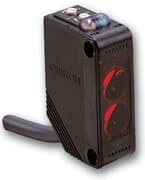
Omron E3Z
Compact photoelectric sensor with built-in amplifier
Reference mode — everything visible. Use for live calls.
Three things to remember
Operating temperature
−25 to +55 °C standard; select M8 connector models (E3Z-T86 / R86 and similar) rated −40 to +55 °C with…
Omron (lower cold limit)
Storage temperature
−40 to +70 °C
Omron (documented)
Headline
The broadest variant catalogue in the compact-photoelectric category — from standard through-beam all the way…
Key specifications
26 rowsColumns compared: Omron E3Z (PNP variants) vs Keyence PZ-G (PNP variants)
Ingress Protection (IP) rating
Competitor- Omron E3Z
- IEC IP67
- Keyence PZ-G
- IEC IP67, NEMA 4A/6/12 (National Electrical Manufacturers Association), DIN IP69K (high-pressure / high-temperature washdown)
Keyence (IP69K)
Operating temperature
Omron- Omron E3Z
- −25 to +55 °C standard; select M8 connector models (E3Z-T86 / R86 and similar) rated −40 to +55 °C with polyurethane (PUR) cable
- Keyence PZ-G
- −20 to +55 °C
Omron (lower cold limit)
Storage temperature
Omron- Omron E3Z
- −40 to +70 °C
- Keyence PZ-G
- Not stated on the captured public spec page
Omron (documented)
Humidity
Tie- Omron E3Z
- Operating 35–85 % relative humidity (RH); storage 35–95 % RH, no condensation
- Keyence PZ-G
- 35–85 % RH, no condensation
Tie
Vibration resistance
Tie- Omron E3Z
- 10–55 Hz, 1.5 mm double amplitude, 2 h each on X/Y/Z
- Keyence PZ-G
- 10–55 Hz, 1.5 mm double amplitude, 2 h per axis
Tie
Shock resistance
Competitor- Omron E3Z
- 500 m/s², 3 shocks per axis
- Keyence PZ-G
- 1 000 m/s², 6 shocks per axis
Keyence (2×)
Housing material
Competitor- Omron E3Z
- Polybutylene terephthalate (PBT)
- Keyence PZ-G
- Glass-fibre-reinforced PBT
Keyence (slight)
Lens material
Tie- Omron E3Z
- Modified polyarylate (methacrylic on retro-reflective)
- Keyence PZ-G
- Polyarylate or acrylic (polymethyl methacrylate, PMMA)
Tie
Connection
Tie- Omron E3Z
- Pre-wired cable 2 m / 0.5 m, M8 standard connector; M12 variants on request (-M1J or -M1TJ suffix)
- Keyence PZ-G
- M8 connector (CP suffix), M12 pigtail (EP), 2 m cable (P), bipolar PNP+NPN combined (CB)
Tie
M8 connector pin count
Omron- Omron E3Z
- 3-pin on standard DC three-wire variants
- Keyence PZ-G
- 4-pin on PZ-G — flagged as a quirk by users coming from 3-pin ecosystems (see Objections)
Omron (ecosystem fit)
Functional safety — mean time to dangerous failure (MTTFd)
Omron- Omron E3Z
- Published per variant in datasheet: 636 years (oil-resistant diffuse) up to 2 165 years (diffuse narrow-beam)
- Keyence PZ-G
- Not stated on the captured public spec page
Omron (ready for SISTEMA / ISO 13849 calculations)
Certifications
Tie- Omron E3Z
- CE, RoHS (Restriction of Hazardous Substances) explicitly confirmed in datasheet. UL / cULus (Underwriters Laboratories) not stated in the captured datasheet — verify internally.
- Keyence PZ-G
- Not stated on the captured public spec page
Both to verify per SKU
Light source
Tie- Omron E3Z
- Through-beam: infrared LED 870 nm (standard) / red 660 nm (long-range). Retro-reflective: red LED 660 nm. Diffuse: infrared 870 nm (standard) / red 650 nm (narrow-beam).
- Keyence PZ-G
- Through-beam: red LED. Diffuse / retro: dual infrared LED.
Tie
Protection circuits
Omron- Omron E3Z
- Reverse-polarity on supply, output short-circuit, mutual-reflection suppression (MSR, on retro / diffuse), reverse-output-polarity
- Keyence PZ-G
- Not detailed on the captured public spec page
Omron (documented)
At a glance
- Category: General-purpose photoelectric sensor in a compact DIN (Deutsches Institut für Normung) housing, with the signal amplifier integrated into the sensor body. Variants cover through-beam, retro-reflective, diffuse-reflective, limited-reflective (for clear objects), distance-settable, and slit-through-beam.
- Typical applications: part-present detection on conveyors, bottling and packaging lines, end-of-travel confirmation, feeder-bowl outlet sensing, pallet-gap detection on stacker infeeds, assembly-cell position checks.
- Price positioning: Mid-market in DACH. Typically at or below Keyence PZ-G on a like-for-like model; noticeably below Keyence when the application gets pushed up into their LR-W / LR-X laser families.
- Headline selling point: The broadest variant catalogue in the compact-photoelectric category — from standard through-beam all the way to oil-resistant, limited-reflective for clear bottles, and background-suppression distance-settable — all inside the same housing footprint, the same mounting bracket family, and with mean time to dangerous failure (MTTFd) figures published per variant.
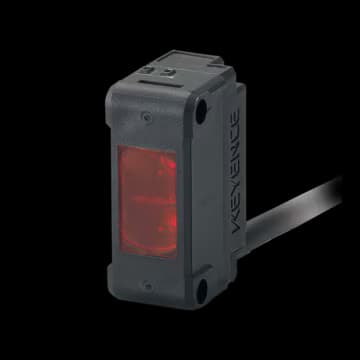
Key specifications
DACH-standard output is PNP (positive-switching). The primary comparison is therefore Omron E3Z-T81 (through-beam, PNP, pre-wired) vs Keyence PZ-G51P (through-beam standard power, PNP, pre-wired). Keyence PR-G is a stainless-steel harsh-environment family and is discussed separately in the narrative, not in this table.
Where Omron wins
- Variant catalogue breadth in one housing. The E3Z family extends to oil-resistant ("-K" suffix), limited-reflective for clear glass or plastic (E3Z-L83 / L88, 30 ± 20 mm window), background-suppression distance-settable (E3Z-LS series), slit-through-beam (E3Z-G) and narrow-beam diffuse — all in the same 11 × 21 × 31 mm body and compatible with the same E39-L mounting bracket family. PZ-G covers the mainstream cases well; anything harder pushes the Keyence customer up into LR-W / LR-X laser CMOS (complementary metal-oxide semiconductor) at materially higher list price.
- Cold-environment operation. Standard operating range goes to −25 °C; the M8 connector variants (E3Z-T86, R86 and similar) with the polyurethane (PUR) sensor cable accessory are rated to −40 °C. Keyence PZ-G stops at −20 °C. For Swiss and DACH cold-storage logistics, deep-freeze food handling, and outdoor industrial sites this is a disqualifier for Keyence, not a marketing angle.
- Published mean-time-to-dangerous-failure data. Omron prints MTTFd per variant directly on the datasheet, which feeds straight into a SISTEMA (Safety Integrity Software Tool for the Evaluation of Machine Applications) calculation for ISO 13849-1 performance-level (PL) assessment. Keyence does not publish this on the public PZ-G page, so customers routinely wait weeks for a factory letter. Machine builders running their own safety file will care about this.
- 3-pin M8 wiring, Light-ON / Dark-ON by wire flip. On DACH-standard 3-pin M8 PNP, the E3Z swaps between Light-ON and Dark-ON modes by reversing the load wiring — a characteristic maintenance technicians like because it needs no configuration. PZ-G uses a 4-pin M8 even on the DC three-wire product, flagged as a pain point by users on PLCtalk (see Objections).
- Replacement depth in DACH. The E3Z is stocked by Distrelec, RS Components, Farnell, and every main Swiss automation distributor down to specific-variant level. Next-day replacement is realistic across most of the catalogue.
Where Keyence wins
- Response time. PZ-G is 500 µs across the range; E3Z is 1 ms standard and 2 ms on the 30 m long-range through-beam. Under roughly 1 000 parts per minute the PLC (programmable logic controller) scan time dominates and the gap is academic; above that the difference is real. Do not try to spin it — concede, or move the conversation to Omron E3AS if the application actually demands sub-millisecond optical response.
- IP69K washdown rating. PZ-G carries both IEC IP67 and DIN IP69K; E3Z is IEC IP67 only. For food and beverage lines, dairy, pharma, and any process with hot high-pressure caustic washdown, IP69K is effectively a must-have spec, and PZ-G is the safer recommendation without additional protection.
- Mechanical robustness. 1 000 m/s² shock and six shocks per axis on PZ-G versus 500 m/s² and three per axis on E3Z. Relevant near stamping, welding, forging, or vibratory feeders running at resonance.
- Wider supply voltage. 10–30 VDC on PZ-G versus 12–24 VDC on E3Z. Helps on retrofits where the 24 V rail sags under load, or on 12 V battery-backed conveyors in intralogistics.
- Lighter connector-body variant. Roughly 10 g on the PZ-G rectangular connector versus 30 g on the E3Z-T86 M8 connector through-beam. Matters when dozens are mounted on a moving gantry or lightweight end-of-arm tooling.
- Sales-engineering cadence in DACH. Keyence's field presence and application engineering in DACH are historically strong, and a customer who is used to a Keyence rep turning up same-week with demo hardware may experience Omron response as slower — even if actual technical support is comparable.
Typical objections & responses
Researched from PLCtalk, Practical Machinist, Trustpilot, and Glassdoor customer comments on Keyence and Omron. Each objection is tied to a source type so you know it's real, not invented.
- "Keyence gives us better post-purchase support than Omron does." (Most common pro-Keyence statement across PLCtalk threads.) → The reputation is half-true. PLCtalk and Practical Machinist have repeated reports of the opposite once the install is in — one user on Practical Machinist described buying roughly USD 75 000 of Keyence sensor and PLC equipment, getting around 4.5 hours of training, and then being told to hire an integrator for anything further. Response: "Fair, Keyence's pre-sales engineering is aggressive. But ask them for 3-year support hours on the specific SKUs you're specifying, in writing. We quote Omron's Swiss support desk response time contractually. The long tail is where the comparison actually matters."
- "We're already standardized on the Keyence catalogue." → Valid on inventory logic, weak on lock-in. Keyence has been publicly criticised on PLCtalk and Practical Machinist for rapid catalogue churn — older models are discontinued and documentation for current-catalogue items is hard to locate. Response: "Standardisation is real value, but check your active-SKU list against Keyence's current catalogue. The ones that have been silently replaced create a bigger re-standardisation cost than moving to E3Z, where the housing, bracket, and wiring pattern have been stable for more than a decade."
- "Keyence is more precise / higher quality." (Frequent on forum posts — sometimes accurate for their laser families, sometimes overstated for PZ-G.) → Don't argue with the laser-CMOS products (Keyence's LJ-X8000 is class-leading). On PZ-G specifically, a PLCtalk user after switching to Keyence's PZ photoelectrics wrote "Low cost yes, so I guess you get what you pay for?" — not a ringing endorsement. Response: "On photoelectric specifically, the PZ-G and E3Z spec sheets land within 20 % of each other on everything except response time. If you need laser-grade precision we'll put an E3AS or ZX1 in front of you — but for presence detection, paying the Keyence premium on a PZ-G isn't buying you measurable quality."
- "Keyence sensors are easier to wire — the PZ-G has an M12 with extra signals." → That same 4-pin M8 on PZ-G is the exact point a PLCtalk user flagged as awkward, noting preference for Omron's 3-pin layout where Light-ON / Dark-ON is done by flipping supply polarity on the load. Response: "3-pin M8 PNP is the DACH standard pre-wire. Every cable, every splitter box, every distributed-I/O module is built for it. The extra Keyence pin usually carries a test or teach function you wire once and never touch again — at the cost of non-standard cabling across the plant."
- "Price is higher on Omron." (Intermittently true in some quotes, more often the reverse in DACH.) → "Against PZ-G direct we are usually at or below. The bigger delta shows up when Keyence pushes you off PZ-G onto LR-W / LR-X because the application got slightly non-standard — reflective targets, clear bottles, oil mist. Omron keeps those in-family at the E3Z price point. And users on forums like PLCtalk have cited Banner as cheaper still than Keyence for general photoelectrics — so the 'Keyence quality justifies the price' narrative is weaker than their reps present it."
- "Your Keyence rep is always on-site; Omron isn't." (DACH-specific — real customer irritation but also fatigue, see Glassdoor / Indeed Keyence sales-culture reviews.) → Two-part answer: (1) For some customers this is a feature, for others it's fatiguing — Glassdoor employee reviews describe cold-call and site-visit quotas on Keyence reps that some customers have publicly called "relentless". (2) Commit to a concrete site cadence: quarterly on-site with a Swiss applications engineer, 24 h email turnaround. Put it in the account plan, not just a promise.
The switch story
Most Keyence photoelectric installs in DACH use PZ-G for mainstream conveyor detection and push non-trivial cases up to LR-W or LR-X laser CMOS. That bifurcation is the commercial opening: the moment a customer's application gets slightly awkward (clear PET bottle, shiny chrome part, −25 °C cold room, oil mist in a machining centre), Keyence prices them into the premium laser line. E3Z keeps those use-cases at mainstream-photoelectric price, because Omron built the variants into the same housing — oil-resistant, limited-reflective, distance-settable, slit, and narrow-beam diffuse all ship in the E3Z body.
Second, cold environments. Swiss and German cold-storage logistics (Migros, Coop, Kühne+Nagel refrigerated DCs, Nestlé deep-freeze manufacturing) routinely specify −25 to −30 °C operating for photoelectrics on conveyor transfers. PZ-G's −20 °C floor is a silent disqualifier there. The −40 °C M8 connector E3Z models with polyurethane cables are the spec Keyence can't match without a product jump.
Third, the safety-file angle. Machine builders running their own SISTEMA analysis for ISO 13849-1 performance level need MTTFd numbers for every safety-related sensor — including non-safety photoelectrics used in guard-monitoring cascades. Omron publishes per variant on the public datasheet. Keyence hands out a letter on request, which slows the file. Not a sexy angle in a first meeting, but decisive for OEM (original equipment manufacturer) machine builders doing their own certification.
Where a customer is genuinely running food-grade washdown lines with IP69K in their spec, or needs 500 µs response on a high-speed printer or inserter, be honest: PZ-G is the right tool. Trying to force an E3Z there is how you lose the next three deals.
Application examples
- Conveyor part-present, standard industrial (most common slot). E3Z-D82 (diffuse-reflective, 1 m range, PNP output, 2 m pre-wired cable). Direct replacement target for PZ-G41P. This is the 60 %-of-volume case.
- Long-range gap detection on palletiser / depalletiser infeed. E3Z-T82 (30 m through-beam, PNP, pre-wired). Competes with PZ-G52P (40 m); specify E3Z if the actual gap is ≤25 m, which covers most pallet-handling lines.
- Clear plastic bottle / PET bottle detection on bottling lines. E3Z-B82 (retro-reflective for clear plastic bottles, no mutual-reflection suppression, 2 m with E39-R1S reflector) or E3Z-L83 (limited-reflective, 30 ± 20 mm window) for inspect-position confirmation against a glass panel. Neither of these targets is reliable on a standard PZ-G retro.
- Bottle neck / label-edge counting (high-speed filler). If the speed actually exceeds 1 000 bottles/min, concede to PZ-G on response time, or step up to Omron E3AS time-of-flight for distance-stability plus faster response.
- Cold-storage conveyor transfer, −25 to −30 °C. E3Z-T86 M8 connector (through-beam 15 m, PNP) + XS3F-M421-402-L polyurethane I/O cable — rated −40 °C. Direct disqualifier against PZ-G.
- Oil-mist environment on CNC (computer numerical control) part-loaders or machining centres. E3Z-D81K or E3Z-R81K (oil-resistant "-K" series, PNP). Same bracket as the standard E3Z, different compound and seal.
- Background-suppression required on shiny stainless workpiece. E3Z-LS81 (background-suppression distance-settable, PNP). Keyence would push the customer to LR-W / LR-X laser CMOS at a materially higher list price.
- Assembly-cell end-of-stroke confirmation on a robot cell. E3Z-R81 retro-reflective (PNP) with small reflector E39-R31 — compact, one-wiring-run, maintenance-accessible. Favour retro over diffuse when the cell layout has varying target reflectivity.
- Slit through-beam for small-part presence or narrow-gap detection. E3Z-G81 (single axis) or E3Z-G82 (two axes), PNP, pre-wired. Use where a narrow detection zone is more important than sensing distance — e.g. wafer-handling, small-part parts feeders, thin-object counting.
- Infeed jam detection on a high-speed packaging line. E3Z-T81 through-beam, PNP, pre-wired 2 m. Pair with an amber pilot light via A22N. If the line runs above ~60 m/min the 1 ms response is fine; if it's a sheet-feed printer running at 180 m/min, specify E3AS.
- Pallet height / stack detection in intralogistics. E3Z-T82 PNP at long-range through-beam for beam-break across the stack envelope. Competes directly with PZ-G52P; E3Z wins in −25 °C cold-store intralogistics.
- Fork-truck presence at a shutter / gate. E3Z-R81 retro (PNP), ruggedised wiring into a Swiss-standard 24 V control panel. Simple, cheap, boring — the right answer.
- Safety-adjacent monitoring cascade (non-OSSD, non-safety category). Any E3Z PNP with published MTTFd figure for the variant — so the machine builder's SISTEMA file inputs are defensible without a factory letter. Keyence public data won't support this today.
Sources
- Omron E3Z datasheet — local file
pdfs/omron/e3z.pdf, downloaded 2026-04-20 fromhttps://assets.omron.eu/downloads/latest/datasheet/en/e3z_compact_photoelectric_sensor_with_built-in_amplifier_datasheet_en.pdf(document IDCSM_E3Z_DS_E_18_10).- Ratings & Specifications table (standard through-beam / retro / diffuse): p. 5
- Ratings & Specifications table (oil-resistant -K series): p. 7
- Common electrical & environmental specs: p. 7, "Common" section
- MTTFd figures: bottom of each Ratings table
- Keyence PZ-G public spec HTML — local file
pdfs/keyence/pz-g-specs.html, snapshot 2026-04-20 ofhttps://www.keyence.com/products/sensor/photoelectric/pz-g/specs/(Keyence gates their PDFs behind registration; HTML spec page is the public source). - Keyence PR-G public spec HTML — local file
pdfs/keyence/pr-g-specs.html, snapshot 2026-04-20 ofhttps://www.keyence.com/products/sensor/photoelectric/pr-g/specs/. Referenced for the stainless-steel harsh-environment positioning, not used for the primary comparison table. - Objections research — PLCtalk thread on Keyence vs Omron vs Mitsubishi (users comparing PZ to Omron light/dark wiring, cost-vs-quality quote); Practical Machinist thread on Keyence post-sale service (USD 75 000 customer, 4.5 h of service, told to hire an integrator); Trustpilot Keyence Corporation reviews; Glassdoor Keyence employee reviews (sales cadence, customer pushback). Snapshots not stored — cited in the card so Julian can re-verify before a specific meeting.
Open questions
- Exact DACH list-price delta E3Z-T81 vs PZ-G51P today — pull from internal Omron price matrix on day 1.
- Is there a current Omron production revision of E3Z with response time <1 ms? Public datasheet says 1 ms standard; check SSC roadmap internally.
- Per-variant UL / cULus status — the captured datasheet confirms CE and RoHS explicitly but does not list UL; confirm with product management.
- Swiss next-day availability depth (Servostar, DSE, Distrelec, RS, Farnell) per variant — map in a separate sheet.
- The briefing doc referenced "Keyence PR-Q" — no such Keyence model exists in the public catalogue. Likely meant PR-G (stainless harsh-environment) or PZ-G (compact amp-built-in). Confirm naming with the hiring manager and correct any internal document.
- Does Omron Swiss support offer a contractual response-time service-level for SSC customers? The "support" objection is where Keyence concedes the least; need a concrete counter-promise.
Before you leave — retrieval check
Customer says
“Keyence gives us better post-purchase support than Omron does.”
Source battlecards/sensors/e3z.md