Omron FH
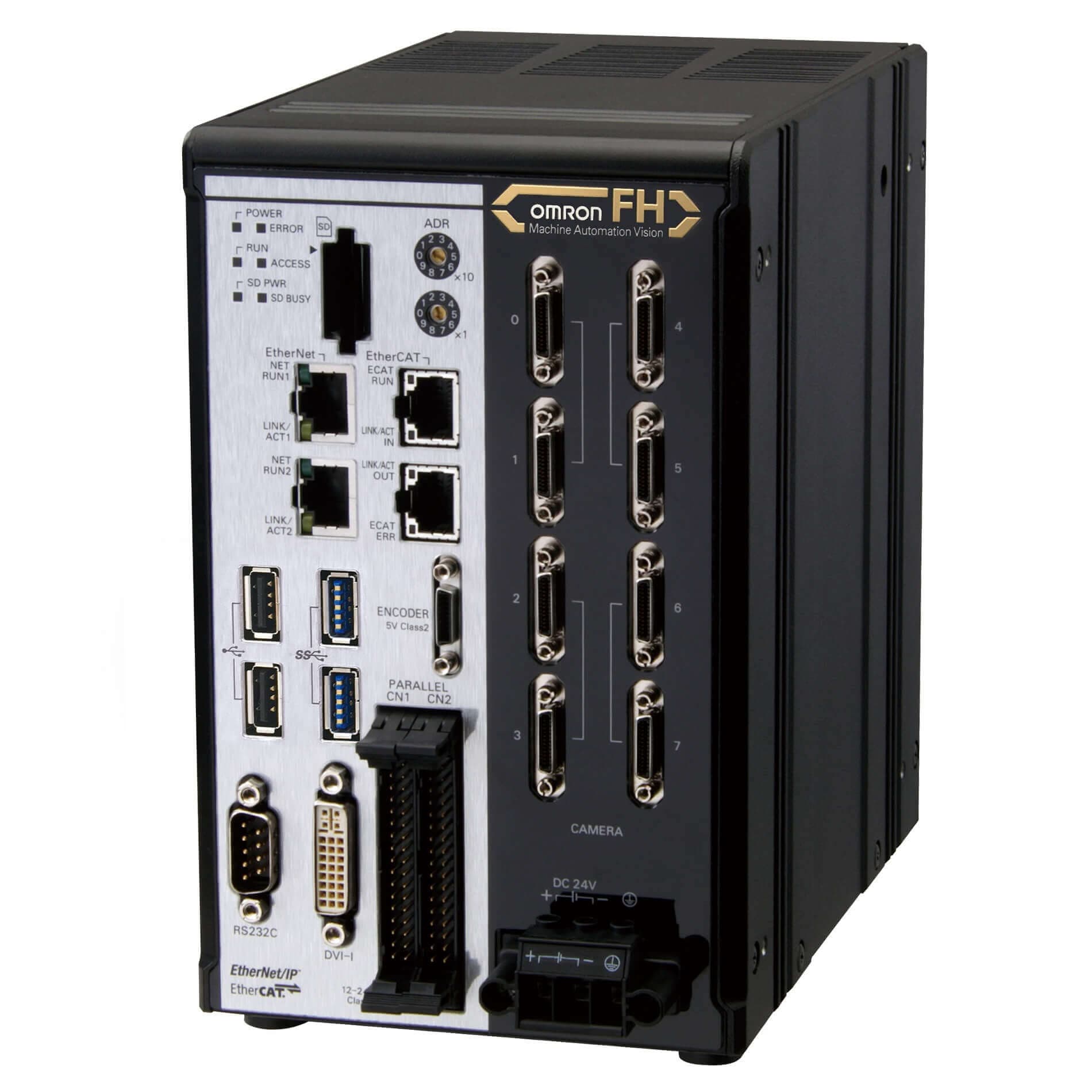
Multi-camera vision system controller, Sysmac-native
Reference mode — everything visible. Use for live calls.
Three things to remember
Tier / processor
FH-L: Intel Atom.
Omron (processor tiering transparent)
Max cameras per controller
Up to 8 (mixed area-scan / line-scan, with up to four 12 MP or 20.4 MP cameras in the mix)
Omron (2× camera ceiling)
Headline
Native Sysmac integration over EtherCAT (Ethernet for Control Automation Technology).
Competitor lineup
Key specifications
19 rowsColumns compared: Omron FH (FH-L / FH-2050 / FH-5050 / FH-5550) vs Keyence CV-X (CV-X400A, CV-X402A, CV-X320A and siblings)
Max sensor resolution — area scan
Competitor- Omron FH
- 20.4 MP (FH cameras, models per cameras page)
- Keyence CV-X
- Up to 21 MP on CV-X; a 64 MP camera is available in the higher-end Keyence vision range (documented by Keyence on CV-X series pages and more explicitly positioned on XG-X)
Keyence (higher peak on 64 MP)
EtherCAT (Sysmac-native, 125 µs–1 ms cycle)
Omron- Omron FH
- Slave, native. Integrated into Sysmac Studio. NJ / NX PLC sees FH as a standard EtherCAT node; vision triggers and results map directly into PLC variables, communication cycle reducible to 1/32 of typical cycle per Omron connection guide.
- Keyence CV-X
- Not supported. CV-X ships EtherNet/IP + PROFINET + RS-232C (Recommended Standard 232 revision C) + PLC-Link. Any Sysmac EtherCAT customer who wants a CV-X has to add an EtherCAT↔EtherNet/IP gateway or drop out of the EtherCAT frame.
Omron (decisive on Sysmac lines)
Cycle-time headline
other- Omron FH
- "Industry-leading processing speeds" — specific µs-per-tool figures depend on model; on FH-5000 multi-core, 4 cameras processed in parallel.
- Keyence CV-X
- "Industry's fastest multi-camera" per CV-X400 series marketing
Marketing claims from both sides — do not quote in front of customer without benchmark. Say "Not specified in captured source" for precise per-tool timing.
Tier / processor
Omron- Omron FH
- FH-L: Intel Atom. FH-2050: Intel Celeron 2-core. FH-5050: Intel Core i7 4-core. FH-5550: Intel Core i7 4-core, 32 GB ECC (error-correcting code) RAM, extended storage.
- Keyence CV-X
- CV-X400A: cable-type, 0.47 MP camera support. CV-X320A: 2 MP camera support. CV-X402A: next-gen CV-X400 series. Exact CPU not published on public CV-X pages.
Omron (processor tiering transparent)
Max cameras per controller
Omron- Omron FH
- Up to 8 (mixed area-scan / line-scan, with up to four 12 MP or 20.4 MP cameras in the mix)
- Keyence CV-X
- Up to 4 per controller (PLCtalk community and Keyence model pages confirm the 4-camera ceiling)
Omron (2× camera ceiling)
Line-scan camera support
Omron- Omron FH
- Up to 4 line-scan cameras (2K / 4K / 8K), mixed with area-scan on same controller
- Keyence CV-X
- Supported — but Keyence typically moves line-scan and 3D customers to XG-X, not CV-X
Omron (in-family on FH)
3D / SWIR / polarized
Omron- Omron FH
- Polarized and SWIR heads offered inside the FH camera family
- Keyence CV-X
- 3D heads exist but are routed to XG-X family, not CV-X
Omron (in-family)
PROFINET slave
Tie- Omron FH
- Yes (all FH tiers per product page)
- Keyence CV-X
- Yes (CV-X dedicated PROFINET manual exists)
Tie
EtherNet/IP
Tie- Omron FH
- Yes
- Keyence CV-X
- Yes — EtherNet/IP configuration allows 496 bytes of data with configurable bit/byte allocation per Keyence manual
Tie
Serial / USB / PLC-Link
Competitor- Omron FH
- RS-232C, USB
- Keyence CV-X
- RS-232C, USB, "PLC-Link" (Keyence-proprietary fast bind to KV PLC)
Keyence (if the plant is Keyence KV PLC)
Sysmac Studio integration
Omron- Omron FH
- Yes, first-class. Scene data, camera setup, flow editing, calibration all inside Sysmac Studio. One variable database with the NJ / NX PLC and 1S / G5 servos. Supported from Sysmac Studio v1.07 upward (and current releases throughout 2025).
- Keyence CV-X
- None. Keyence CV-X is configured in its own IDE; interaction with an Omron PLC is a fieldbus-level tag exchange.
Omron
AI defect tools
Omron- Omron FH
- AI Defect Inspection (self-learning), AI Fine Matching (handles legitimate product variation), AI Scratch Detection filter (FH-2052 / FH-5052 -20 suffix models)
- Keyence CV-X
- Auto Teach, LumiTrax lighting integration, "ViSUAL" AI-assisted tools on CV-X400 series
Roughly tied; different philosophies (Omron: explicit AI filters; Keyence: Auto Teach built into flow)
Shape-matching algorithm
Omron- Omron FH
- Shape Search III — shape-based (edge / geometry) pattern matching, robust to illumination drift, partial occlusion, rotation, and out-of-focus conditions; search speed up to 9× older Shape Search per Omron.
- Keyence CV-X
- PatMax is Cognex's algorithm, not Keyence's. Keyence's CV-X uses its own shape tool (not publicly branded "PatMax"). Do not conflate.
Omron publishes algorithm detail; Keyence does not name theirs as clearly on public pages
Photometric stereo
Tie- Omron FH
- Yes (FH, for dent / emboss / surface defect under varying albedo)
- Keyence CV-X
- LumiTrax (Keyence's multi-angle illumination approach — functionally in the same family)
Tie on capability; differing implementation
Digital watermark / hidden code
Omron- Omron FH
- Digimarc decoding supported on FH
- Keyence CV-X
- Not specified in captured source
Omron
Operating system
Omron- Omron FH
- Windows 10 IoT Enterprise 2019 LTSC (Long-Term Servicing Channel), 64-bit — supports patching roadmap through the documented LTSC window
- Keyence CV-X
- Proprietary Keyence firmware (not exposed as a general Windows host)
Depends: Omron better for IT/OT integration, Keyence better for "sealed appliance" posture
GMP / 21 CFR Part 11 package
Omron- Omron FH
- Optional upgrade available (pharma / life sciences)
- Keyence CV-X
- Not specified on captured source
Omron (documented)
At a glance
- Category: Industrial vision system controller (box controller + separate camera heads) for in-line inspection, measurement, code reading, and AI-assisted defect detection. Three main Omron performance tiers: FH-L (Lite, Intel Atom, 2–4 cameras), FH-2000 / FH-2050 (mid, Intel Celeron 2-core, 2 / 4 / 8 cameras), FH-5000 / FH-5050 / FH-5500 / FH-5550 (high, Intel Core i7 4-core / 8-core, 2 / 4 / 8 cameras). Camera lineup covers area-scan 0.3 MP (megapixel) to 20.4 MP, line-scan 2K / 4K / 8K, plus SWIR (short-wave infrared) and polarized heads.
- Typical applications: Tier-1 automotive weld/bead/connector inspection, semiconductor and electronics assembly, pharmaceutical blister-pack OCR (optical character recognition) / OCV (optical character verification), battery cell inspection, food-and-beverage label and fill-level checks, printed circuit board (PCB) presence-and-orientation, label placement on FMCG (fast-moving consumer goods) lines.
- Price positioning: Mid-to-premium. FH-L (Lite) is deliberately priced below CV-X on entry-level single- or dual-camera inspection. FH-5050 / FH-5550 lands at or slightly below a comparable CV-X400A bundle once you include multi-camera licence cost — and noticeably below CV-X when the customer would otherwise have to buy two CV-X controllers to cover 5–8 cameras.
- Headline selling point: Native Sysmac integration over EtherCAT (Ethernet for Control Automation Technology). The FH is a first-class Sysmac Studio device — cameras, scenes, inspection results, and motion axes share one variable database with the NJ / NX series Machine Automation Controller. For a line already running Omron PLC (programmable logic controller) + 1S / G5 servo on EtherCAT, the FH collapses vision-to-motion latency (Keyence documents no equivalent), eliminates the glue-code typically written to bridge a CV-X over EtherNet/IP, and keeps one IDE (integrated development environment) for PLC, motion, safety and vision.
Key specifications
DACH-standard fieldbuses are EtherCAT (Sysmac-native), PROFINET (Process Field Network, Siemens ecosystem), and EtherNet/IP (Rockwell / ODVA ecosystem). The primary comparison is Omron FH-5052 (4-core high-performance, 4 cameras, EtherCAT + PROFINET + EtherNet/IP) vs Keyence CV-X400A (0.47 MP-supporting cable-type controller, up to 4 cameras, EtherNet/IP + PROFINET). XG-X is referenced only when a Keyence customer is pushed off CV-X because they need line-scan, 3D, or flowchart-custom programming.
Where Omron wins
- Sysmac + EtherCAT integration. This is the game. If the line's PLC is Omron NJ or NX, the FH is the only vision controller on the market that behaves as a native EtherCAT slave inside the Sysmac Studio project. One tag database, one IDE, one download button to commission PLC, servo, safety, and vision. The Omron connection guide (document P577) documents cycle-time reductions of up to 1/32 for common PLC-to-vision handshakes (positioning recognition, axial motion start) versus a gateway-bridged competitor. For any customer standardising on Sysmac — and much of Swiss machine-building and Tier-1 automotive does — this collapses commissioning time and eliminates the "who owns the middle" integration argument. Keyence CV-X cannot match this; it is architecturally outside the EtherCAT frame.
- 8 cameras per controller. Hard ceiling on CV-X is 4. When the customer's inspection needs 5+ views — classic cases being 360° weld / bead inspection from four directions plus two overview cameras, or palletiser loads checked from above plus all four sides — Keyence either needs two CV-X controllers (and a synchronisation scheme) or has to climb into the XG-X custom family at a price jump. One FH-5052 / FH-5552 covers it natively.
- Wider camera-family coverage without changing controller. Area-scan from 0.3 MP to 20.4 MP, line-scan 2K / 4K / 8K, SWIR, polarized — all on one FH controller. CV-X keeps most of this on-brand but routes 3D and line-scan cases toward XG-X.
- One engineering workflow for PLC + motion + vision + safety. Sysmac Studio is genuinely one IDE. The operator who commissions the vision is the same person who commissions the PLC logic and the servo profile. Keyence has its own IDE; tag mapping between Keyence CV-X and an Omron / Siemens / Rockwell PLC is work the integrator bills for.
- AI Defect Inspection with Photometric Stereo on surface-defect cases. Battery-cell inspection, stamped-metal dent detection on BiW (body-in-white) panels, bead inspection on adhesive dispense — the combination of photometric stereo imaging plus the AI defect filter is Omron's strongest application-specific pitch. CV-X's LumiTrax is the counterpart; Omron's published application set runs deeper in automotive and battery.
- 21 CFR Part 11 / GMP upgrade path for pharma and life-science DACH customers (Roche, Novartis, Lonza, Vetter, Siegfried, Sandoz/Hexal). Not sexy on CV-X's public material.
- Open OS posture. Windows 10 IoT LTSC is a known quantity for plant IT/OT teams running Siemens WinCC, Ignition, or OPC UA (Open Platform Communications Unified Architecture) servers. They can audit and patch it on their own schedule. A "black box" Keyence appliance is sometimes preferred by production and sometimes blocked by IT — know the customer before you lean on either angle.
Where Keyence wins
- First-time setup speed and the pre-sales experience. Widely acknowledged — including on PLCtalk — that Keyence's "Auto Teach" and guided setup make a CV-X demo come together faster than an FH demo when the integrator has never touched either. For short-sales-cycle customers with no existing Omron relationship, this matters.
- Higher peak camera resolution (64 MP) exists in the Keyence range. Keyence markets a 64 MP camera on the CV-X series; Omron FH tops at 20.4 MP in the published camera family. For micro-electronics or inspection of very large FOV (field of view) at very high pixel density, this is a real spec advantage for Keyence — concede it if it comes up.
- PLC-Link to Keyence KV PLC. If the plant is already Keyence KV-series PLC plus CV-X vision, the two lock together via PLC-Link on a proprietary-fast path. Omron has no equivalent into a Keyence PLC — the answer there is NJ + FH, not FH alone.
- "Sealed appliance" operating posture. Some production teams prefer that vision is not a Windows host that plant IT can touch. Keyence's controller is a closed firmware appliance; Omron FH is a Windows 10 IoT LTSC node. Both sides are defensible; know which the customer prefers before pitching.
- Local support cadence in DACH. Keyence's DACH field engineering is historically strong; same-week on-site demos and free in-kind loaner hardware are standard. Omron's cadence is comparable at enterprise / Tier-1 accounts but thinner at small machine-builder customers. Account-plan against this honestly.
- Shape-based tool ergonomics on simple presence / absence. Keyence's Auto Teach on presence of bolts, screws, nuts is community-praised on PLCtalk for converging quickly on "differentiating tiny features" without a vision engineer in the loop. Omron's Shape Search III is competitive and arguably more robust once tuned — but the first-hour experience tilts Keyence.
Typical objections & responses
Researched from the PLCtalk "Most versatile machine vision" thread (linked in sources), the PLCtalk "Cognex vs Keyence vision systems" thread, Practical Machinist Keyence service threads, and Peko Precision's Keyence review. Each objection is tied to a source type so you can re-verify before a meeting.
- "We already know Keyence. CV-X is easy to set up; FH has a learning curve." (Most common pro-Keyence first-meeting statement; corroborated on PLCtalk and on the Peko Precision blog.) → Concede the first-hour advantage, shift to total cost: "Yes, if we're comparing one person setting up one camera for one scene, Keyence wins the first afternoon. But this line is Sysmac and EtherCAT. Plug a CV-X in and your integrator writes a gateway or a tag-map layer — that's week two. FH drops into the Sysmac project as a node, same variable database as the PLC. Count commissioning in weeks, not hours."
- "Keyence gives us better post-sales support than Omron." (Commonly claimed. Reality is mixed: PLCtalk and Practical Machinist both have threads where customers describe substantial post-sales Keyence cost or minimal included training.) → "Ask them for the 3-year post-sales support plan on the specific CV-X bundle, in writing, including on-site hours included. Then ask us the same. The short-sales-cycle perception favours Keyence; the long tail on multi-year production runs is where the FH's Sysmac integration actually pays off — because the same Omron engineer who owns the PLC owns the vision."
- "CV-X can do 4 cameras; we only need 4." (Genuinely valid on some lines.) → "Understood — FH-L or FH-2050 is the right FH tier for 2–4 cameras, and we'll price that, not the FH-5552. The question for the next three years is what happens when production adds a fifth camera angle. On FH you add a camera. On CV-X you add a second controller and synchronise them. We see this most on battery and BiW (body-in-white) lines where post-launch inspection requirements grow."
- "Keyence has a 64 MP camera; Omron tops at 20.4 MP." (Accurate on public spec pages.) → Concede directly: "True. If the application genuinely requires 64 MP — very-fine PCB, wafer-like features across a large FOV, or micro-mechanical parts — Keyence has a real spec advantage there, and we should put the right tool on the job. For almost every other application I see in Switzerland the 20.4 MP head plus Shape Search III or photometric stereo delivers the result. Let's benchmark on the actual part."
- "CV-X is an appliance; FH is a Windows PC — our IT won't patch it." (Real concern, especially in pharma and regulated environments.) → Two-part: "(1) Windows 10 IoT Enterprise LTSC is the patch-managed, long-lifecycle industrial Windows SKU — it is the same base that many MES (Manufacturing Execution System) clients run on. Your IT can patch it on their maintenance window. (2) Our 21 CFR Part 11 / GMP upgrade gives you audit-trail and e-signature out of the box, which a closed-firmware appliance doesn't offer you. This is usually an argument for FH in a validated environment, not against."
- "Your price is higher than CV-X." (Intermittently true — depends heavily on DACH quote dynamics.) → "Compare like-for-like: FH-L vs CV-X200 entry, or FH-2050 4-camera vs CV-X400A with the 4-camera licence bundled. Also count the integration labour — on a Sysmac line, the FH saves integrator hours that the CV-X's gateway layer costs. Quote shows what it shows; total-installed-cost is usually closer, sometimes Omron-favourable."
- "Does Omron support PatMax?" (Misconception — PatMax is Cognex, not Keyence.) → "PatMax is a Cognex algorithm, not a Keyence one. Our equivalent on FH is Shape Search III — edge-and-shape based, documented as up to 9× faster than the prior generation, robust to rotation, partial occlusion, defocus, and lighting drift. Keyence publishes less about their matching algorithm internals; don't let the lingua franca blur the comparison."
- "We're a Rockwell / Siemens plant, so the Sysmac argument doesn't apply." (Legitimate.) → "Fair. The integration pitch for FH is strongest on an Omron NJ / NX / Sysmac line. If the PLC is Siemens S7 or Rockwell ControlLogix, you're comparing on EtherNet/IP and PROFINET — where both FH and CV-X are broadly peer. Then the decision comes back to the 8-camera ceiling, AI Defect + photometric stereo, and FH-L price point, not the Sysmac angle."
The switch story
The Omron FH sells on two axes in DACH, and both need to be led differently depending on the account.
Axis one — Sysmac / EtherCAT accounts. Most Swiss and southern-German machine-builders who already run Omron PLC (NJ, NX) have an existing Sysmac Studio project per machine. Any vision controller outside that project is integration debt: gateway hardware, variable mapping, a second IDE, divergent project files, and a second engineer in the commissioning room. The FH is the only vision controller that lives inside that project. This is not a marketing angle — it shows up as real commissioning weeks saved, and for machine-builder customers who deliver fixed-price with liquidated damages on late handover, it's financially decisive. Lead with it the moment the customer mentions Sysmac, NJ, NX, 1S servos, or G5 servos. If they don't mention any of those, don't force it.
Axis two — 5+ cameras, or mixed camera-type requirements, on any PLC. The moment an inspection spec calls for more than four camera views, or mixes area-scan and line-scan, or needs SWIR or polarized imaging alongside standard vision, the Keyence answer is "either two CV-X controllers or step up to XG-X". That's a price jump and a complexity jump. FH-5052 (4-camera) or FH-5552 (8-camera) absorbs it natively. The clearest use-cases in DACH: battery-cell inspection at CellForce, Northvolt Zwickau, PowerCo Salzgitter or Morrow Basel; BiW automotive lines at Mercedes Sindelfingen / Stuttgart, BMW Regensburg, Porsche Zuffenhausen, Audi Ingolstadt, Volvo Gent; pharma packaging lines at Roche Kaiseraugst, Novartis Stein, Lonza Visp, Siegfried Zofingen; printed-electronics and semiconductor at Infineon Villach (Austria), ams-OSRAM Premstätten (Austria).
Where a customer is genuinely doing a single-camera presence-check on a standalone machine and has no Omron PLC in the plant, be honest: CV-X is a perfectly good answer, first-day integration is faster on Keyence, and trying to force an FH into that account is how you lose the next three deals in the same plant.
Where the customer needs true 64 MP imaging at the top end of what CV-X publishes and you cannot engineer around it with a smaller FOV and multiple cameras, concede and recommend the right tool. Omron does not beat Keyence on single-camera peak resolution today.
Application examples
All examples assume DACH context. Each case names the competing Keyence controller, the Omron FH model and camera, and why the FH wins (or loses) that specific slot.
- Battery-cell visual inspection on a high-volume pouch / prismatic cell line (Northvolt Heide / Zwickau, PowerCo Salzgitter, CellForce Kirchentellinsfurt, Morrow Basel). FH-5552 8-camera + polarized and 12 MP heads + AI Defect Inspection + photometric stereo for electrode coating defects, can-edge damage, and top-cap weld inspection — all in one controller, tied into the Sysmac-controlled stacker / winder motion over EtherCAT. Keyence alternative: two CV-X400A controllers plus synchronisation, or XG-X at materially higher price.
- Automotive BiW weld-bead inspection from four angles, Tier-1 OEM (Mercedes Sindelfingen, BMW Regensburg, Porsche Zuffenhausen, Audi Ingolstadt). FH-5052 4-camera + 12 MP heads + AI Scratch / bead-inspection tools. Native EtherCAT into NJ-series robot cell controller. Direct counter to CV-X400A on a 4-camera cell; on a 6-camera cell (4 sides + 2 overview) the 4-camera CV-X ceiling tips the deal Omron.
- Pharma blister-pack OCR / OCV, lot-code and expiry validation on a GMP line (Roche Kaiseraugst, Novartis Stein, Lonza Visp, Vetter Ravensburg, Siegfried Zofingen). FH-2052 + 5 MP monochrome head + OCR / OCV tool + 21 CFR Part 11 / GMP upgrade. Audit trail and e-signature required — that upgrade is FH-specific; CV-X's public page does not advertise an equivalent compliance package.
- Printed-electronics and semiconductor fine-feature inspection on a wafer handler or back-end line (Infineon Villach, ams-OSRAM Premstätten, STMicroelectronics field-service wins in Geneva). If the feature pitch is at the edge of 20.4 MP capability, FH handles it; if it genuinely requires 64 MP single-camera, concede to Keyence CV-X with the 64 MP head.
- Food and beverage label placement and fill-level check on a high-speed filler (Nestlé Orbe, Rivella Rothrist, Ricola Laufen, HERO Lenzburg, Emmi Dagmersellen). FH-L (Lite) 2 cameras + 0.3–2 MP head + Shape Search III for label rotation + AI for splash / tilt fill cases. Matches CV-X200 entry-class on cost, not a single-controller story, so lead with Sysmac integration only if the filler is Omron-PLC-based; if it's Siemens, compete head-to-head on spec and price.
- FMCG (fast-moving consumer goods) date-code and 2D-code read-and-grade on a carton line (Emmi, Migros Industrie, Coop Tavaro, Lindt & Sprüngli Kilchberg). FH-L or FH-2050 + 5 MP head + 2D Code II + Digimarc decoding. Digimarc watermark decoding is an Omron-specific tool for brand owners testing digital-watermark track-and-trace; not on CV-X public spec.
- Robot-guided bin-picking integration with an Omron iA robot + NX PLC on a Tier-2 automotive part feeder. FH-5052 + 12 MP head + Shape Search III for randomly oriented parts. Vision-to-motion handshake runs entirely on EtherCAT inside one Sysmac project — commissioning days saved versus a CV-X bridged over EtherNet/IP. Keyence has no analogous in-IDE motion-vision coupling.
- Automotive connector and wire-harness assembly verification (Leoni Roth, TE Connectivity Steinach, Komax Dierikon). FH-2052 4-camera + 5 MP heads + AI Fine Matching (handles legitimate harness colour / variant differences) + OCR on the product label. CV-X400A is viable; FH wins when the plant standardises on Sysmac-controlled servo-feeders.
- Pharma vial fill-level and stopper-seat inspection under variable lighting (Roche, Novartis, Lonza, Vetter). FH-2050 2-camera + photometric stereo for stopper-dent, + AI Defect Inspection on particulate in the liquid. LumiTrax on CV-X is the direct counter — honest recommendation: if the customer already has LumiTrax experience, it's a real fight and price will decide.
- Line-scan continuous-web inspection on a coating, slitting, or printing line (SIG Combibloc, Model Weinfelden, Bobst Mex). FH-5052 + 4K / 8K line-scan head. Keyence would route this to the XG-X family, not CV-X — so this is an XG-X fight, and Omron's pitch is the unified FH family covers both area-scan and line-scan without switching product tier.
- Palletiser / depalletiser overview + four-side label check on a bonded-warehouse conveyor (Kühne+Nagel, Galliker Transport, Schenker Intralogistics). FH-5052 5 cameras (top + four sides). Direct 4-camera ceiling bite for CV-X — one-controller FH wins.
- Multi-variant assembly-line final inspection with rapid changeover (ABB Baden, Bystronic Niederönz, Stadler Rail Bussnang). FH-2052 + AI Fine Matching for product variants, scene switching triggered over EtherCAT from the NJ PLC recipe. On a pure Sysmac line this is the easiest sell. On a mixed-PLC line, spec-compete on AI Fine Matching versus Keyence Auto Teach.
Sources
- Omron FH product page (Europe) — https://industrial.omron.eu/en/products/fh-vision-system — captured 2026-04-20. Used for tier lineup (FH-L, FH-2050, FH-5050, FH-5550), camera count, network interfaces, AI Defect Inspection, photometric stereo, Digimarc, 21 CFR Part 11 upgrade, Windows 10 IoT Enterprise LTSC, Sysmac Studio integration.
- Omron FH-5052 model page — https://industrial.omron.eu/en/products/FH-5052 — captured 2026-04-20. Image URL source.
- Omron FH cameras page — https://industrial.omron.eu/en/products/fh-cameras — referenced for 20.4 MP ceiling, line-scan 2K / 4K / 8K, SWIR, polarized heads.
- Omron NJ-series EtherCAT connection guide to FH — https://files.omron.eu/downloads/latest/connection_guide/en/p577_nj-series_-%5Bethercat%5D-_fh-series_vision_system_cg_en.pdf — the "1/32 common-communication cycle" figure for positioning / axial-motion-start comes from this document.
- Omron FH-Series press release (2013) — https://www.omron.com/global/en/media/press/2013/05/i0527.html — historical context on speed-precision-versatility positioning.
- Omron FH Sysmac Studio operation manual — indexed via manuals.plus mirror; referenced for confirmation of scene editing, flow editing, and project-management integration.
- Omron FH Shape Search III (YouTube technical overview) — https://www.youtube.com/watch?v=EfWBlF5vaWA — used only to cross-reference Shape Search III robustness claims publicly stated by Omron.
- Keyence CV-X series overview (EU) — https://www.keyence.eu/products/vision/vision-sys/cv-x100/models/cv-x400a/ — captured 2026-04-20. Used for CV-X400A positioning, 0.47 MP camera support, 4-camera ceiling.
- Keyence CV-X series model list — https://www.keyence.com/products/vision/vision-sys/cv-x100/models/ — referenced for CV-X320A (2 MP), CV-X402A (next-gen), CV-X400A (cable-type 0.47 MP).
- Keyence CV-X public spec HTML — local file
pdfs/keyence/cv-x-specs.html, snapshot 2026-04-20 ofhttps://www.keyence.com/products/vision/vision-sys/cv-x100/specs/(Keyence gates detailed PDFs behind registration; HTML spec page is the public source). - Keyence XG-X customizable vision system — https://www.keyence.com/products/vision/vision-sys/xg-x/ — referenced for where Keyence routes line-scan / 3D / custom-flowchart customers off CV-X.
- PLCtalk "Most versatile machine vision" thread — https://www.plctalk.net/forums/threads/most-versatile-machine-vision.130431/ — source of the 8-camera-Omron vs 4-camera-Keyence remark, glue-bead inspection and panoramic-stitch observations, and the "no single system is universally most versatile" community verdict.
- PLCtalk "cognex vs keyence vision systems" thread — http://www.plctalk.net/qanda/showthread.php?t=77455 — referenced for the general community positioning of Keyence on ease-of-use vs Cognex / Omron on depth.
- PLCtalk "Keyence, Omron, Mitsubishi" thread — https://www.plctalk.net/threads/keyence-omron-mitsubishi.60193/ — cross-vendor sentiment.
- Peko Precision product review of Keyence vision — https://www.pekoprecision.com/blog/review-keyence-vision/ — practitioner review, used for the "expensive but works" positioning confirmation.
- Averroes / Overview AI / Elementary machine vision market reviews — referenced for market positioning of CV-X and FH in the 2025–2026 machine-vision landscape.
- Pricing forum observations — Accio, Overview AI comparison pages, and PLCtalk commentary on Keyence pricing ranges ($15K–$60K+ per line bundled, vs competitors) — used for the price-positioning paragraph in the "At a glance" section.
Open questions
- Precise per-tool cycle-time benchmarks for FH-5052 vs CV-X400A on the same test part. Neither vendor publishes head-to-head figures. Request from Omron SSC product marketing before any technical shoot-out meeting — "industry-leading" is not a quotable number.
- Exact DACH list-price delta FH-L vs CV-X200 entry, and FH-5052 (4-camera) vs CV-X400A (4-camera licensed). Pull from internal Omron price matrix day 1. Quoted Keyence ranges on forums ($15K–$60K+ per line) are wide enough to be useless without a concrete quote.
- Does Omron's 21 CFR Part 11 / GMP upgrade cover full Annex 11 (European Union GMP Annex 11) audit-trail requirements for Swiss / German pharma? Confirm with Omron regulatory before pitching Roche / Novartis / Lonza accounts.
- What is Omron's current AI Defect Inspection training-data requirement (number of good / bad images) vs Keyence Auto Teach? Often the deciding factor in first-meeting technical credibility. Not specified in captured source.
- 64 MP camera roadmap on FH — Omron's FH cameras page tops at 20.4 MP today. Is there a higher-resolution head in the 2026–2027 SSC roadmap? If not, we need a crisp answer for the single-camera micro-inspection use case.
- Sysmac Studio version compatibility — FH support starts at v1.07, but specific AI filters and camera heads require newer Sysmac Studio versions. Map the minimum version per FH-model / AI tool combination internally.
- Keyence XG-X positioning — this card covers CV-X as the primary competitor. If a deal pivots toward line-scan / 3D / flowchart-custom, it's actually an FH-vs-XG-X fight, not FH-vs-CV-X. A separate XG-X-focused section (or card) would tighten this. For now, flagged in-line where relevant.
- Is the FH controller's Windows 10 IoT Enterprise LTSC 2019 on a supported update path beyond the 2029 LTSC end-of-servicing date? Plant IT will ask on multi-year capex. Confirm Omron's OS-refresh commitment.
- Local Swiss applications-engineering cadence commitment. The Keyence DACH field-presence objection is real. Need a contractual response-time and on-site cadence from Omron Swiss support to put against it, in writing, per account.
Before you leave — retrieval check
Customer says
“We already know Keyence. CV-X is easy to set up; FH has a learning curve.”
Source battlecards/sensors/fh.md