Omron FQ2
Standalone smart camera (all-in-one vision sensor)
Reference mode — everything visible. Use for live calls.
Three things to remember
Shutter speed
1/250 s to 1/60 000 s (with built-in lighting) / 1/1 s to 1/4 155 s (ambient only)
Omron (documented range)
Setup / programming interface
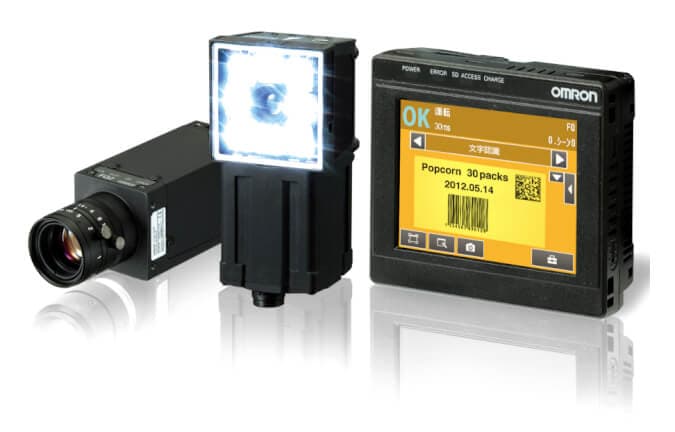
Touch Finder FQ2-D30 (AC-powered) or FQ2-D31 (battery, 1.5 h) — 3.5-inch TFT (thin-film transistor) LCD…
Omron (handheld pendant at the machine is a real operator win)
Headline
The Touch Finder — a physical handheld teach pendant with a colour touchscreen that lets a maintenance…
Key specifications
28 rowsColumns compared: Omron FQ2 (inspection variants) vs Keyence IV3 (smart camera variants)
Shutter speed
Omron- Omron FQ2
- 1/250 s to 1/60 000 s (with built-in lighting) / 1/1 s to 1/4 155 s (ambient only)
- Keyence IV3
- Not specified in captured source (pulse / continuous lighting is switchable)
Omron (documented range)
Response time
Tie- Omron FQ2
- Not specified as a single figure in captured source — camera throughput is driven by shutter + processing and varies per tool chain. Touch Finder can display at sensor frame rate.
- Keyence IV3
- Not specified in captured source
Both — spec per application, not a headline number
Output type
Tie- Omron FQ2
- Open-collector, NPN or PNP selectable per order
- Keyence IV3
- PNP or NPN selectable per wiring (IV3)
Tie
Number of discrete I/O (input/output) signals
Omron- Omron FQ2
- 7 inputs, 3 standard outputs, expandable to 24 outputs via FQ-SDU Sensor Data Unit
- Keyence IV3
- Not specified in captured source (standard + optional comm / I/O units)
Omron (documented explicitly)
Supply voltage
Competitor- Omron FQ2
- 21.6–26.4 VDC (including ripple) — i.e. 24 VDC −10 % / +10 %
- Keyence IV3
- 24 VDC +25 % / −20 % (smart camera); 24 VDC ±10 % (amplifier)
Keyence (wider tolerance window on smart camera)
Current consumption
Omron- Omron FQ2
- 2.4 A max. (sensor) + 0.2–0.4 A (Touch Finder)
- Keyence IV3
- ≤ 3.3 A without AI lighting; ≤ 1.8 A with AI lighting unit (smart camera)
Omron (marginally lower)
IP (ingress protection) rating
Tie- Omron FQ2
- IP67 (sensor); Touch Finder IP40
- Keyence IV3
- IP67 (smart camera and lighting units)
Tie on the camera; Omron Touch Finder is IP40 only — do not mount it in washdown
Operating temperature
Tie- Omron FQ2
- 0 to 40 °C or 0 to 50 °C depending on model
- Keyence IV3
- 0 to +50 °C
Roughly equal — check per SKU
Storage temperature
Omron- Omron FQ2
- −25 to +65 °C
- Keyence IV3
- Not specified in captured source
Omron (documented)
Humidity
Tie- Omron FQ2
- 35–85 % RH (relative humidity), no condensation
- Keyence IV3
- 35–85 % RH
Tie
Vibration resistance
Omron- Omron FQ2
- 10–150 Hz, 0.35 mm amplitude
- Keyence IV3
- Not specified in captured source
Omron (documented)
Weight
Omron- Omron FQ2
- ≈ 150–160 g sensor; ≈ 270 g Touch Finder (no battery / strap)
- Keyence IV3
- Not specified in captured source on IV3 smart camera
Omron (documented)
CMOS image sensor — pixel count
Competitor- Omron FQ2
- 350 000 px (standard S2 — 752 × 480) / 760 000 px (high-res S3 / S4 — 928 × 828) / 1.3 Mpx on C-mount (FQ2-S C-mount variants, 1 280 × 1 024)
- Keyence IV3
- 1 280 × 960 (≈ 1.23 Mpx) on every IV3 smart camera and remote head
Keyence (higher base resolution across the range)
CMOS sensor size
Tie- Omron FQ2
- 1/3-inch or 1/2-inch
- Keyence IV3
- 1/2.9-inch
Roughly equal
Colour / monochrome
Tie- Omron FQ2
- Both, per SKU (stock-keeping unit)
- Keyence IV3
- Both, per SKU (CA = colour, MA = monochrome)
Tie
Field of view (FOV)
Tie- Omron FQ2
- Narrow / Standard / Wide (short) / Wide (long) per variant — FOV tied to lens selection on C-mount S-variants
- Keyence IV3
- IV3-500 @ 50 mm: 22 × 16 mm; @ 3 000 mm: 1 184 × 888 mm. IV3-600 @ 50 mm: 51 × 38 mm; @ 3 000 mm: 2 730 × 2 044 mm
Tie — both offer narrow / standard / wide
Minimum installation distance
Competitor- Omron FQ2
- Datasheet-defined per lens / FOV variant. "Not specified in captured source" for a single clean figure.
- Keyence IV3
- IV3-400CA: ≥ 400 mm; IV3-500/600CA: ≥ 50 mm
Keyence (shorter minimum on standard / wide)
Light source
Tie- Omron FQ2
- White LED + infrared (IR) LED options; pulse / continuous selectable; external lighting via FQ-WD / FQ-LX units
- Keyence IV3
- White LED and infrared LED options; pulse / continuous switchable; optional AI (artificial intelligence) lighting unit
Tie
Setup / programming interface
Omron- Omron FQ2
- Touch Finder FQ2-D30 (AC-powered) or FQ2-D31 (battery, 1.5 h) — 3.5-inch TFT (thin-film transistor) LCD (liquid-crystal display), 320 × 240 px, resistive touch, 1 M touch operations rated life, SDHC (secure digital high capacity) logging slot, one Touch Finder drives up to 32 cameras. Also free "Touch Finder for PC" software.
- Keyence IV3
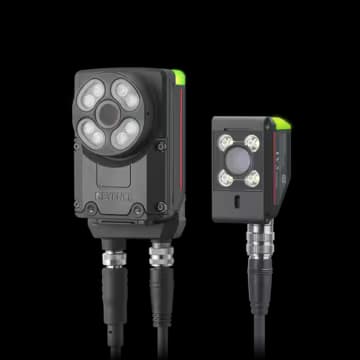
- IV3-Navigator PC software on Windows 7 / 10 / 11 (Home / Pro / Enterprise). Optional external IV3-CP50 control panel, 5.7-inch TFT colour LCD 640 × 480 px (VGA). No handheld teach device like the Touch Finder.
Omron (handheld pendant at the machine is a real operator win)
Image-processing tools / inspection items
Omron- Omron FQ2
- Search, Shape Search II (Omron's rotation-and-scale-tolerant pattern matcher — Keyence / Cognex analogue is PatMax / Shape Trax), sensitive search, area, colour data, edge position, edge pitch, edge width, labelling; up to 32 simultaneous measurements, 32 registered scenes (or "programs"), 360° position compensation, HDR (high dynamic range), filters (colour gray, smoothing, dilate, erode, median, extract-edges)
- Keyence IV3
- Total of 65 inspection tools listed: Learning (AI presence / difference), Outline, Color area, Area, Edge pixels, Color average, Brightness average, Width, Diameter, Edge presence, Pitch, OCR, Color prohibit, Brightness prohibit, Position adjustment, high-speed position adjustment (1-axis / 2-axis edge), Blob count. Up to 128 programs with SD card (32 without).
Keyence on raw tool count and AI-auto-setup; Omron on shape-matching depth (Shape Search II)
OCR / OCV
Tie- Omron FQ2
- Yes — dedicated FQ2-CH series for alphabets, numbers, symbols; OCV via compare-to-reference
- Keyence IV3
- Yes — OCR tool included in the standard IV3 tool set
Tie
1-D / 2-D / DPM code reading
Omron- Omron FQ2
- Yes — FQ2-S4 combined models and dedicated FQ-CR1 (multi-code) / FQ-CR2 (2-D code reader); DPM supported
- Keyence IV3
- Not specified in captured source as a dedicated tool on IV3 (Keyence positions SR-series readers for code tasks — confirm on SKU basis)
Omron (explicit DPM / code-reader depth in family)
Ethernet comms
Competitor- Omron FQ2
- 100BASE-TX / 10BASE-T
- Keyence IV3
- 1000BASE-T / 100BASE-TX (gigabit)
Keyence (gigabit vs 100 Mbit)
Industrial protocols — native
Tie- Omron FQ2
- EtherNet/IP, PROFINET, Ethernet TCP no-protocol, Ethernet UDP no-protocol, Ethernet FINS/TCP no-protocol, PLC (programmable logic controller) Link
- Keyence IV3
- EtherNet/IP, PROFINET, TCP/IP
Omron (PLC Link and FINS/TCP give a clean Omron-to-Omron drop-in; otherwise tie)
Industrial protocols — via option unit
Competitor- Omron FQ2
- RS-232C via FQ-SDU2 Data Unit
- Keyence IV3
- EtherCAT, CC-Link, DeviceNet, RS-232C, PROFIBUS via separate communication units
Keyence (wider fieldbus option list off-the-shelf)
AI (artificial intelligence) / learning-based inspection
Competitor- Omron FQ2
- Not specified in captured source — FQ2 is a rule-based pattern / feature engine (Shape Search II).
- Keyence IV3
- IV3 "Learning" tool — automatic imaging- and detection-condition determination from OK/NG sample images
Keyence (AI auto-setup is the IV3 headline feature)
At a glance
- Category: Standalone industrial smart camera — lens, LED (light-emitting diode) illumination, CMOS (complementary metal-oxide semiconductor) image sensor, and the image-processing CPU (central processing unit) are all inside a single IP67-rated housing. Configured either on an Omron Touch Finder handheld (FQ2-D30 / FQ2-D31, 3.5-inch resistive touch display) or via the free Touch Finder for PC software over Ethernet. Covers inspection (FQ2-S1 / S2 / S3), combined inspection + ID (FQ2-S4), and dedicated OCR (optical character recognition) / code-reading variants (FQ2-CH, FQ-CR1/CR2).
- Typical applications: presence/absence, assembly completeness (screws, caps, gaskets), label-present / label-correct, date-code and lot-code OCR / OCV (optical character verification), 1-D and 2-D code reading incl. DPM (Direct Part Marking), pattern matching on small mechanical assemblies, colour-presence checks, pharmaceutical blister / tablet counting, Swiss watchmaking component-orientation QC (quality control).
- Price positioning: Mid-market. FQ2 sits meaningfully below Keyence IV3 on captured DACH (Deutschland–Austria–Confoederatio Helvetica) list compared like-for-like (IV3 is one of Keyence's premium-priced families and requires a PC or separate IV3-CP50 control panel — the FQ2 Touch Finder is often bundled into SSC (Swiss Solution Center) quotes). Also below Cognex In-Sight 2000 on the mid-resolution side; above Banner iVu.
- Headline selling point: The Touch Finder — a physical handheld teach pendant with a colour touchscreen that lets a maintenance technician retrigger, rerun, review NG (no-good) images and edit the inspection live at the machine, without a laptop, without a PC software install, without an Ethernet dongle, without Windows drivers. Keyence's IV3 equivalent is a PC-based tool (IV3-Navigator, Windows 7/10/11) or the optional IV3-CP50 external VGA control panel. The Touch Finder is the single biggest operator-facing differentiator in this comparison.
Key specifications
DACH-standard output is PNP (positive-switching). Both families offer PNP and NPN. The primary comparison is therefore Omron FQ2-S2 series (standard-resolution inspection, PNP, integrated lens and light) vs Keyence IV3-500CA / IV3-500MA (standard field-of-view smart camera, colour / monochrome, PNP output selectable).
Where Omron wins
- Touch Finder handheld pendant at the machine. A line operator or maintenance tech can walk up with the Touch Finder clipped to a belt, tap the screen, see the last 100 images, retrigger, re-teach, save to SD, swap scenes — all without a laptop. Keyence's IV3 equivalent is either a Windows PC running IV3-Navigator (which means somebody has to carry a laptop, match Windows versions, possibly deal with IT's domain policy on USB / Ethernet) or the separately-ordered IV3-CP50 control panel that is typically panel-mounted, not handheld. On real DACH shop floors — three-shift operation, maintenance turnover, multiple languages — the Touch Finder is a genuine cost-of-ownership advantage.
- One Touch Finder drives up to 32 cameras. A printing-and-packaging cell with three inspection stations, a date-code OCR, and a 2-D code reader on the carton outfeed is one FQ2 fleet, one Touch Finder. Keyence's setup software is also multi-sensor but requires the PC to be online on the same subnet; the Touch Finder is point-and-shoot.
- Shape Search II pattern matcher. Omron's rotation- and scale-tolerant shape-based search is closer in behaviour to Cognex PatMax than to Keyence IV3's outline tool. For registered pattern matching on mechanical parts (flanges, stamped brackets, PCB (printed circuit board) fiducials, watch-movement components, needle-bearing orientation), Shape Search II handles partial occlusion and reflection noise more predictably than the IV3 outline tool. Keyence's own answer to this class of problem is the higher-tier CV-X / XG-X systems — i.e. a product-line jump, not an IV3 capability.
- Broader code-reading / DPM depth in the same family. FQ2-S4 combines inspection and ID (identification) in one SKU, and the FQ-CR1 / FQ-CR2 dedicated readers share the Touch Finder, accessories, and lighting with the inspection models. Users on devicebase.net note that IV3 carries an OCR tool but Keyence positions the SR-series handhelds / fixed readers for serious code-read jobs — another product-line jump.
- PLC-Link / FINS support for Omron PLC environments. On a Sysmac NX / NJ platform, the FQ2 drops in via FINS/TCP with no middleware — no EDS (electronic data sheet) / GSDML (general station description markup language) file dance. A Keyence IV3 into an Omron Sysmac still works (EtherNet/IP), but has more glue. Reverse is true on Keyence PLC environments — be honest in mixed shops.
- Documented I/O count and storage / vibration figures. FQ2 ships with 7 in / 3 out (expandable to 24 via SDU) and documented 10–150 Hz / 0.35 mm vibration resistance and −25 to +65 °C storage on the public spec sheet. IV3 public specs do not enumerate these in captured form — a small but real machine-builder concern for declaration-of-conformity paperwork.
- Touch Finder for PC is free. The identical Touch Finder interface is available as free PC software download — no IV3-Navigator-style paid / licensed chain on the configuration side.
Where Keyence wins
- AI auto-setup is genuinely impressive. The IV3 "Learning" tool ingests a handful of OK and NG images and auto-picks imaging conditions (exposure, gain, lighting mode) and detection features. For a maintenance tech doing a simple presence / absence check on a new part variant, this is measurably faster than walking through Shape Search II's teach-and-threshold flow on the FQ2. A Vision Systems Design-era piece and Keyence marketing both centre the AI story; it is real, not marketing fluff. Concede on the core easy-case flow; move the conversation to the tool depth needed once the problem is non-trivial.
- Higher base resolution on the whole range. IV3 is 1 280 × 960 across every smart-camera and remote-head SKU. FQ2 standard (S2) is 752 × 480, and you have to step up to FQ2-S3 / S4 or the 1.3 Mpx C-mount variants to match. For small-feature measurements — e.g. µm-level (micrometre) bead-width checks or fine-pitch pin counting — the IV3 standard SKU meets the spec where the FQ2 standard SKU does not.
- Gigabit Ethernet. IV3 runs 1000BASE-T; FQ2 is 100BASE-TX. In practice, for a single-camera PLC interlock the gap is immaterial. But a packaging line that wants to log every image for batch traceability, or a recipe changeover that pushes dozens of scenes and reference images, is faster on the IV3.
- Broader fieldbus option list off-the-shelf. IV3's optional communication units cover EtherCAT, CC-Link, DeviceNet, RS-232C and PROFIBUS in addition to the native EtherNet/IP / PROFINET / TCP. FQ2 needs EtherNet/IP or PROFINET for the top-tier fieldbuses (good coverage, but fewer off-the-shelf gateway options).
- Amplifier-separated (remote-head) form factor. IV3-G120 amplifier + IV3-G500/G600 remote sensor head splits the camera body from the electronics — useful in tight fixtures, on a robot end-effector, or where ambient temperature at the camera is outside the amplifier's rating. FQ2 is all-in-one only; a remote-head FQ2 equivalent does not exist in the same family.
- Wider supply-voltage tolerance on the smart camera. IV3 smart camera is 24 VDC +25 % / −20 % (i.e. ≈ 19.2–30 V). FQ2 is 21.6–26.4 V. On a noisy 24 V rail that sags under contactor pull-in, the IV3 is slightly more forgiving.
- Sales-engineering cadence in DACH. Same as the E3Z card: Keyence's DACH field presence is historically strong. A customer who is used to a Keyence rep at the plant within the week may experience Omron response as slower. Counter with a concrete site-visit cadence and an SSC (Swiss Solution Center) demo-hardware commitment, not a marketing line.
Typical objections & responses
Researched from PLCtalk, Practical Machinist, devicebase.net (the IV3 dedicated user forum) and Vision Systems Design. Each objection is tied to a source type so you know it's real, not invented.
- "The IV3 is the easiest vision sensor to set up — the AI does it for us." (Strongest and most common pro-Keyence statement in DACH.) → Concede on the simple case. Answer: "On a straight presence / absence check with stable lighting, you're right — IV3's AI auto-setup is fast. Where it gets interesting is the second inspection on the same line: rotation, scale change, partial occlusion, reflective surfaces. That's where Shape Search II on the FQ2 is more predictable, and where IV3 customers on PLCtalk have reported hitting a ceiling — one Keyence IV user on PLCtalk wrote the IV is 'a bit limited' and 'was not up to more than three tests within a 100 ms trigger window'. Let's pick your hardest inspection and run it on both."
- "IV3 is more accurate / higher quality." → Don't argue the reputation. Do argue the data. A PLCtalk user specifically on the IV series wrote: "I have a lot of trouble with accuracy and repeat-ability to find good and bad parts with these cameras and feel like they aren't adequate for their application." Response: "On the tool set that matters for pattern-based parts — rotation-tolerant matching, sub-pixel edge — the FQ2 Shape Search II and the FQ2-S3 / S4 high-res variants are in the same accuracy class. Keyence's own marketing points you to CV-X when you push IV3 — that's a ≥ 3× price jump. On FQ2 we handle that inside the same family."
- "We'd rather set up from a PC — Navigator is fine." → For an engineer, fair. For a line operator or maintenance tech at 02:00 on a B-shift with a failed inspection, a handheld Touch Finder beats IT-approving a laptop. Response: "Ask your plant-floor team whether maintenance carries a laptop to every cell. In most DACH plants the answer is no. The Touch Finder is a radio-sized pendant, clipped to the belt, no Windows updates, no domain policy. Different tool for the shop floor vs. the engineering office."
- "IV3 has gigabit Ethernet; FQ2 is only 100 Mbit." → True. Response: "For a single PLC-triggered inspection per part, 100 Mbit is not the bottleneck — the shutter and the processing pipeline are. For image-logging into an MES (manufacturing execution system) across dozens of cameras, yes, IV3's gigabit helps. If that's your actual bottleneck, we should be talking about the FH / FHV series, not FQ2. Pick the right product line before we optimise comms."
- "Your image processing is rule-based; theirs has AI." (Marketing line Keyence leans on hard.) → Acknowledge, then qualify. Response: "IV3 Learning is a presence / difference classifier — it's genuinely good at 'does this part look like OK examples'. It is not a measurement tool. Anything that returns a number — bead width, gap, angle, position, pin count, pitch — runs on measurement algorithms on both products. And our Shape Search II is deterministic: when a QA (quality assurance) auditor asks why a part was rejected, we can point to a match score and a feature. AI-classifier outputs are harder to defend in a regulated environment — pharma, med-device, automotive IATF (International Automotive Task Force) 16949."
- "IV3 Navigator handles 128 programs; FQ2 only 32." → Real spec difference. Response: "32 scenes plus 1 000 touch-operations-rated Touch Finder covers the practical recipe count for most single-line installations — dozens of SKUs on one FQ2 is normal. When you need more than 32 active inspections, you're usually also past what a vision sensor should be doing — that's an FH / FHV conversation."
- "Keyence post-sales service is better." (DACH-specific — see the E3Z card for the full counter.) → Use the same two-part answer: Keyence pre-sales is aggressive, post-sales is mixed — Practical Machinist has a much-cited thread on a customer who bought roughly USD 75 000 of Keyence hardware and was told to hire an integrator. Counter with a written SSC response-time commitment.
- "We're on Keyence PLCs (KV-7500 / KV-8000) — IV3 is a one-cable fit." → Valid on the Keyence-PLC side; do not fight it, redirect. Response: "If your PLC architecture is standardised on Keyence, I won't argue the comms story. Where FQ2 lands cleanly is on Omron NX / NJ, Siemens S7 (PROFINET), Rockwell CompactLogix / ControlLogix (EtherNet/IP). On a greenfield line where the PLC is also open, we should pair FQ2 + Sysmac and take the integration cost out of the project."
- "Price is lower on Keyence." (Rarely true in DACH on IV3 specifically.) → Keyence IV3 is a premium-priced family in DACH. Response: "Pull the IV3 quote — full kit: smart camera + IV3-Navigator licence chain + IV3-CP50 if they specified one + lighting unit. Then compare to an FQ2-S + FQ2-D30 Touch Finder + lighting. The FQ2 quote on a like-for-like colour standard-view is typically lower. Also ask for 3-year spares pricing in writing — Keyence catalogue churn (PLCtalk) is a real TCO (total cost of ownership) factor."
The switch story
Most IV3 installs in DACH land in one of three slots: (1) a presence / absence or "is-the-label-on" check where the AI auto-setup shines; (2) a colour or outline-based sort that anyone could do; (3) an OCR date-code on pharma or food packaging. IV3 handles all three well enough — do not pretend otherwise.
The commercial opening comes from the second inspection. The moment a customer asks for a rotation-tolerant pattern match, a dimensional measurement with sub-pixel edges, reflective-surface handling, partial-occlusion tolerance, or a code-plus-inspection combo in one camera, IV3 starts to run out of room. Keyence's playbook at that point is to propose CV-X / XG-X — which is a 3–5× list-price jump and usually a separate controller. FQ2 keeps those cases in the same family (FQ2-S3 / S4, FQ-CR, FQ2-CH), on the same Touch Finder, with the same wiring.
Second opening: the operator experience. Swiss and South-German machine-builders sell machines that run three shifts, in four languages, with maintenance technicians who rotate. The Touch Finder handheld is not a spec-sheet feature — it is a training-and-spares story. One pendant, one interface, no PC, no domain policy. Pitch this in the production-manager conversation, not the engineering-manager conversation; production hears it instantly.
Third opening: Omron PLC alignment. Where the customer runs Sysmac NX / NJ, FQ2 drops in via FINS/TCP and EtherNet/IP with pre-built function blocks. Closing speed on a bundled Sysmac-plus-vision project is the strongest argument against a standalone Keyence sensor.
Where a customer is genuinely doing a single-inspection presence / absence on a well-lit, well-fixtured station and they want zero-setup-time — be honest, the IV3 AI flow is genuinely fast. Bringing an FQ2 there forces the customer into a teach-and-threshold cycle that the IV3 avoids. Don't fight a one-inspection presence-check on AI setup time. Fight the second inspection.
Application examples
- Cap-present / cap-correct on a PET (polyethylene terephthalate) bottling line. FQ2-S2 colour (350 k pixel), standard field of view, PNP. Shape Search II on the cap profile + colour-area check for the tamper band. Touch Finder mounted at the reject-divert for operator trigger-rescue. Direct replacement for IV3-500CA with Learning tool.
- Pharma blister-pack tablet count and colour check. FQ2-S3 high-res (760 k pixel) monochrome + external FQ-LX ring light. Labelling tool for blob count, colour-data tool for tablet presence on colour variants. Documented shutter range (1/60 000 s) helps on fast index-and-flash lines.
- Date-code / lot-code OCR on a folding-carton outfeed. FQ2-CH (dedicated OCR variant) with alphabets / numbers / symbols. Touch Finder mounted at end-of-line so the packaging operator can tap through the last 100 codes during a changeover. IV3's OCR is also competent — differentiator is Touch Finder, not OCR engine.
- Carton barcode + contents inspection in one camera. FQ2-S4 combined inspection + ID, colour or monochrome per line. One cable, one Touch Finder, one scene set. IV3 does not have a single-SKU inspection + ID equivalent in the same package — customer would add a Keyence SR code reader.
- DPM (Direct Part Marking) 2-D code read on a machined metal part. FQ-CR2 2-D code reader from the same FQ family; shares Touch Finder and lighting with the FQ2. IV3's code-read performance on DPM is not called out on the captured spec — typical Keyence answer is the SR series, i.e. a family jump.
- Screw / fastener presence on a Swiss watch-movement carrier. FQ2-S3 high-res monochrome + FQ2-WLF coaxial LED lighting (small-part, reflective metal). Shape Search II for screw-head pattern, 360° position compensation for jig tolerance. For the Swiss watchmaking customer-base (Bienne / Biel, Le Locle, La Chaux-de-Fonds, Grenchen), the fine-feature and small-FOV variants are the decisive piece.
- Label present + label orientation on a Nestlé / Emmi / Ricola packaging line. FQ2-S2 colour + diffuse light. Colour-data tool for print presence, edge-position for label skew. Touch Finder mounted at the line-operator desk for changeover re-teach.
- Bottle-fill-level check on a beverage line. FQ2-S2 colour, backlight across the bottle, edge-pitch tool on the meniscus. For cold-product or high-speed fillers above 1 000 bottles/min, concede to a laser-profile or photoelectric-array solution and stop forcing vision.
- Connector pin-presence and pin-pitch on a wire-harness assembly cell. FQ2-S3 high-res monochrome, telecentric external lens on C-mount variant. Edge-pitch + edge-position tools. On pin counts above ~30 at fine pitch, reach for FH / FHV.
- PCB fiducial detection for a robot pick-and-place cell. FQ2-S3 high-res with Shape Search II on the fiducial cross. Hand the XY (cartesian) offset to the robot via EtherNet/IP or FINS/TCP. Deterministic feature-based result — easier to defend to a QA auditor than an AI classifier.
- Weld-nut presence on a stamped automotive bracket. FQ2-S2 colour + angled LED. Shape Search II for the nut outline plus area tool. IATF-16949-aware customers prefer deterministic outputs; pitch the audit-trail angle.
- Food-packaging date-code verification (Haribo / Lindt / Ovomaltine class). FQ2-CH OCR variant, Touch Finder at end-of-line, EtherNet/IP into the line PLC. Operator retriggers NG cases from the pendant — this is the kind of line where the Touch Finder's maintenance-friendliness pays back fastest.
- Pharma tube / vial stopper-colour check. FQ2-S2 colour + ring light. Colour-data and brightness-prohibit tools. Touch Finder for audit-ready image logging via SD card. Pair with FQ-CR2 on the carton for code read; one family, one pendant.
- Small-assembly orientation check on an intralogistics sortation. FQ2-S2 colour wide-view variant + ambient-light tolerant shutter. Shape Search II for orientation. Pair with E3Z photoelectric for trigger.
Sources
- Omron FQ2 product page (Europe) —
https://industrial.omron.eu/en/products/fq2, fetched 2026-04-20. Used for: model variants (S1 / S2 / S3 / S4, CH, FQ-CR1, FQ-CR2), CMOS resolution tiers (350 k / 760 k / 1.3 Mpx), shutter range (1/250 to 1/60 000 s with lighting), communications (EtherNet/IP, PROFINET, PLC Link, FINS/TCP, TCP/UDP), Touch Finder FQ2-D30 / D31 specifications (3.5-inch TFT, 320 × 240 px, resistive touch, 32-sensor multiplex), environmental specs (IP67 sensor / IP40 Touch Finder, 0–40/50 °C operating, −25 to +65 °C storage, 10–150 Hz / 0.35 mm vibration), supply (21.6–26.4 VDC, 2.4 A sensor + 0.2–0.4 A Touch Finder), weights (~150–160 g sensor, ~270 g Touch Finder), image-processing tools (Search / Shape Search II / sensitive search / area / colour data / edge tools / labelling, HDR, 32 simultaneous measurements, 32 scenes), I/O (7 in / 3 out, expandable to 24 out via FQ-SDU2). - Omron FQ2 datasheet / brochure (note) — the Omron EU public product page references a "FQ2 Brochure" and "FQ2-S/CH Smart Camera Users Manual" (≈ 27 MB PDF) at
https://files.omron.eu/downloads/latest/, but no Omron FQ2 PDF is currently stored in this repo'spdfs/omron/(onlye2e-next.pdf,e3z.pdf,g9sa.pdfare present as of 2026-04-20). Flagged in Open questions. - Keyence IV3 specs page (US) —
https://www.keyence.com/products/vision/vision-sensor/iv3/specs/, fetched 2026-04-20. Local snapshotpdfs/keyence/iv3-specs.html. Used for: model list (IV3-400 / 500 / 600 smart cameras, IV3-G120 amplifier + IV3-G500/600 remote heads), 1 280 × 960 CMOS across range, FOV table, minimum installation distance, 65-tool inspection list, 128 programs (with SD), 24 VDC supply tolerance, 3.3 A / 1.8 A current, 1000BASE-T / 100BASE-TX Ethernet, EtherNet/IP / PROFINET / TCP/IP native, EtherCAT / CC-Link / DeviceNet / RS-232C / PROFIBUS via comm units, IV3-Navigator Windows 7 / 10 / 11, IV3-CP50 5.7-inch VGA control panel, IP67, 0–50 °C operating, 35–85 % RH. - Keyence IV3 product page (features) —
https://www.keyence.com/products/vision/vision-sensor/iv3/— AI Learning tool description, positioning narrative (presence / difference checking). - Objections research:
- PLCtalk thread "Keyence IV Series Vision Sensor Vs Cognex Insight Series" (
https://www.plctalk.net/forums/threads/keyence-iv-series-vision-sensor-vs-cognex-insight-series.110248/) — quotes about IV being "a bit limited" on inspection tools and "was not up to more than three tests within a 100 ms trigger window". - PLCtalk thread "Keyence IV series vision" (
https://www.plctalk.net/threads/keyence-iv-series-vision.82684/) — user quote about accuracy and repeatability problems with the IV series on OK/NG part classification. - devicebase.net IV3 community questions (
https://devicebase.net/en/keyence-iv3-series/questions) — referenced for PoE (Power over Ethernet) power-budget limitations and transistor/SSR (solid-state relay) combined-output malfunction reports. - Practical Machinist post-sales-support thread (carried over from the E3Z card objections research, cited for the general Keyence support-after-install pattern).
- Vision Systems Design on smart-camera positioning (
https://www.vision-systems.com/cameras-accessories/article/16737657/smart-cameras-challenge-host-based-systems-in-industrial-applications).
- PLCtalk thread "Keyence IV Series Vision Sensor Vs Cognex Insight Series" (
Open questions
- FQ2 datasheet PDF not in repo.
pdfs/omron/contains onlye2e-next.pdf,e3z.pdf,g9sa.pdf. Download the FQ2-S/CH users manual (≈ 27 MB) fromhttps://files.omron.eu/downloads/latest/and the FQ2 brochure topdfs/omron/fq2.pdfon day 1 so later battle cards can cite page numbers the same way the E3Z card citesCSM_E3Z_DS_E_18_10. - FQ2 response time / throughput headline figure. The public page does not give a single cycle-time number — it is tool-chain- and shutter-dependent. Pull a typical "Shape Search II + one edge tool + 1 I/O output" benchmark from Omron SSC internal benchmark sheets to counter IV3's "128 programs / fast" marketing.
- FQ2 list pricing vs IV3-500CA in DACH. Claimed "meaningfully below" above based on general DACH Keyence premium positioning; verify with Omron Swiss price matrix vs a live IV3 quote. This is the single highest-leverage number in a competitive meeting.
- IV3 AI model retraining cycle. IV3 Learning stores OK/NG image sets; unclear from the captured spec how the AI model behaves on production-drift (seasonal lighting, carton supplier change). Ask a Keyence customer directly in the next visit. If retraining is painful in the field, that is a valuable counter-talking-point.
- FQ2 UL / cULus (Underwriters Laboratories / Canadian UL) status per SKU. Not listed on the public product page. Confirm with Omron product management — relevant for any customer whose machines ship to North America.
- Omron SSC (Swiss Solution Center) contractual support-response SLA (service-level agreement). Same open question as the E3Z card — the customer-support objection is where Keyence concedes the least, and a concrete counter-promise is the strongest answer.
- Shape Search II vs Shape Search III versioning. A couple of Omron DACH marketing pages reference "Shape Search III" on current FQ2. The public EU product page uses "Shape Search II". Confirm with product management which is current on FQ2 firmware shipping today, and update the spec table accordingly.
- Keyence IV3 price reality check. Captured research gives capability and positioning; IV3 list price is not public (Keyence gates pricing). Pull a current IV3-500CA quote from an independent DACH integrator or a Keyence-to-Omron churn account before the next customer meeting.
- Touch Finder discontinuation risk. Omron has published Touch Finder as a long-running accessory; verify lifecycle status on FQ2-D30 / FQ2-D31 before recommending it in a new OEM machine design, since a Touch-Finder-dependent install is brittle if the pendant goes end-of-life.
Before you leave — retrieval check
Customer says
“The IV3 is the easiest vision sensor to set up — the AI does it for us.”
Source battlecards/sensors/fq2.md