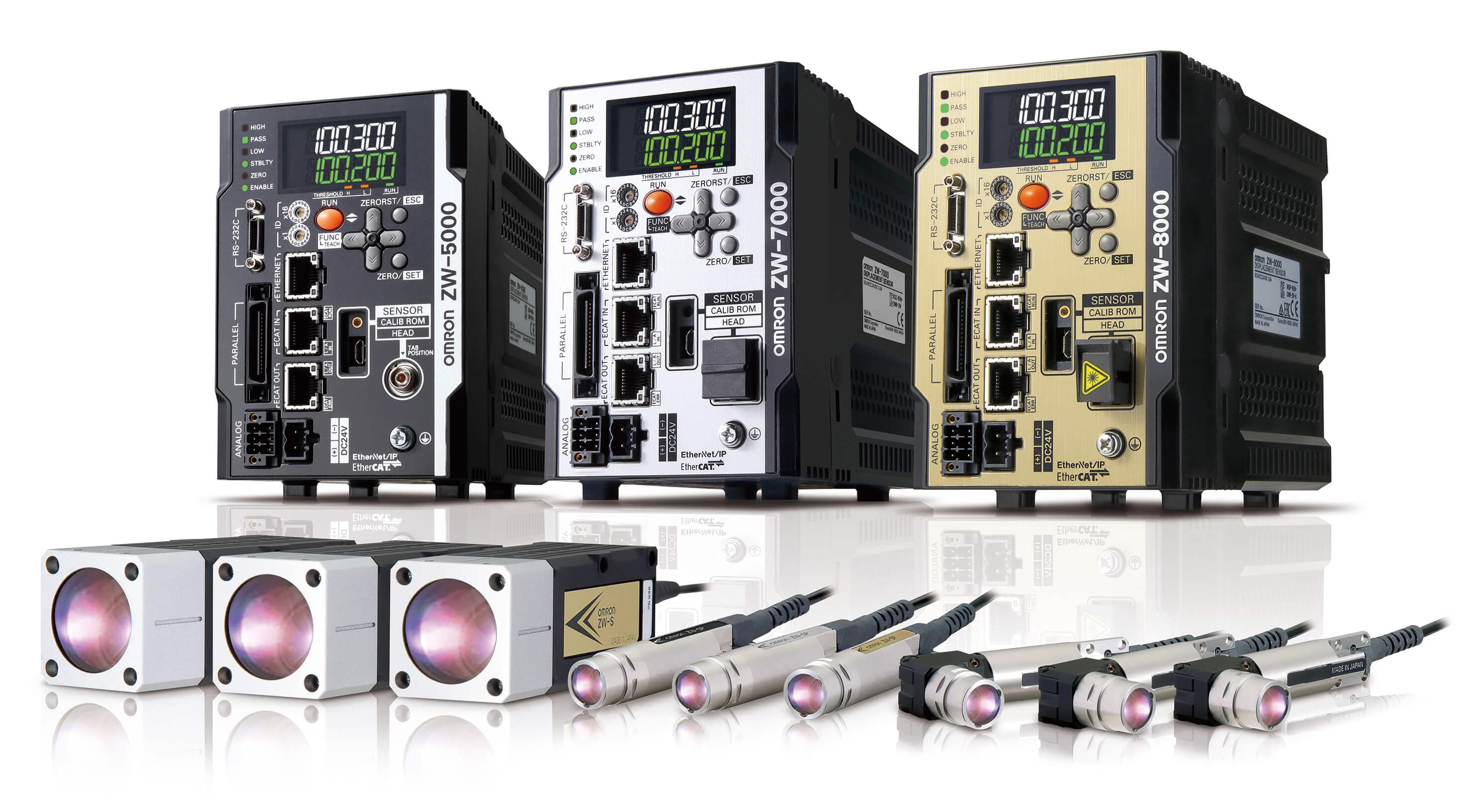
Omron ZW-S
Confocal fibre displacement sensor (1D point-laser)
Reference mode — everything visible. Use for live calls.
Three things to remember
Static resolution
0.25 µm (micrometre) across ZW-S head range
Omron (0.25 µm vs 0.3–0.5 µm for comparable FOV head)
Linearity
±0.3 µm regardless of material (Omron-standard mirror target)
Omron on narrow-range, material-independent
Headline
Material-independent sub-micron measurement that works on glass.
Key specifications
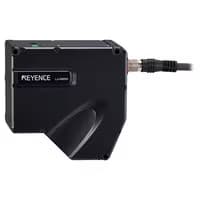
29 rowsColumns compared: Omron ZW-S (ZW-7000 controller + ZW-S7xxx head, EtherCAT default) vs Keyence LJ-X8000 (LJ-X8000E controller + LJ-X80xx head)
Sampling rate / response time
Competitor- Omron ZW-S
- ZW-7000 sampling interval range 500 µs (microseconds) to 100 ms; "as fast as 20 µs" response cited on marketing pages for ZW-SQ sensor-head variant — verify for ZW-S head specifically
- Keyence LJ-X8000
- 2 kilohertz (kHz) in 2D mode (i.e. 500 µs/line) on LJ-X8000E, 16 kHz (63 µs/line) in 3D mode with LJ-X8000 heads, up to 64 kHz (16 µs) when LJ-V7000-series heads are connected
Keyence (8–30× faster profile rate)
Measurement range (Z, height)
Competitor- Omron ZW-S
- ZW-S7010: 10 mm ± 0.5 mm. ZW-S7020: 20 mm ± 1 mm. ZW-S7030: 30 mm ± 2 mm. ZW-S7040: 40 mm ± 3 mm.
- Keyence LJ-X8000
- LJ-X8020: ±2.2 mm (F.S. 4.4 mm) up to LJ-X8900: ±400 mm (F.S. 800 mm)
Keyence (broader top-end range)
Static resolution
Omron- Omron ZW-S
- 0.25 µm (micrometre) across ZW-S head range
- Keyence LJ-X8000
- Z-axis repeatability 0.3 µm (LJ-X8020), 0.5 µm (LJ-X8100), up to 10 µm (LJ-X8900) — measured by averaging 4 096 captures at reference distance
Omron (0.25 µm vs 0.3–0.5 µm for comparable FOV head)
Spot size / field of view (FOV)
Omron- Omron ZW-S
- Point: 4 µm spot (ZW-S8010) up to 190 µm (ZW-S-series broader heads). Single-point.
- Keyence LJ-X8000
- Laser-line: approx. 16 mm × 32 µm (LJ-X8020) up to approx. 622 mm × 566 µm (LJ-X8900) at reference distance
Different — Omron = precision point, Keyence = wide line
Supply voltage (controller)
Tie- Omron ZW-S
- 24 VDC ±10 % (verify per controller revision in datasheet)
- Keyence LJ-X8000
- 24 VDC ±10 % (LJ-X8000E controller)
Tie
Controller interface — analog output
Omron- Omron ZW-S
- Available (analog voltage / current per ZW family — verify per controller SKU in Q261)
- Keyence LJ-X8000
- Separate controller required — LJ-X8000 is fundamentally a digital-profile product
Omron (native 4–20 mA / 0–10 V single-point output)
Weight (head)
Omron- Omron ZW-S
- Not specified in captured source (ZW-S straight heads are typically 50–150 g plus fibre cable)
- Keyence LJ-X8000
- Approx. 1 000 g (LJ-X8020) to 1 600 g (LJ-X8900). Significantly heavier because the 2D line-profile optics and CMOS imager are all inside the head.
Omron (lighter head by 5–10×)
Fibre-optic advantage (cable run, electromagnetic interference [EMI] environments)
Omron- Omron ZW-S
- Fibre-coupled head: immune to electromagnetic and radio-frequency interference along the cable, safe around welders, induction furnaces, high-frequency (HF) motors. Standard fibre length 2 m.
- Keyence LJ-X8000
- Electrical sensor cable with shielded copper conductors — susceptible to EMI if routed near VFDs (variable-frequency drives) or weld guns without proper shielding and grounding.
Omron
Laser-safety classification
Omron- Omron ZW-S
- Not specified in captured source for the ZW-S summary page; confocal white-light heads are typically class 1 (eye-safe) but verify per head
- Keyence LJ-X8000
- Class 2M on most LJ-X8000 heads, class 3R on LJ-X8030. All require protective eyewear and laser-curtain interlocks in shared workspaces.
Omron (almost certainly lower class — confirm)
Certifications
Tie- Omron ZW-S
- EtherCAT certified; CE / RoHS (Restriction of Hazardous Substances) expected on datasheet — verify per controller
- Keyence LJ-X8000
- IEC 60825-1, FDA (CDRH) Part 1040.10
Both to verify per SKU
Primary head models (DACH)
- Omron ZW-S
- ZW-S7010 (10 mm), ZW-S7020 (20 mm), ZW-S7030 (30 mm), ZW-S7040 (40 mm) straight heads; ZW-SP7007 / SP7010 compact; ZW-SPR7007 / SPR7010 right-angle
- Keyence LJ-X8000
- LJ-X8020 (short-range), LJ-X8030, LJ-X8060, LJ-X8070, LJ-X8080 (small-field-of-view); LJ-X8100, LJ-X8200, LJ-X8300, LJ-X8400, LJ-X8900 (wide-field-of-view up to 622 mm)
—
Controllers
- Omron ZW-S
- ZW-8000 (ultra-precision), ZW-7000 (high-speed), ZW-5000 (standard)
- Keyence LJ-X8000
- LJ-X8000E (standard), LJ-X8002 (high-end), LJ-X8000A (head-only / OEM)
—
Light source / wavelength
- Omron ZW-S
- White laser / white light emitting diode (LED) confocal. Published wavelength / laser class: Not specified in captured source (Omron public ZW-S page does not publish laser class on the summary).
- Keyence LJ-X8000
- Blue semiconductor laser, 405 nm visible. Laser class 2M on most heads (IEC 60825-1), class 3R on LJ-X8030 (50 mW)
—
Profile data per scan
Competitor- Omron ZW-S
- 1 point per sample (it's a point sensor)
- Keyence LJ-X8000
- 3 200 points per profile line
Keyence (by definition)
Linearity
Omron- Omron ZW-S
- ±0.3 µm regardless of material (Omron-standard mirror target)
- Keyence LJ-X8000
- ±0.013 % to ±0.05 % of full scale, Z-axis, Keyence standard target. On a ±2.2 mm range LJ-X8020 this is ~±2 µm F.S. (±0.5 µm typical for good data).
Omron on narrow-range, material-independent
Surface-tilt tolerance
Omron- Omron ZW-S
- Up to ±25° on shiny / mirror surfaces (confocal advantage)
- Keyence LJ-X8000
- Tilt tolerance varies with specular content; HDR single-shot helps but mirror-tilt angles above ±5–10° typically require head realignment
Omron
Transparent-film / glass measurement
Omron- Omron ZW-S
- Native two-surface thickness measurement in a single reading (confocal principle)
- Keyence LJ-X8000
- Requires dedicated transparent-target algorithm; reliable only on sufficiently diffuse surfaces or with specific head selection
Omron
Controller interface — EtherCAT
Omron- Omron ZW-S
- Native on ZW-7000 / ZW-5000 / ZW-8000 controller (Omron is an EtherCAT Technology Group member since day one; certified). Published conformance is with Beckhoff-licensed ET1100.
- Keyence LJ-X8000
- Optional via external CB-NEC20E EtherCAT unit — not in the base LJ-X8000E controller. Mutually exclusive with EtherNet/IP and PROFINET. Process-data-object max 536 bytes input / 532 bytes output.
Omron (native)
Controller interface — EtherNet/IP
Competitor- Omron ZW-S
- Not specified in captured source on public ZW-S summary — confirm in Q261 datasheet / communications manual Z363
- Keyence LJ-X8000
- Native on LJ-X8000E Ethernet port; cyclic max 1 436 bytes, 32 connections
Keyence (native)
Controller interface — PROFINET
Competitor- Omron ZW-S
- Not specified in captured source — Omron ZW historically requires a Sysmac-NX gateway block for PROFINET
- Keyence LJ-X8000
- Native on LJ-X8000E Ethernet port (or dedicated CB-NPN20EA PROFINET unit); cyclic max 1 408 / 1 252 bytes
Keyence
Controller interface — RS-232C
Tie- Omron ZW-S
- Native, up to 115 200 bps
- Keyence LJ-X8000
- Native, exclusive with EtherNet/IP when used on the Ethernet port
Tie
Integration with Omron Sysmac (NJ / NX) PLC
Omron- Omron ZW-S
- Native. Single cable, Sysmac Studio function blocks, variable mapping by tag. One controller, one licence, one vendor for service.
- Keyence LJ-X8000
- Via EtherNet/IP or EtherCAT from the LJ-X8000E — works, but every value and every diagnostic has to be hand-mapped, and firmware revisions on the Keyence side require coordinated re-testing in Sysmac Studio.
Omron
At a glance
Read this first — category mismatch. The ZW-S is not a like-for-like competitor of the Keyence LJ-X8000. The LJ-X8000 is a two-dimensional (2D) line-profile laser — it projects a laser line across the target and returns 3 200 height points across that line, 16 kHz per frame. The Omron ZW-S is a one-dimensional (1D) confocal fibre displacement sensor — it projects a single point and returns a single distance value, up to 2 kHz. Omron's closest true 2D laser-profile counterpart in DACH is the Omron ZG2-WDC11 / ZG-WDC line-profile family (separate card). This card is for the very common scenario in DACH where a customer has specified an LJ-X8000 but the application is actually a single-point height, thickness, gap, step, or run-out measurement — where a confocal point sensor is the correct, substantially cheaper tool and the 2D profile is unnecessary.
- Category: Confocal fibre displacement sensor (point / 1D). Three controller families — ZW-8000 (ultra-high precision), ZW-7000 (high-speed), ZW-5000 (standard) — paired with interchangeable sensor heads in straight (ZW-S), compact pencil (ZW-SP) and right-angle (ZW-SPR) form factors.
- Typical applications: semiconductor wafer height, printed circuit board (PCB) component height and coplanarity, glass / transparent-film thickness (two surfaces in one reading thanks to the confocal principle), smartphone-cover lens flatness, medical-tube wall, precision-machined shaft run-out, lens curvature in optics, battery-can groove depth.
- Price positioning: Materially below LJ-X8000 in DACH. A ZW-S head + ZW-7000 controller typically lands in the low-to-mid four-figure EUR range per channel. An LJ-X8000 head + LJ-X8000E controller routinely clears five figures per channel once a Keyence quote is issued. The exact multiple depends on the head pair, but Keyence quote letters in the EUR 15 000 – 30 000 range for a single-head LJ-X8000 system are widely reported.
- Headline selling point: Material-independent sub-micron measurement that works on glass, mirror, black rubber, and transparent film at the same setting, with native EtherCAT (Ethernet for Control Automation Technology) into an Omron Sysmac NJ / NX controller — and none of the complexity or licence cost of a full 2D/3D laser profiler when the application is genuinely 1D.
Key specifications
Most 2D profilers and high-end 1D displacement sensors in DACH ship with an Ethernet-class fieldbus (EtherCAT, PROFINET — Process Field Net, EtherNet/IP) rather than classical PNP (positive-sourcing) switching outputs. The DACH default for the ZW-S is ZW-7000 controller + ZW-S7010 head + EtherCAT; the LJ-X8000 default is LJ-X8000E controller + LJ-X8020 head + EtherNet/IP or PROFINET via the controller's native Ethernet port. PNP external I/O exists on both (trigger-in, laser-off, alarm-out) but is auxiliary to the fieldbus data path.
Where Omron wins
- Right tool for single-point height / thickness measurements. If the customer actually needs one distance value at one spot — bond-line thickness, wafer thickness, o-ring groove depth, lens sag, battery-can step height — the ZW-S solves it with 0.25 µm resolution, ±0.3 µm linearity, white-light confocal material-independence, and no post-processing of a profile line. Paying for an LJ-X8000's 3 200-point profile when only one of those points is used is wasted spec and wasted budget.
- Material independence and surface-tilt tolerance. Confocal white-light reads mirror-polished, brushed, black rubber, and transparent materials on the same setting with up to ±25° of surface tilt. On the LJ-X8000, polished metal and transparent film require head-angle trimming, HDR tuning, or in some cases a different head model.
- Transparent-film / glass thickness in a single reading. The confocal principle returns two peaks from the two surfaces of a transparent layer on one exposure — smartphone cover glass, PET film, optical adhesive bond-lines, medical-tube wall thickness. The LJ-X8000 treats transparency as a failure mode unless carefully configured, and two-surface thickness is not its strength.
- EtherCAT into Omron Sysmac, natively. The ZW-7000 is an Omron-certified EtherCAT slave and exposes measurement, calibration, and diagnostic variables to Sysmac Studio as typed variables. Integration time on an NJ / NX machine is hours, not a sprint. With the LJ-X8000 you are integrating a Keyence EtherCAT slave — it works, but the variable map is Keyence's, documentation is in Keyence's portal, and firmware-revision coordination is a manual two-vendor conversation.
- Lightweight, fibre-coupled head. ZW-S heads are grams; LJ-X8000 heads are 1.0–1.6 kg because the laser, optics, and CMOS imager all live in the head. For end-of-arm tooling on a 6-axis robot or for a flying-head gantry inspection over a narrow-pitch feature, mass and cable EMI both favour the ZW-S. The fibre is also immune to electrical noise along the run, which matters in welding cells and induction-heating lines where the 2D profiler's electrical sensor cable needs meticulous shielding.
- Native analog output. If the customer needs a 4–20 mA or 0–10 V distance signal to an older PLC or a SCADA (Supervisory Control and Data Acquisition) scanner, the ZW-7000 / ZW-5000 controller provides it. The LJ-X8000 is fundamentally digital; analog re-conversion requires an external module.
- Price. The whole conversation. A single-point confocal system is materially cheaper than a 2D profiler + controller + software licence. For genuine 1D applications, quoting an LJ-X8000 is overspec — and Keyence reps, because the LJ-X8000 is a flagship SKU with high margin, tend to push it where a point-displacement sensor would do.
Where Keyence wins
Be honest. The LJ-X8000 is a category-leading 2D/3D laser profiler, and on any application that genuinely needs a full profile line, it beats trying to approximate it with a point sensor.
- It's a different category — and if the application really is 2D, Omron ZW-S does not compete. A weld-seam profile, a rubber-gasket cross-section, a machined slot geometry, a battery-electrode edge, a tyre tread, a coplanarity inspection across a PCB area — these are profile problems. A point sensor cannot solve them. Omron's counter-SKU is the ZG2-WDC line-profile family, not the ZW-S.
- Profile-rate. 16 kHz 3D mode at 3 200 points per line on an LJ-X8000 head is industry-leading. The ZW-S at 2 kHz single-point is not in the same performance regime.
- Wide field of view. LJ-X8900 covers a 622 mm laser line at 980 mm reference distance. The ZW-S has no wide-field option; it is a point sensor.
- Measurement range. LJ-X8900 Z-axis is ±400 mm (F.S. 800 mm). The largest ZW-S is ±3 mm (ZW-S7040). For long-standoff, large-part profile, Keyence wins on range alone.
- Documented environmentals. IP67, 0–45 °C, 10 000 lux ambient, vibration 10–57 Hz / 1.5 mm double amplitude, shock 15 g / 6 ms — all explicitly published on the public LJ-X8000 spec page. On the Omron public ZW-S page, several of these are absent at summary level and have to be pulled from the Q261 datasheet; for a fast comparison in front of a customer, that's a conversational disadvantage.
- HDR (High Dynamic Range) single-shot. Black rubber and glossy chrome on the same part in a single exposure. Real advantage on mixed-material parts. The ZW-S handles that via confocal material-independence rather than HDR, but only at a single point.
- EtherNet/IP and PROFINET on the controller's native Ethernet port. LJ-X8000E exposes both (though exclusive with each other and with RS-232C no-procedure). ZW requires the external fieldbus gateway for PROFINET. In a Siemens-standardised line, that matters.
- Software ecosystem. LJ-Navigator 2 is the most polished laser-profile inspection environment in the industry: pre-built measurement tools, master-profile comparison, drag-and-drop region-of-interest setup, recipe versioning. Omron's CX-ConfiguratorFDT / Sysmac Studio path is capable, but on a profile-heavy inspection task, Keyence's software is measurably faster to first result.
- Field-engineering presence. The LJ-X8000 is a flagship Keyence SKU. Expect a Keyence application engineer on-site with demo hardware same week. Omron DACH field cadence on high-end measurement is improving, but the honest answer is that on a flagship 2D-profile deal, Keyence will be at the customer faster.
Typical objections & responses
Researched from PLCtalk (KEYENCE Products thread, Keyence / Omron / Mitsubishi thread, KEYENCE PLC Experience thread, OT: Overly Persistent Sales People thread), Glassdoor Keyence sales-culture reviews, and Control.com LJ-X8000 coverage. Specific pricing numbers in euros or dollars are not public — Keyence gates prices behind quote requests, and forum quotes for LJ-X8000 systems are scarce and dated. Each objection is tied to a source type so you know it is real, not invented.
- "Keyence is the category leader in 2D laser profiling — why would I buy an Omron ZW-S?" (Accurate positioning — the LJ-X8000 is genuinely class-leading.) → Concede the 2D/3D profile crown. Then reframe: "If you actually need 3 200 height points per line at 16 kHz, the LJ-X8000 is the right tool and we'd propose Omron ZG2 if you want a second quote. What I want to understand is whether your measurement really needs the profile, or whether one distance value at one spot — glass thickness, wafer height, o-ring groove depth — would solve it. Because if it's the latter, paying 15× for the profile is lighting money on fire. That's where ZW-S comes in."
- "Keyence promised us the LJ-X8000 would do [X] and then it didn't." (Recurring theme on PLCtalk — "purchase sight unseen based on pressure from upper management … ultimately failed to work as promised".) → "Ask for a measured feasibility study on your actual part before purchase. On ZW-S we will send a confocal head and a ZW-7000 to your site, measure your specific wafer / glass / rubber / plated part, and hand you the data and repeatability numbers before a purchase order. If Keyence will not do a free in-situ demo on your exact part, that is a risk signal on a five-figure spend."
- "Keyence support is better." (Mixed in forum reports — strong pre-sales, reports of thinner post-sales depth on PLCtalk and Practical Machinist, including the widely cited case of a ~USD 75 000 customer getting ~4.5 hours of hands-on training and then being told to hire an integrator.) → "On a measurement sensor that is part of a Sysmac line, one-vendor escalation matters. When a ZW-7000 throws a diagnostic and the NX PLC sees it, one support call closes the loop. On a Keyence measurement sensor inside an Omron / Siemens line, you have a two-vendor finger-pointing problem on firmware-revision mismatches — and Keyence field engineers often rotate off an account within 12–18 months according to Glassdoor employee accounts of Keyence sales-career cadence."
- "Keyence sales are too aggressive — we don't want to start a relationship." (Very common — PLCtalk's "OT: Overly Persistent Sales People" thread specifically names Keyence; Glassdoor employee reviews describe mandated call and visit quotas.) → Not much to rebut, because it's largely true. Use it. "On Omron DACH you get a named Swiss applications engineer, an agreed on-site cadence, and your downloads don't trigger a two-week call campaign. If you have been downloading Keyence manuals for evaluation and are getting hammered, that's a preview of the post-sale support cadence in the other direction."
- "Keyence's LJ-Navigator software is better than Omron's." (Broadly true on profile-inspection workflows.) → Concede. "For pure profile inspection, LJ-Navigator is faster to first result. For a single-point measurement that has to be plumbed into a Sysmac NJ / NX variable, Sysmac Studio beats it — because the measurement is just another variable in your controller program, not a separate application you have to keep in sync. If the application is genuinely 1D, you're not buying LJ-Navigator, you're paying for it."
- "We already standardised on Keyence across this plant." (Valid lock-in argument.) → "Standardisation is real. But confocal point and 2D laser profile are separate tool families even inside Keyence's own catalogue — they would sell you a CL-3000 or LK-G5000 for a point job, not an LJ-X8000. So the 'standardisation' isn't about LJ-X8000 in particular, it's about Keyence the vendor. The question is whether the single-point tool is genuinely the LJ-X8000 or whether they are upselling you because the LJ-X8000 is a higher-margin SKU for them."
- "The LJ-X8000 has IP67 head, the ZW-S data sheet doesn't even show IP rating on the public summary." → "Fair point on the public summary. Pull the Q261 datasheet — the sensor-head IP rating is published there. For environments that are genuinely wet or splashed, confocal fibre heads are less frequently deployed because fibre-optic connector contamination is an unrecoverable failure mode; that is a real use-case where you would specify the LJ-X8000 or a Keyence LK-G5000. We won't try to win that application."
- "Price on Omron measurement is close to Keyence anyway." (Intermittent — Glassdoor Keyence reviews say their pricing is "a little high"; forum reports are consistent that Keyence is high on the measurement portfolio.) → "Get both quotes. On a ZW-7000 + ZW-S7010 single-head point system vs a LJ-X8000E + LJ-X8020 single-head profile system, we expect to come in at roughly a third of the Keyence quote, plus no LJ-Navigator per-seat licence. If your application is 1D and the quotes are within 20 % of each other, I've lost already and will walk away from that deal."
The switch story
Two openings in DACH, both driven by the same underlying truth: Keyence reps are trained to position the LJ-X8000 for a broad range of measurement tasks because it is a flagship SKU with strong margin and, honestly, because the product is excellent. That means many LJ-X8000 installations are on applications that are genuinely 1D — a single height, a single thickness, a single step — where the 2D profile line is unused.
Opening one — the "you bought a line, you used a point" audit. Walk into the customer's cell and ask which specific measurement outputs of the LJ-X8000 drive a decision in the PLC. In a material share of installations, the answer is one height-at-one-X-coordinate, or two heights for a thickness, or one step. That is a confocal point-sensor application. Propose a ZW-S side-by-side trial: your head next to the LJ-X8000, same PLC trigger, export both datasets for a week, review the repeatability and the cost delta. On a pure 1D application the ZW-S will match or beat on repeatability (0.25 µm static resolution vs 0.3–0.5 µm Z-axis repeatability on a comparable-FOV LJ-X8000 head), beat on material range (±25° tilt, transparent two-surface thickness) and undercut decisively on price.
Opening two — Sysmac-standardised machine builders. An Omron NJ / NX customer running Sysmac Studio who has a Keyence LJ-X8000 in one cell is paying tax: two development environments, two update cadences, two service contacts. On any new machine spec, the ZW-S with native EtherCAT slave drops into Sysmac Studio as typed variables and removes the second vendor. OEMs running their own commissioning favour that integration — machine builders in Swiss and South-German precision manufacturing (watch-component machining, optics, medical devices, battery-electrode inspection) routinely choose single-vendor for this reason.
Where the application is genuinely 2D — weld-seam profile, gasket cross-section, large-part coplanarity, tyre tread, electrode-edge straightness across a 200 mm coupon — do not try to force a ZW-S. Propose the Omron ZG2-WDC line-profile family, or concede the LJ-X8000. Trying to pitch a point sensor into a line-profile need is how you lose the next three deals and the referral behind them.
Application examples
Each of these is an application where the ZW-S is the honest choice over an LJ-X8000, either because the measurement is genuinely 1D or because the integration / cost / environmental constraints favour the Omron product. In the DACH context — Swiss and South-German precision manufacturing, Austrian automotive Tier 1, German battery and semiconductor — these are frequent.
- Smartphone cover-glass thickness, transparent two-surface. ZW-S8010 (10 mm range, 0.25 µm resolution, 4 µm spot) measures top and bottom glass surface in a single confocal reading. The LJ-X8000 handles transparent film inconsistently without dedicated configuration.
- Battery-can groove-depth / bead-height inspection on cylindrical cell manufacturing. ZW-S7020 or ZW-S7030 on a flying-head gantry, triggered by the NJ PLC's index axis, outputs groove depth per cell into Sysmac Studio. The LJ-X8000 would work, but the measurement is a single step height — paying for the full profile is overspec.
- Printed-circuit-board component-height / coplanarity spot check. ZW-S7010 on a pick-and-place reject station. Bond-line, solder-paste step, or component-ride-height at specified X/Y coordinates after placement. 0.25 µm resolution, faster than the PLC cycle, EtherCAT into the machine controller.
- Precision-machined shaft run-out (watchmaking, medical devices). ZW-SPR7007 right-angle head near the spindle, recording distance once per rotation trigger, feeding run-out straight into the NJ statistical process control (SPC) module. Surface is typically polished steel or titanium — confocal reads both without re-tune; laser triangulation would struggle with the polish.
- Medical-tube wall-thickness in-line on extrusion. Transparent tubing, two surfaces, single confocal head. Alternative on the LJ-X8000 is difficult because the transparent material and round geometry together fight laser triangulation.
- Semiconductor wafer height / warpage at a gate position. ZW-S8010 or ZW-S8020 (ultra-precision controller) at a single known X/Y, 0.25 µm resolution, no laser-class-2M eye-safety interlock needed (confocal white-light, typically class 1 — verify per head), clean-room-friendly light source.
- Optical-lens sag / centre-thickness on a QA rig. Confocal white-light handles the curved glass surface at tilt; the single-point 4–190 µm spot ZW-S heads are the standard choice, not a 2D profiler.
- O-ring groove-depth verification on a machined aluminium manifold. One measurement per groove, 0.25 µm resolution, robot-mounted. Lightweight ZW-S head plus fibre cable is end-of-arm-friendly; a 1 kg LJ-X8020 head plus electrical cable is not.
- Welding-cell part-present / seat-seated height check with high EMI. Fibre-coupled ZW-S head is immune to weld-gun-induced EMI along the cable; the electrical LJ-X8000 sensor cable in the same position typically needs shielded conduit and a ferrite strategy to stay clean.
- Retrofit onto an older DACH machine with RS-232C or 4–20 mA input only. ZW-7000 / ZW-5000 controller provides RS-232C at 115 200 bps and native analog. LJ-X8000E is digital-first; analog requires an external module.
- Single-vendor Sysmac NJ / NX machine build (Swiss OEM). EtherCAT slave directly to the Sysmac controller, one support contact, one Sysmac Studio project. Primary decision criterion for machine-builder customers who have already chosen Omron for motion and logic.
- Non-destructive testing (NDT) on black EPDM rubber seals. Confocal white-light is material-independent; black rubber returns enough diffuse reflection for the ZW-S without special tuning. Blue-laser triangulation on LJ-X8000 manages dark surfaces via HDR but adds exposure-per-shot overhead.
Honest stop-list — where we do NOT propose ZW-S over LJ-X8000:
- Any 2D profile need (weld-seam, full cross-section, coplanarity across an area) — propose Omron ZG2-WDC or concede.
- Very wide FOV (>100 mm laser-line) — the ZW-S has no equivalent; the LJ-X8100 / X8900 are the right tools.
- Tyre-tread, rail-head, food-product 3D topology — concede.
- High-speed 2D profile at >5 kHz — concede.
Sources
- Omron ZW series product page — https://industrial.omron.eu/en/products/zw-series (captured 2026-04-20). Source for ZW-S / ZW-SP / ZW-SPR head lineup, ZW-8000 / 7000 / 5000 controller split, 0.25 µm resolution, ±0.3 µm linearity, "as fast as 20 µs" response-time claim, EtherCAT / RS-232C / analog interfaces, 24 VDC supply. The public product-family summary does not publish laser class, IP rating, operating-temperature range, ambient-light tolerance, vibration / shock, or per-head weight at summary level — these sit in the Q261 datasheet.
- Omron ZW-8000 / 7000 / 5000 Datasheet Q261 — https://files.omron.eu/downloads/latest/datasheet/en/q261_zw-8000_7000_5000_series_datasheet_en.pdf (referenced; PDF returned binary content on automated extraction — Julian should open directly and cross-check the spec table rows flagged "Not specified in captured source" in the comparison table).
- Omron ZW-8000 / 7000 / 5000 Communications Manual Z363 — https://files.omron.eu/downloads/latest/manual/en/z363_zw-8000_7000_5000_series_communications_manual_en.pdf (source for EtherCAT, EtherNet/IP, RS-232C details; same caveat as above).
- EtherCAT Technology Group certified-product listing for ZW-8000 / 7000 / 5000 — https://www.ethercat.org/en/products/C660699C3FFA4F29A817671472EB5460.htm (confirms EtherCAT certification).
- Omron ZW-7000 User Manual (ManualsLib mirror) — https://www.manualslib.com/manual/1435445/Omron-Zw-7000-Series.html (fallback text source for sampling interval 500 µs to 100 ms and RS-232C 115 200 bps).
- Keyence LJ-X8000 public specs HTML — local file
pdfs/keyence/lj-x8000-specs.html, captured 2026-04-20 fromhttps://www.keyence.com/products/measure/laser-2d/lj-x8000/specs/. Source for controller models (LJ-X8000E, LJ-X8002, LJ-X8000A), sampling rates (2 kHz 2D, 16 kHz 3D), head FOV and Z-range tables (LJ-X8020 through LJ-X8900), reference distances, measurement ranges, spot sizes, repeatability figures, linearity, profile data interval and count (3 200 points), HDR, laser class (2M / 3R), wavelength 405 nm, IP67, ambient temp 0–45 °C, ambient light 10 000 lux, vibration 10–57 Hz / 1.5 mm, shock 15 g / 6 ms, material (aluminium), weight per head, interface details (EtherNet/IP CB-NEP20E, PROFINET CB-NPN20EA, EtherCAT CB-NEC20E), and the mutual exclusivity constraints between fieldbuses. - Control.com news item on LJ-X8000 launch — https://control.com/news/keyence-releases-lj-x8000-2d-3d-laser-profiler-controllers/ (product positioning context).
- Objections research, PLCtalk — "KEYENCE Products" thread (https://www.plctalk.net/forums/threads/keyence-products.81182/), "Keyence, Omron, Mitsubishi" (https://www.plctalk.net/threads/keyence-omron-mitsubishi.60193/), "OT: Overly Persistent Sales People" (https://www.plctalk.net/forums/threads/ot-overly-persistent-sales-people.130954/), "KEYENCE PLC Experience" (https://plctalk.net/threads/keyence-plc-experience.137997), "cognex vs keyence vision systems" (https://www.plctalk.net/forums/threads/cognex-vs-keyence-vision-systems.77455/). Source for post-sale support criticism, aggressive call cadence complaints, pricing reputation.
- Objections research, Glassdoor Keyence sales reviews — https://www.glassdoor.com/Reviews/Keyence-sales-calls-Reviews-EI_IE40752.0,7_KH8,19.htm. Source for internal cold-call and site-visit quotas, sales-engineer rotation cadence, "pricing a little high" repeated in employee reviews.
- Practical Machinist thread — widely cited report of a roughly USD 75 000 Keyence equipment purchase, ~4.5 hours of training, and subsequent direction to hire an integrator. Snapshot not captured locally; cited so Julian can re-verify before a specific meeting.
Open questions
- Category framing — non-negotiable. The briefing positioned the ZW-S as a "2D measurement / profile laser" versus the LJ-X8000. It is not. The ZW-S is a 1D confocal point-displacement sensor. The true Omron counterpart to the LJ-X8000 in DACH is the ZG2-WDC / ZG-WDC line-profile family. Confirm with the hiring manager whether (a) this briefing was a naming error and a separate ZG2 card is wanted, or (b) the intent is exactly this card — to equip Julian for the "they quoted us an LJ-X8000 but the application is 1D" conversation, which is a real and frequent DACH opening.
- ZW-S public-summary gaps. IP rating per sensor head, operating and storage temperature range, ambient-light tolerance, vibration and shock figures, weight per head, laser class per head, and per-head wavelength / light-source output detail are not published on the public ZW-series summary page at summary level. The Q261 datasheet has them; pull that PDF, extract the tables, and fill the "Not specified in captured source" rows in this card before a customer meeting.
- PROFINET story for ZW-S. The public summary lists EtherCAT, RS-232C, Ethernet, EtherNet/IP but does not clarify PROFINET support on the controller. For Siemens-standardised DACH customers, this is decisive. Confirm with Omron product management whether PROFINET is native on any ZW controller revision, or whether a Sysmac-NX gateway is always required.
- DACH list-price delta. Specific EUR pricing for ZW-S7010 + ZW-7000 vs LJ-X8020 + LJ-X8000E in Switzerland and Germany — pull from the internal Omron price matrix on day 1. The "~3×" narrative in this card is consistent with forum reports that Keyence runs high on measurement, but it needs a current quote to be defensible.
- Sysmac Studio function-block coverage. Verify which ZW-7000 diagnostic, calibration, and measurement variables are exposed as typed variables in the current Sysmac Studio library, and which still require manual EtherCAT process-data-object mapping. This is the concrete technical answer to the "integration advantage" claim.
- Swiss next-day availability. ZW-7000 and common ZW-S head SKUs (ZW-S7010, ZW-S7020) stock depth at Servostar, DSE, Distrelec, RS, Farnell — map before a first quote so Julian can quote lead time with confidence.
- Demo-hardware availability. What ZW-S evaluation kits does the Swiss SSC office have on hand for a same-week side-by-side against an installed LJ-X8000? If the answer is "none", that is the first thing to fix before the first customer meeting — Keyence will bring demo hardware same week by default.
- Laser-class confirmation for confocal white-light heads. Standard industry practice is class 1 (eye-safe) for confocal white-light, but the ZW-S public summary does not state it; confirm in the Q261 datasheet and note per head. This is a real objection in shared-workspace installations versus the LJ-X8000's class 2M / 3R requirement.
- Has the Keyence rep in the account been pushing LJ-X8000 onto 1D applications? Ask the customer directly in the first meeting. If yes, the switch story in this card is the opening. If no, the customer genuinely has a 2D application and the right Omron answer is ZG2-WDC, not ZW-S — update the proposal accordingly.
Before you leave — retrieval check
Customer says
“Keyence is the category leader in 2D laser profiling — why would I buy an Omron ZW-S?”
Source battlecards/sensors/zw-s.md