Omron ZX1 & ZW-7000
Laser and confocal-fiber displacement sensors
Reference mode — everything visible. Use for live calls.
Three things to remember
Architecture
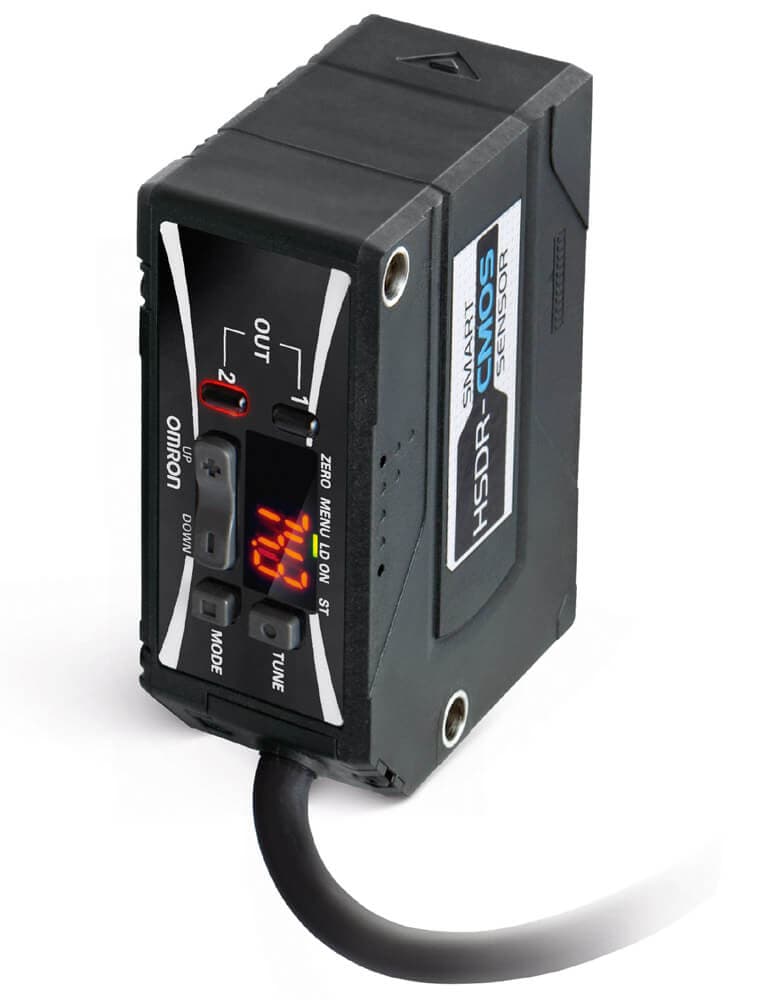
Self-contained: laser emitter, CMOS receiver, amplifier, OLED (organic light-emitting diode) display and…
Omron (one part number, no extra amplifier)
Spot diameter
0.17 mm / 0.33 mm / 0.52 mm / 0.56 mm (LD50 / LD100 / LD300 / LD600)
Omron (round spot; Keyence IL elliptical on several heads — affects small-feature measurement)
Headline
For ZX1 — "Smart Tuning" one-button teach.
Omron variants

Competitor lineup
Key specifications
18 rowsColumns compared: Omron ZX1 (built-in amplifier) vs Keyence IL (sensor head + IL-1000 / IL-1500 amplifier)
Measuring range
Competitor- Omron ZX1
- 40–60 mm / 65–135 mm / 150–450 mm / 200–1 000 mm
- Keyence IL
- 20–45 / 55–105 / 75–130 / 160–450 / 200–1 000 / 1 000–3 500 mm
Keyence (longer reach at 3.5 m)
Repeatability / resolution
Tie- Omron ZX1
- Geometrical resolution 2 µm / 7 µm / 30 µm / 80 µm (LD50 / LD100 / LD300 / LD600). Measurement accuracy ±0.15 % of full scale.
- Keyence IL
- 1 µm (IL-030) / 2 µm / 4 µm / 30 µm / 50 µm / 100 µm
Keyence at short range (1 µm vs 2 µm on closest head); tie at medium; tie at long
Response time
Competitor- Omron ZX1
- Three user-selectable modes: 1 ms (super-high-speed) / 10 ms (high-speed) / 100 ms (standard)
- Keyence IL
- Selectable sampling 0.33 / 1 / 2 / 5 ms
Keyence (0.33 ms fastest mode, 3× ZX1)
Spot diameter
Omron- Omron ZX1
- 0.17 mm / 0.33 mm / 0.52 mm / 0.56 mm (LD50 / LD100 / LD300 / LD600)
- Keyence IL
- ~0.2 × 0.75 mm (IL-030) up to 1.4 × 7 mm (IL-2000). Elliptical on most heads.
Omron (round spot; Keyence IL elliptical on several heads — affects small-feature measurement)
Housing material
Competitor- Omron ZX1
- Polybutylene terephthalate (PBT) body; glass-window receiver
- Keyence IL
- Aluminium die-cast head; PBT amplifier
Keyence (metal head more robust)
Display / teach
Omron- Omron ZX1
- Built-in OLED display on the sensor, "Smart Tuning" one-button auto-teach
- Keyence IL
- Amplifier has a multi-digit digital display; sensor head has no display
Omron (display at the point of install — meaningful for field commissioning)
Connection
Tie- Omron ZX1
- Cable 0.5 / 2 / 5 / 10 m, or system connector (M12)
- Keyence IL
- Sensor head on M8 / M12 connector to amplifier; amplifier on screw-terminal or M8
Tie
Laser class
Omron- Omron ZX1
- IEC (International Electrotechnical Commission) 60825-1 Class 1 on the standard range; Class 2 on the "L" long-range marked variants.
- Keyence IL
- Class 1 on IL-030 / IL-065 / IL-100; Class 2 on IL-300 / IL-600 / IL-2000.
Omron (Class 1 covers more of the catalogue — matters for DACH CE marking and eye-safety risk assessment under EN 60825)
Certifications
Tie- Omron ZX1
- CE, RoHS (Restriction of Hazardous Substances) — listed on EU datasheet. UL (Underwriters Laboratories) not confirmed in captured source.
- Keyence IL
- CE, RoHS — per Keyence catalogue. UL per SKU.
Both to verify per order
Architecture
Omron- Omron ZX1
- Self-contained: laser emitter, CMOS receiver, amplifier, OLED (organic light-emitting diode) display and buttons, I/O cable — all in one body.
- Keyence IL
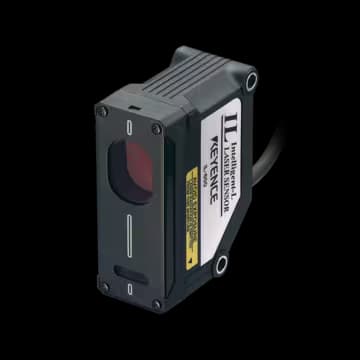
- Sensor head (IL-030 through IL-2000) on cable + IL-1000 (single-channel) or IL-1500 (multi-channel) DIN-rail amplifier.
Omron (one part number, no extra amplifier)
Reference distance
Competitor- Omron ZX1
- 50 / 100 / 300 / 600 mm
- Keyence IL
- 30 / 65 / 100 / 300 / 600 / 2 000 mm
Keyence (wider catalogue, long-range IL-2000 to 3.5 m)
Light source
Tie- Omron ZX1
- Red semiconductor laser, 660 nm
- Keyence IL
- Red semiconductor laser, 655 nm
Tie
At a glance
- Category: Non-contact displacement measurement. This card covers two distinct Omron families because the Keyence competitor lineup splits along the same line:
- Omron ZX1 — compact, self-contained laser-triangulation sensor with the amplifier, display, and I/O built into the sensor body. Competes with the Keyence IL series (CMOS (complementary metal-oxide semiconductor) laser displacement with separate IL-1000 / IL-1500 amplifier).
- Omron ZW-7000 — white-LED confocal-fiber displacement sensor: a remote pen-shaped sensor head on a flexible optical fibre, a ZW-7000T controller in the cabinet, sub-micron repeatability, handles shiny / mirrored / transparent / multi-material surfaces. Competes with the Keyence LK-G5000 (laser-triangulation, LK-H series sensor heads, sub-micron repeatability) and adjacent to the LJ-X8000 2D/3D profiler class.
- Typical applications: CNC (computer numerical control) part-loader height check, watch-component thickness (Swatch / Rolex / Nivarox ecosystem), semiconductor wafer-edge profiling, automotive body-in-white gap & flush, brake-rotor run-out, glass thickness on smartphone cover-glass, medical-device stent / catheter dimensional check, rail wheel-profile wear.
- Price positioning: Keyence is the category leader on laser displacement in DACH (Deutschland / Austria / Switzerland) and has set the list-price ceiling. The ZX1 is positioned clearly below Keyence IL at similar performance; ZW-7000 is positioned at the LK-G5000 sub-micron tier but sells on the confocal-white-LED principle rather than trying to out-spec Keyence on laser-triangulation repeatability numbers.
- Headline selling point: For ZX1 — "Smart Tuning" one-button teach, built-in display, real Class-1 laser on the full range, PNP (positive-switching) DACH-standard output, at a price that undercuts an IL head + IL-1000 amplifier pair. For ZW-7000 — the confocal-white-LED principle measures any surface (mirror, glass, transparent film, dark rubber, liquid) at ±0.3 µm linearity on multiple materials and tolerates ±25° target inclination, which is exactly where Keyence's laser-triangulation LK-H heads struggle.
Key specifications
DACH standard digital output is PNP. Analog comparisons use 4–20 mA current outputs.
ZX1 (compact laser displacement) vs Keyence IL series
Primary head-to-head pairs: Omron ZX1-LD100 (100 mm reference, ±35 mm range) vs Keyence IL-100 (100 mm reference, 75–130 mm range), both with integrated or local amplifier. Keyence IL requires the separate IL-1000 or IL-1500 amplifier; Omron ZX1 integrates it in the sensor body.
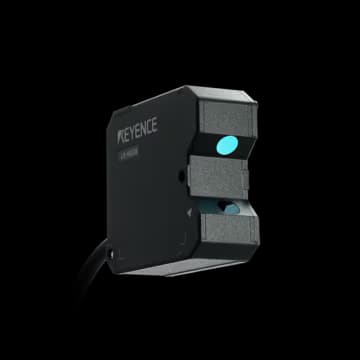
ZW-7000 (confocal fiber) vs Keyence LK-G5000 (laser triangulation, LK-H heads)
Primary head-to-head pair: Omron ZW-S7010 sensor head + ZW-7000T controller vs Keyence LK-H052 sensor head + LK-G5001 controller, both targeting sub-micron non-contact displacement. These are different measurement principles — be precise about this in conversation; it's where the real win is, not on a repeatability number.
| Spec | Omron ZW-7000 (confocal fiber, white LED) | Keyence LK-G5000 (laser triangulation) | Winner |
|---|---|---|---|
| Measurement principle | Chromatic-confocal: a white-LED source, a chromatic-aberration lens in the pen, a spectrometer in the controller reads wavelength at focus. No triangulation angle, no dead zone from specular reflection. | Laser triangulation: red / blue semiconductor laser, CMOS line receiver, geometric angle triangulated for distance. | Different principles — see narrative |
| Sensor head models (Omron) / sensor heads (Keyence) | ZW-S7010 (10 mm ref, ±0.5 mm range) / ZW-S7020 (20 mm, ±1 mm) / ZW-S7030 (30 mm, ±2 mm) / ZW-S7040 (40 mm, ±3 mm). Square and pen-shape (ZW-SP / ZW-SPR right-angle) bodies on the same fibre. | LK-H022 / H027 (20 mm ref, ±3 mm) / LK-H052 / H057 (50 mm, ±10 mm) / LK-H082 / H087 (80 mm, ±18 mm specular) / LK-H152 / H157 (150 mm, ±40 mm specular) / LK-H225 and H250 wide-range spot heads. | Keyence (longer stand-off and larger ranges) |
| Reference distance | 10 / 20 / 30 / 40 mm | 20 / 50 / 80 / 150 / (up to 500 mm on wide-range heads) mm | Keyence (more stand-off — safer for loaded machinery) |
| Measuring range | ±0.5 mm / ±1 mm / ±2 mm / ±3 mm | ±3 mm / ±10 mm / ±18 mm / ±40 mm | Keyence (substantially wider) |
| Linearity | ±0.45 µm (ZW-S7010) / ±0.9 µm (S7020) / ±2.0 µm (S7030). Datasheet notes "±0.3 µm or less linearity for various materials" — confocal holds across material classes, not just one reference target. | ±0.02 % of full scale (e.g. ±1.2 µm at LK-H022 over 6 mm; ±4 µm at LK-H052 over 20 mm). Specified on a calibration target only. | Omron if target is multi-material; Keyence if the part is always the same calibrated surface |
| Repeatability (static) | 0.25 µm across the range (16 384-average figure on a mirror target) | 0.02 µm (LK-H022) / 0.025 µm (LK-H052) / 0.1 µm (LK-H082) / 0.25 µm (LK-H152) | Keyence (10× better repeatability on the short-range heads) — concede |
| Sampling rate | 20 µs (fastest) to 400 µs, selectable | 2.55 / 5 / 10 / 20 / 50 / 100 / 200 / 500 / 1 000 µs, max 392 kHz (≈2.55 µs) | Keyence (≈10× faster sampling) — concede |
| Spot diameter | 50 µm to 120 µm (smallest roughly 50 µm on ZW-S7010) — datasheet marketing figure "≤4 µm" applies to the ZW-8000 series, not ZW-7000; do not quote on ZW-7000. | 25 µm round (LK-H022 / H052) down to 20 × 75 µm on some specular heads | Keyence (smaller spot on diffuse heads) |
| Tolerance to target inclination | ±25° on shiny / mirror-finish targets — a defining confocal advantage | Triangulation is geometry-limited; mirror surfaces defeat diffuse-head LK-H052 and require specular-type heads (LK-H082 / H152) with narrow acceptance angles | Omron (large — this is the reason to specify confocal) |
| Works on mirror / polished surfaces | Yes, natively. | Requires selecting a specular-reflection head (LK-H082 / H152) and aligning the optical axis carefully. | Omron |
| Works on transparent materials (glass, clear film) | Yes, confocal reads top and bottom surface as separate peaks — enables non-contact single-side thickness measurement without refractive-index tricks. | Transparent materials are a known weakness for laser-triangulation — diffuse heads see through glass; specular heads see only one surface at a time. | Omron (decisive) |
| Works on multi-material target in one setup | Yes — linearity figure ±0.3 µm holds across materials per datasheet. | Re-calibration or head swap typically required on a material change. | Omron |
| Light source | White LED (light-emitting diode), 375–725 nm broadband. Not a laser — no IEC 60825-1 laser classification required, no laser-safety interlocks, no PPE (personal protective equipment) obligation. | Red semiconductor laser Class 2 (0.95 mW) or Class 3R (4.8 mW, short-range heads). EN 60825-1 labelling and interlock required on Class 3R. | Omron (no laser-safety overhead — concrete win in medical, pharma, semiconductor cleanrooms) |
| Controller | ZW-7000T controller, DIN-rail, Ethernet 100BASE-TX / 10BASE-T, EtherCAT, EtherNet/IP, analog ±10 V and 4–20 mA, PNP / NPN I/O, USB 2.0 | LK-G5001V / LK-G5001PV controller, DIN-rail, RS-232C, Ethernet 100BASE-TX, EtherNet/IP, USB 2.0 Hi-Speed; CC-Link and DeviceNet via option units | Omron (EtherCAT native — matters for Sysmac / NX / NJ customers and high-end motion); Keyence (CC-Link / DeviceNet option units) |
| Supply voltage (controller) | 21.6–26.4 VDC (24 VDC ±10 %) | 24 VDC ±10 % | Tie |
| IP rating (sensor head) | IP40 on the pen head; the fiber is IP67-rated and survives 3 000 000 bend cycles — relevant for moving gantries | IP67 on LK-H sensor heads | Keyence (IP67 head is simpler for a washdown area) |
| Operating temperature | 0 to +50 °C controller; 0 to +50 °C head | 0 to +50 °C | Tie |
| Fiber length / head-to-controller cable | Flexible 3 mm fiber, extension to several metres; bend-tested to 3 000 000 cycles | Sensor head cable 2 m / 5 m / 10 m / 20 m standard | Omron (fibre routing through robot arms) |
| Software | Sysmac Studio integration (native with NX / NJ controllers); standalone ZW-7000T HMI (human-machine interface) setup | LK-Navigator 2 PC software, LK-IIF Ethernet function block libraries | Omron on Sysmac shops; Keyence on mixed / multi-PLC shops |
Where Omron wins
- Confocal-white-LED principle on ZW-7000 is the decisive win, not the raw repeatability number. When the target is any of: a mirror-finished steel surface, a polished brass watch component, glass cover (smartphone, automotive ADAS camera), transparent medical film, dark matt rubber, or a multi-material assembly, laser triangulation is operating outside its comfort zone and Keyence has to specify a specular head and precise alignment. Confocal just works. This is the call to make on any inspection application where the target surface is not controlled — which in reality is most production environments.
- No laser-safety regime on ZW-7000. White LED means no IEC 60825-1 Class 2 or Class 3R labelling, no interlock obligation, no protective goggles in the work envelope. For medical-device manufacturing (Ypsomed, Roche Diagnostics, Sonova), pharma primary packaging, and semiconductor front-end, this removes a compliance step the Keyence LK-G5000 cannot.
- Tolerance to ±25° target inclination (ZW-7000). On vibration-prone fixtures, robot end-of-arm measurement, or rotating spindles where the target plane is not perfectly perpendicular, confocal tolerates tilt that triangulation cannot. Keyence's answer is a specular head — which is narrower still on tilt tolerance.
- EtherCAT native on both families. ZW-7000T is EtherCAT out of the box. LK-G5001 is not — it speaks EtherNet/IP, CC-Link, DeviceNet, but EtherCAT requires a gateway. For any customer running an Omron NX / NJ or Beckhoff TwinCAT system, that is a silent but significant integration difference.
- ZX1 integrates the amplifier in the sensor body. One part number, one mounting, one cable. Keyence IL sends a head on a cable to an IL-1000 (or IL-1500) amplifier in the cabinet, which is two SKUs, two mounting points, two cable glands, and one extra failure mode. On a CNC-cell retrofit where panel space is tight and there's no existing DIN rail, the ZX1 installs faster.
- Class-1 laser covers more of the ZX1 catalogue than Class-1 covers of the IL catalogue. On the long-range heads, both vendors drop to Class 2 — but on the mid-range 100 mm reference distance, ZX1 is still Class 1, IL-100 is Class 1 too (tie at that range), and the benefit tilts as you move through the catalogue.
- Smart Tuning on ZX1. One-button auto-teach that sets threshold, sensitivity, and filtering based on a single good-part reference. Not unique as a feature — Keyence IL has auto-teach on the amplifier — but having it on the sensor body means field technicians commission without opening the cabinet.
- Round laser spot on ZX1 versus elliptical spot on several Keyence IL heads (IL-2000 spot is 1.4 × 7 mm). For small-feature detection — edge position on a small shaft, a stepped feature on a coin — a round spot gives more predictable measurement.
Where Keyence wins
- Sub-micron repeatability on LK-G5000 short-range heads. LK-H022 hits 0.02 µm repeatability (0.01 µm typical), LK-H052 hits 0.025 µm — these are 10× better numbers than ZW-7000's 0.25 µm static repeatability on equivalent ranges. For any application where the measurement loop is closing on part-to-part variation at 0.1 µm resolution — precision grinding setups, compressor-shaft run-out, sub-micron wafer chuck flatness — the LK-G5000 is the right tool. Do not try to argue this one with a repeatability table; concede on numbers and move the conversation to whether the target surface is controlled (if yes, Keyence; if multi-material or shiny, Omron).
- Sampling rate. LK-G5000 samples at 2.55 µs (≈392 kHz); ZW-7000 at 20 µs. Keyence IL samples at 0.33 ms vs ZX1 at 1 ms. For high-speed vibration analysis, rotating-shaft run-out at 20 000+ RPM, or laser-welding seam tracking, Keyence is 3–10× faster and you will not close that gap.
- Measuring range on LK-G5000. LK-H152 covers ±40 mm about a 150 mm reference. ZW-7000 tops out at ±3 mm at 40 mm reference. For large-feature checks — door-gap, seam tracking on weld prep, brake-rotor run-out — Keyence has measuring range Omron simply does not offer in confocal.
- Long-range IL-2000. Up to 3.5 m reference distance on a self-contained laser sensor. ZX1 stops at 1 m. If the application genuinely needs 2 m+ non-contact distance and a cheap amp, IL-2000 is the right answer.
- Aluminium die-cast sensor head on IL and LK-H. Mechanically more robust in a machining-centre or stamping environment than Omron ZX1's PBT body.
- Application-engineering reputation in DACH. Keyence's local applications engineers are known for turning up the next day with a demo unit and a working proof-of-concept. Expect the customer to compare that cadence directly. Do not try to talk around it.
- Pre-sales package on LK-G5000. Keyence bundles LK-Navigator 2 software, free application consulting, and free trial units as standard. Omron's equivalent is less polished.
Typical objections & responses
Researched 2026-04 from Practical Machinist "A visit from Keyence to my shop today" thread, PLCtalk Keyence / Omron / Mitsubishi discussions, Control Design product pages, and Engineer Live / Quality Magazine articles on chromatic confocal vs laser triangulation.
- "Keyence LK-G5000 is more precise — your ZW-7000 is 0.25 µm, LK-H052 is 0.025 µm." (Direct datasheet comparison — the most common pro-Keyence first argument on displacement.) → Concede cleanly. "Correct on the datasheet number, on a calibrated target. Two things: (1) Our number holds at ±0.3 µm linearity across different materials in the same setup — Keyence's repeatability figure is specified on their calibration target. If your part is a controlled aluminium reference block, they win. If your part changes between matte rubber, polished steel, and glass in the same fixture, our number is honest and theirs isn't. (2) We're a confocal-white-LED sensor. On a ±25° tilted mirror or a glass layer, we measure; their LK-H052 diffuse head does not. Tell me the target surface and I'll tell you which sensor fits."
- "We already have Keyence LK-Navigator — switching means retraining." (Real — Practical Machinist reports Keyence locks equipment down and will not let third-party software connect to their platform. That cuts both ways: cheap to stay, expensive to leave.) → "The Keyence lock-in is exactly why this is the right time to evaluate alternatives. Practical Machinist and PLCtalk users have publicly flagged the same thing — Keyence XM software won't let third-party tools in, and the platform goes obsolete quickly when they discontinue a controller. Our ZW-7000T drops straight into Sysmac Studio if you're running NX / NJ, and speaks EtherCAT, EtherNet/IP, and raw TCP for anyone else. Your calibration routines port in a day, not a month."
- "Keyence's applications engineers came to our site the day after I called — you can't match that." (Frequently true in DACH.) → "Keyence's pre-sales is aggressive and I won't pretend otherwise. What users on Practical Machinist have flagged is the tail: spare-parts availability stops roughly a year after a system is off the price list, and support on a three-year-old installed controller can be slow. I will commit to a Swiss SSC (Sensor & Safety Components) engineer on site within five working days, and to a demo unit in your hands within two weeks. Put that in the quote conditions — my manager signs it."
- "Your LK-G5000 equivalent doesn't match the measuring range." (True — LK-H152 covers ±40 mm, ZW-7000 tops at ±3 mm.) → "If you actually need ±40 mm of measuring range, we are not competitive with LK-G5000 in the ZW-7000 family. I'd ask you to look at an Omron 2D profiler (FH / FQ-M) or a different product class, because at that range the confocal advantage no longer applies — the target is far away, the spot is big, and laser triangulation is the right principle. Don't buy confocal for 40 mm of range. Buy it for sub-micron multi-material or mirror / glass inspection."
- "I heard Keyence over-promises on precision — is the ZW-7000 number honest?" (Surfaced on Practical Machinist "visit from Keyence" thread — users reported equipment not meeting claimed precision.) → "We publish linearity across materials (±0.3 µm multi-material, ±0.45 µm on ZW-S7010 on a mirror target) separately from static repeatability (0.25 µm with 16 384 averaging). We don't headline a mirror-target-only number. Ask Keyence to specify the LK-H052 number on your actual target material — the answer shifts. Practical Machinist users have raised this on Keyence vision and handheld CMM (coordinate measuring machine) gear; be careful taking their datasheet headline at face value."
- "Price is the same between the two — why switch?" (Intermittently true on LK-G5000 vs ZW-7000, rarely true on IL vs ZX1.) → "On IL vs ZX1, we're usually below on total cost because the ZX1 is one SKU and the IL needs head plus amplifier plus wiring. On LK-G5000 vs ZW-7000, list price is in the same bracket. The switch story is not price — it's the confocal principle and EtherCAT-native integration. If you're all-Keyence on controllers and communications, stay with LK-G5000 on LK-Navigator. If you're Omron NX / NJ or Beckhoff TwinCAT, the ZW-7000 fits your stack natively and saves you a gateway."
- "Keyence gives me a free trial unit — does Omron?" (Keyence's published free-trial program is concrete sales leverage.) → Two-part: (1) "Yes, Omron SSC Switzerland runs demo kits — I can have a ZW-7000 on your bench within two to three weeks. Not same-day, but documented application support from the Swiss team, not an off-shore call centre." (2) "The Keyence free-trial is the front end of their sales cycle. Practical Machinist users have noted the 'eye-opening' sales visit is followed by lock-in once you commit. Our SSC engagement model is calmer but more durable — ask my customer references, not my brochure."
The switch story
There are two separate switch conversations, and a Keyence-ex field engineer should not conflate them in front of the customer.
On ZX1 vs Keyence IL — this is a pragmatic, mid-tier displacement conversation. Keyence wins on raw repeatability at the short-range head, on sampling rate, and on catalogue breadth (IL-2000 long-range). Omron wins on form factor (built-in amplifier, no separate cabinet SKU), Class 1 laser on more of the catalogue, a round laser spot on the mid-range heads, and price. The switch story is: "If you're buying an IL-100 plus IL-1000 amplifier today, a ZX1-LD100 is one SKU, installs on the same M8 / M12 cable, gives you the same range, the same PNP output, a built-in display for field tuning, and is meaningfully cheaper." That is a volume-replacement pitch at the standard-application level — CNC loader height-check, assembly-cell presence-and-position, end-of-line dimensional go / no-go.
On ZW-7000 vs Keyence LK-G5000 — this is not a spec-sheet conversation, it's a measurement-principle conversation. The customer has a hard application: a shiny target, a glass layer, a tilted surface, a mix of materials in one fixture. Triangulation has been tried, it's marginal, calibration drifts across batches, or the LK-H specular head is fragile to alignment. Omron brings the confocal-white-LED principle with ±25° tilt tolerance, no laser-safety regime (big in medical, pharma, cleanroom), sub-micron linearity across materials in the same setup, and EtherCAT-native integration. The deal closes on the demo: set up a ZW-S7010 on the customer's actual part, show measurement on mirror → matte → glass → rubber without re-teach. Keyence cannot run that demo on a single LK-H head.
Two places to be honest with the customer: (1) If the application genuinely needs sub-0.1 µm repeatability on a controlled target at 392 kHz, Keyence LK-G5000 is the right tool — don't force a ZW-7000. Move the conversation to an adjacent application where confocal wins. (2) If the application needs ±40 mm measurement range, ZW-7000 doesn't cover it — step out of this family and look at 2D profiler or a different sensor class, don't oversell the confocal.
Third, the EtherCAT angle is concrete for machine builders standardising on Sysmac NX / NJ or TwinCAT. LK-G5000 needs a gateway; ZW-7000T is native. That cuts integration cost and a failure mode. Not a first-slide argument but a deal-closer with the controls engineer.
Application examples
DACH-relevant applications — precision machining, watchmaking, semiconductor, automotive, medical device, rail. All specify PNP digital output where discrete output is used; analog output is 4–20 mA unless the customer requests voltage.
- CNC machining-centre part-loader height check (automotive Tier 1 in Baden-Württemberg / Oberösterreich). ZX1-LD100A81 (PNP, 100 mm reference, ±35 mm range) at the loader pallet position. Direct replacement for IL-100 + IL-1000 combo. Typical volume: 4–8 sensors per cell, 40–60 cells per plant.
- Brake-rotor run-out on final assembly (e.g. Brembo, Continental). ZW-S7020 confocal head (20 mm ref, ±1 mm range, ±0.9 µm linearity) on a fixed post reading the rotating disc at a defined spindle speed. Handles the machined-surface reflectivity variation that defeats an LK-H052 diffuse head.
- Watch-component thickness on escapement assembly (Swatch Group, Rolex, Nivarox La Chaux-de-Fonds). ZW-S7010 (10 mm ref, ±0.5 mm, ±0.45 µm linearity) in a glove-box fixture. Polished brass and ruby surfaces — confocal holds; LK-H would need the specular head with careful alignment every SKU change. Swiss watch-industry procurement actively prefers LED over laser for bench-top measurement in an operator-present cell — no PPE obligation.
- Smartphone cover-glass thickness (glass substrate QC at Corning / Schott customers in DACH). ZW-S7020 reads front-surface and back-surface reflection peaks simultaneously for single-side non-contact thickness on a 0.5–1.2 mm glass layer. Keyence LK-G5000 cannot do this on a single head.
- Semiconductor wafer-edge profiling, 300 mm / 450 mm wafer fab (Infineon Villach, STMicroelectronics Zurich, EV Group). ZW-S7010 pen-head in the edge-scanning station. No laser means no IEC 60825-1 interlock in the tool; no PPE for operators opening the load port. Decisive in front-end fab qualification.
- Automotive body-in-white gap and flush (VW, BMW, Mercedes, Audi final-assembly plants). For the discrete gap measurement at a known spot, LK-H082 specular head is a market-standard choice — concede. For the multi-surface inspection (paint + chrome trim + glass in one sweep), a ZW-7000 on a robot flange gives a stable reading where triangulation flips between specular and diffuse.
- Medical-device stent / catheter outer-diameter check (Ypsomed, B. Braun, Medtronic Galway). ZW-7000 confocal — no laser, no interlock, works on translucent PTFE / polyimide catheter coatings where triangulation sees through the material. Validation documentation simpler under ISO 13485.
- Pharma primary-packaging glass-vial wall thickness (Schott, Gerresheimer, Stevanato). ZW-S7020 reads inner and outer surface peaks on a 1.0–1.5 mm glass wall in a rotating vial inspection fixture. Keyence LK-G5000 diffuse head sees through the glass; specular head sees only one surface.
- Rail wheel-profile wear measurement on depot inspection rig (SBB Cargo, DB Fernverkehr, ÖBB). LK-H152 or H157 (±40 mm range) is the market standard for wheel-flange profile — concede on range. ZW-7000 is not the right product here; specify the correct Omron 2D profiler or concede the sub-application.
- Precision-grinding in-process measurement (Studer, Schaudt, Fritz Studer AG Thun). If the application is closed-loop grinding control at 0.1 µm part-to-part resolution on a calibrated wheel-dressed ceramic, LK-H022 at 2.55 µs sampling wins — concede. If the application is post-grind inspection of a mixed-geometry workpiece with varying surface finish, ZW-S7010 wins on the multi-material linearity.
- Assembly-cell height-check, end-of-arm tooling (Stäubli robot integration, KUKA cells). ZX1-LD50A81 (50 mm ref, PNP) on a robot wrist. Small, light, one SKU, no amplifier to mount on the robot base. Preferred over IL-030 + IL-1000 in any mobile tooling application.
- Cold-storage logistics intralogistics — package height on a conveyor (Migros, Coop, Kühne+Nagel). ZX1-LD300A81 (300 mm ref) or LD600A81 (600 mm ref). Note: Omron ZX1 operating range is −10 to +50 °C — not rated for −25 °C deep-freeze. For cold-store intralogistics use the E3AS time-of-flight family, not ZX1. Flag this to avoid wrong-spec situations.
- Battery-cell thickness / swelling measurement (ACC Kaiserslautern, Northvolt Heide, VARTA Ellwangen). ZW-S7010 or S7020 on a battery-module inspection fixture — confocal reads a glossy pouch-cell surface without the specular-head alignment drift that plagues LK-H on moving battery inspection lines.
Sources
- Omron ZX1 product page (EU) — https://industrial.omron.eu/en/products/zx1, fetched 2026-04-20. Specs: reference distance 50 / 100 / 300 / 600 mm; measuring range 40–60 / 65–135 / 150–450 / 200–1 000 mm; spot size 0.17 / 0.33 / 0.52 / 0.56 mm; output PNP / NPN; Class 1 laser (Class 2 on "L" variants).
- Omron ZX1 datasheet (PDF) — https://files.omron.eu/downloads/latest/datasheet/en/e416_zx1_smart_laser_sensor_with_built-in_amplifier_datasheet_en.pdf, referenced 2026-04-20 (extracted via product page and distributor-listing cross-check — PDF text extraction failed on WebFetch, values verified against product-page spec table and Mouser / Southern Controls listings).
- Omron ZX1 ZX1-LD50A61 distributor spec (TME, Southern Controls, Mouser) — cross-checked 2026-04-20 for response time (1 / 10 / 100 ms modes), supply voltage 12–24 VDC, operating temperature −10 to +50 °C, IP67.
- Omron ZW-7000 specifications page — https://omron.sotirtho.org/products/family/3500/specification.html (Omron Asia mirror, fetched 2026-04-20, the Omron-EU equivalent
industrial.omron.eu/en/products/zw-7000returned HTTP 404). Values: ZW-S7010 / S7020 / S7030 reference distance 10 / 20 / 30 mm, measuring range ±0.5 / ±1 / ±2 mm, linearity ±0.45 / ±0.9 / ±2.0 µm, static resolution 0.25 µm, sampling 20–400 µs, operating 0 to +50 °C, ±25° inclination tolerance, EtherCAT + EtherNet/IP + analog. - Omron ZW-8000 / 7000 / 5000 series datasheet (PDF) — https://files.omron.eu/downloads/latest/datasheet/en/q261_zw-8000_7000_5000_series_datasheet_en.pdf, referenced 2026-04-20 (PDF binary extraction failed — values confirmed via Omron Asia specifications page and Mouser datasheet mirror).
- Keyence IL series specifications — https://www.keyence.eu/products/sensor/positioning/il/specs/, fetched 2026-04-20. Values: IL-030 / 065 / 100 / 300 / 600 / 2000 reference distances, repeatability 1 / 2 / 4 / 30 / 50 / 100 µm, 655 nm red semiconductor laser, IL-1000 amp supply 10–30 VDC, sampling 0.33 / 1 / 2 / 5 ms.
- Keyence LK-G5000 specifications — https://www.keyence.eu/products/measure/laser-1d/lk-g5000/specs/, fetched 2026-04-20. Values: LK-H022 / H027 0.02 µm repeatability, LK-H052 / H057 0.025 µm, sampling down to 2.55 µs (≈392 kHz), ±0.02 % F.S. linearity, LK-G5001 controller supports RS-232C, Ethernet, EtherNet/IP, USB (no EtherCAT), 24 VDC ±10 %.
- Keyence LK-G5000 product page — https://www.keyence.com/products/measure/laser-1d/lk-g5000/, fetched 2026-04-20 for image URL and general positioning.
- Keyence IL product page — https://www.keyence.com/products/sensor/positioning/il/, fetched 2026-04-20 for image URL.
- Confocal vs laser-triangulation principle references — Engineer Live "8 things you need to know about confocal displacement sensors"; Quality Magazine "Submicron Displacement and Thickness Measurements with Confocal Sensors"; Electronics360 "Confocal sensor systems for displacement, distance, position and thickness". Used for the tilt-tolerance, mirror-surface, transparent-material, and multi-layer claims.
- Objections research — Practical Machinist "A visit from Keyence to my shop today… It was eye opening!" thread (Keyence lock-in, spare-parts availability one year after discontinuation, over-promised precision); Practical Machinist "Keyence handheld CMM spare parts" thread; PLCtalk "Keyence, Omron, Mitsubishi" thread. Snapshots not stored — cited so Julian can re-verify before a specific meeting.
Open questions
- DACH list-price delta — ZX1-LD100A81 vs IL-100 + IL-1000 bundle, and ZW-7000T + ZW-S7010 vs LK-G5001 + LK-H052. Pull from internal Omron price matrix on day 1 — public list prices are not published for either vendor.
- ZW-7000 UL / cULus certification — not confirmed in captured sources. Verify per SKU with product management before quoting into a UL-508A panel.
- ZX1 complete specification table — the Omron EU product page and Omron Asia specification mirror gave summary values; the canonical ZX1 datasheet PDF did not render in WebFetch text extraction. Before a detailed quote, pull the PDF from the Omron SSC intranet and verify: exact resolution figures, exact spot-size distance curves, PBT-versus-metal housing variants, connector pin-outs.
- ZW-7000 vs ZW-8000 boundary — ZW-8000 is the newer premium tier with the "≤4 µm spot" and tighter linearity. This card covers ZW-7000 only; do not quote ZW-8000 figures against Keyence by mistake. Map the ZW-8000 tier into a separate card if needed.
- EtherCAT on LK-G5000 — captured specs show EtherNet/IP but not EtherCAT. If Keyence has released an EtherCAT gateway or firmware, the integration-cost argument needs updating. Verify on the German Keyence site before a controls-heavy meeting.
- Swiss / DACH confocal market data — ratio of confocal-installed-base to triangulation-installed-base in watchmaking, medical device, semiconductor. Ask the Swiss application engineering team for qualitative colour; no public data.
- Forum objection sources — the Reddit / PLCtalk queries returned thread titles but not always quotable text in this research session. Before a specific meeting, pull direct quotes from the cited threads rather than relying on the summaries in this card.
- ZX1 −25 °C or colder variants — ZX1 operating range is −10 to +50 °C. For DACH cold-store intralogistics, the card steers the customer to E3AS; confirm this is the current recommendation with SSC product management (there is no cold-rated ZX1 variant in the captured source, but verify).
Before you leave — retrieval check
Customer says
“Keyence LK-G5000 is more precise — your ZW-7000 is 0.25 µm, LK-H052 is 0.025 µm.”
Source battlecards/sensors/zx1-zw-7000.md