Omron G3NA & G3PE
Panel-mount and three-phase solid-state relays for DACH heater, motor and resistive-load switching
Reference mode — everything visible. Use for live calls.
Three things to remember
Repetitive peak off-state voltage
Not specified in captured source
Omron G3PE (30 kV surge-pass, unique in the comparison)
Operating ambient temperature
−30 to +80 °C
Omron (−30 °C cold limit matches Finder hockey-puck; beats Finder modular)
Category
zero-crossing (the output only turns on when the AC load voltage crosses zero.
Competitor lineup


Key specifications
21 rowsColumns compared: Omron G3NA (panel-mount hockey-puck) vs Omron G3PE (integrated heat-sink, incl. 3-phase)
Load current
Competitor- Omron G3NA
- 5 A / 10 A / 20 A / 40 A / 50 A / 90 A
- Omron G3PE
- 15 / 25 / 35 / 45 A single-phase; 15 / 25 / 35 / 45 A three-phase
Finder (widest DIN-rail current range)
Load voltage
Competitor- Omron G3NA
- 24–240 VAC (20 A models); 200–480 VAC on G3NA-x50B-UTU-2
- Omron G3PE
- 100–240 VAC or 200–480 VAC
Finder (660 V on hockey-puck)
Control voltage (input)
Competitor- Omron G3NA
- 5–24 VDC, or 100–240 VAC on selected models
- Omron G3PE
- 12–24 VDC
Crydom (widest DC window, lowest input current)
Dielectric strength (input to output)
Competitor- Omron G3NA
- Not specified in captured source (datasheet PDF not text-extractable via WebFetch — publicly stated as 4 000 VAC on sibling Omron SSR datasheets; verify)
- Omron G3PE
- Not specified in captured source
Finder (6 kV on 15–30 A modular)
Repetitive peak off-state voltage
Omron- Omron G3NA
- Not specified in captured source
- Omron G3PE
- Surge-pass circuit rated >30 kV (Omron marketing claim on product page)
Omron G3PE (30 kV surge-pass, unique in the comparison)
Typical OFF-state leakage current
- Omron G3NA
- Not specified in captured source
- Omron G3PE
- Not specified in captured source
—
ON-state voltage drop
- Omron G3NA
- Not specified in captured source
- Omron G3PE
- Not specified in captured source
—
Alarm / status output
other- Omron G3NA
- Built-in red LED indicator; no SSR-fault output on G3NA
- Omron G3PE
- Built-in LED; alarm output on selected G3PE variants — verify SKU
G3PE (alarm output on variants)
Operating ambient temperature
Omron- Omron G3NA
- −30 to +80 °C
- Omron G3PE
- −30 to +80 °C
Omron (−30 °C cold limit matches Finder hockey-puck; beats Finder modular)
Representative model
- Omron G3NA
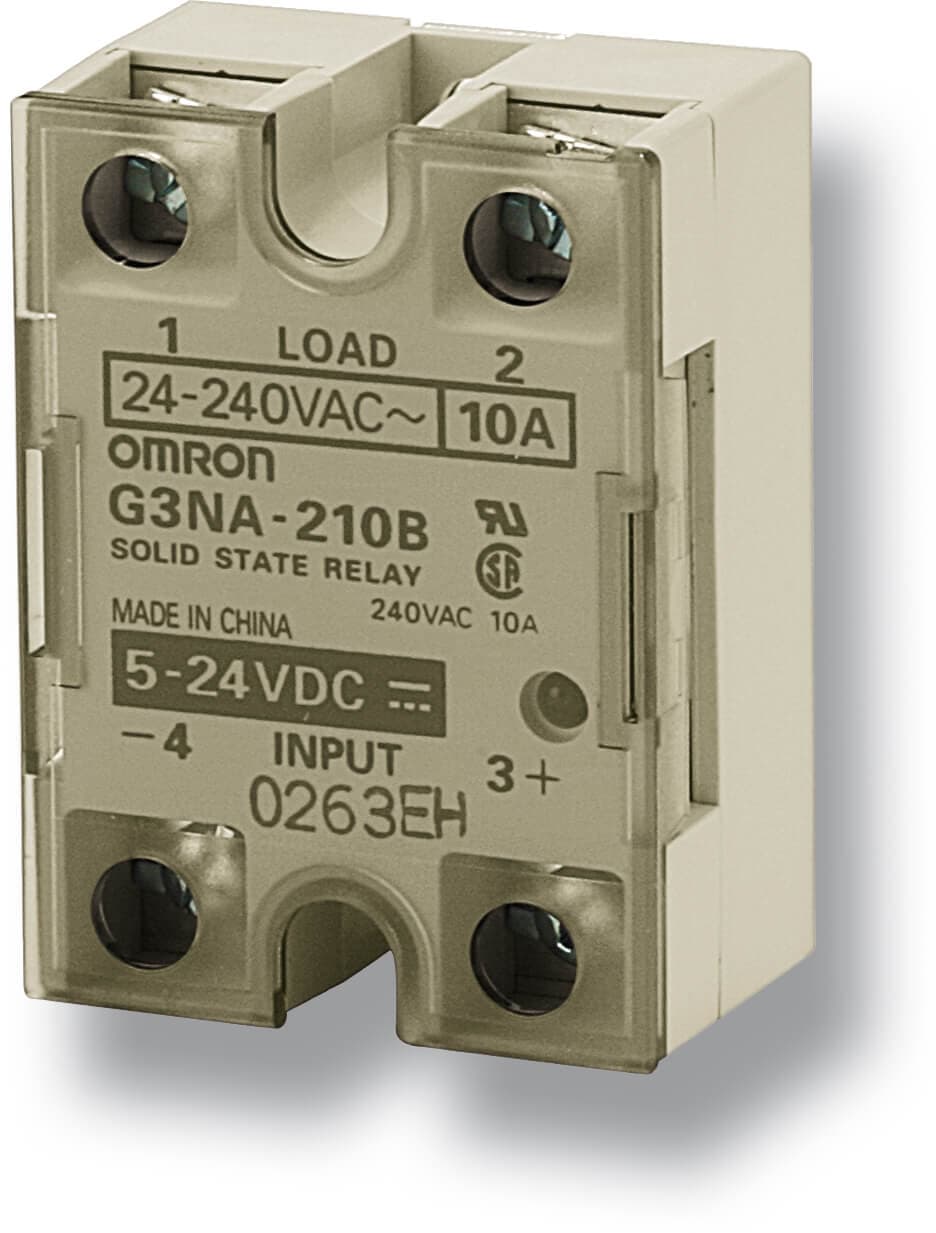
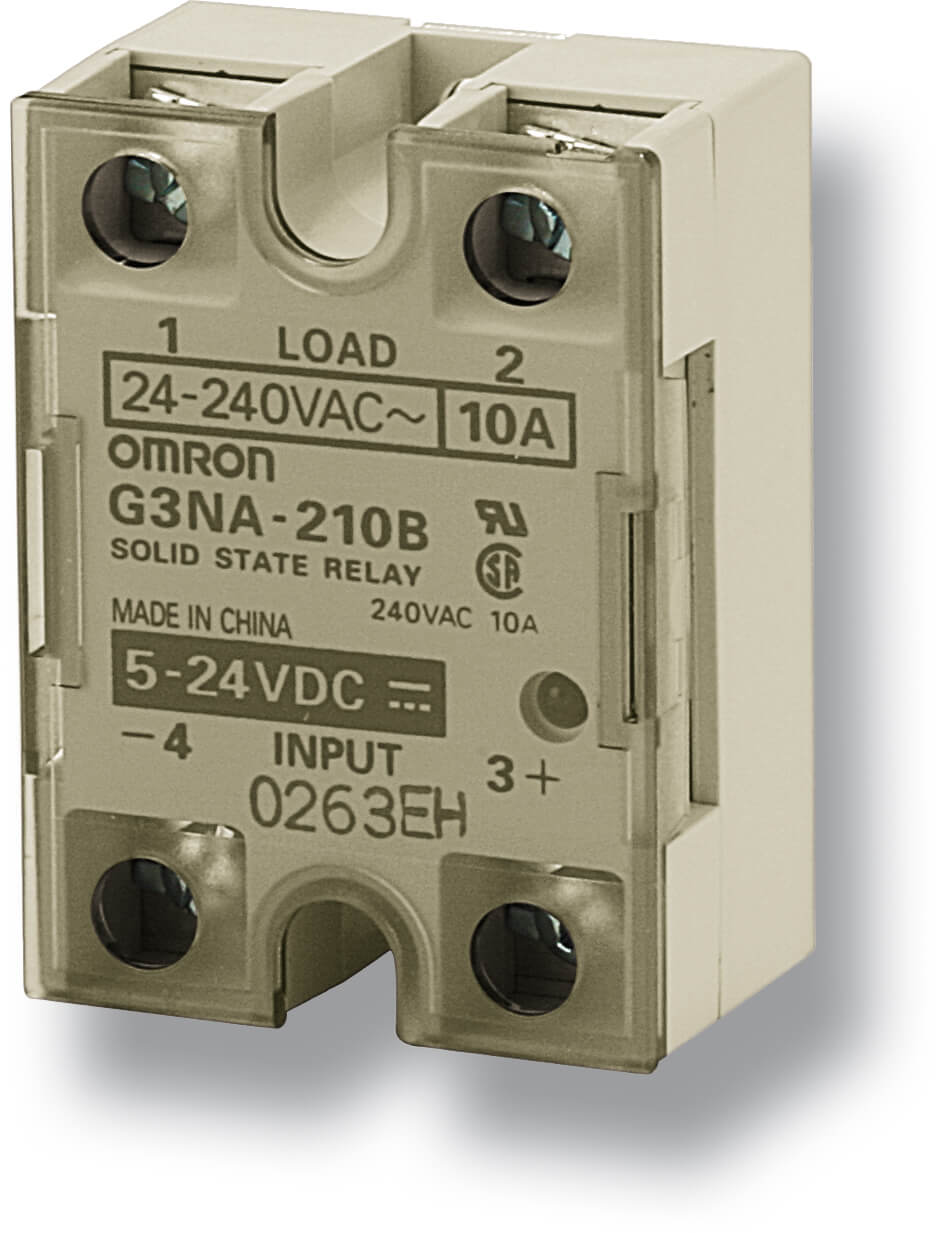
- G3NA-220B-UTU / G3NA-240B-UTU / G3NA-450B-UTU-2
- Omron G3PE
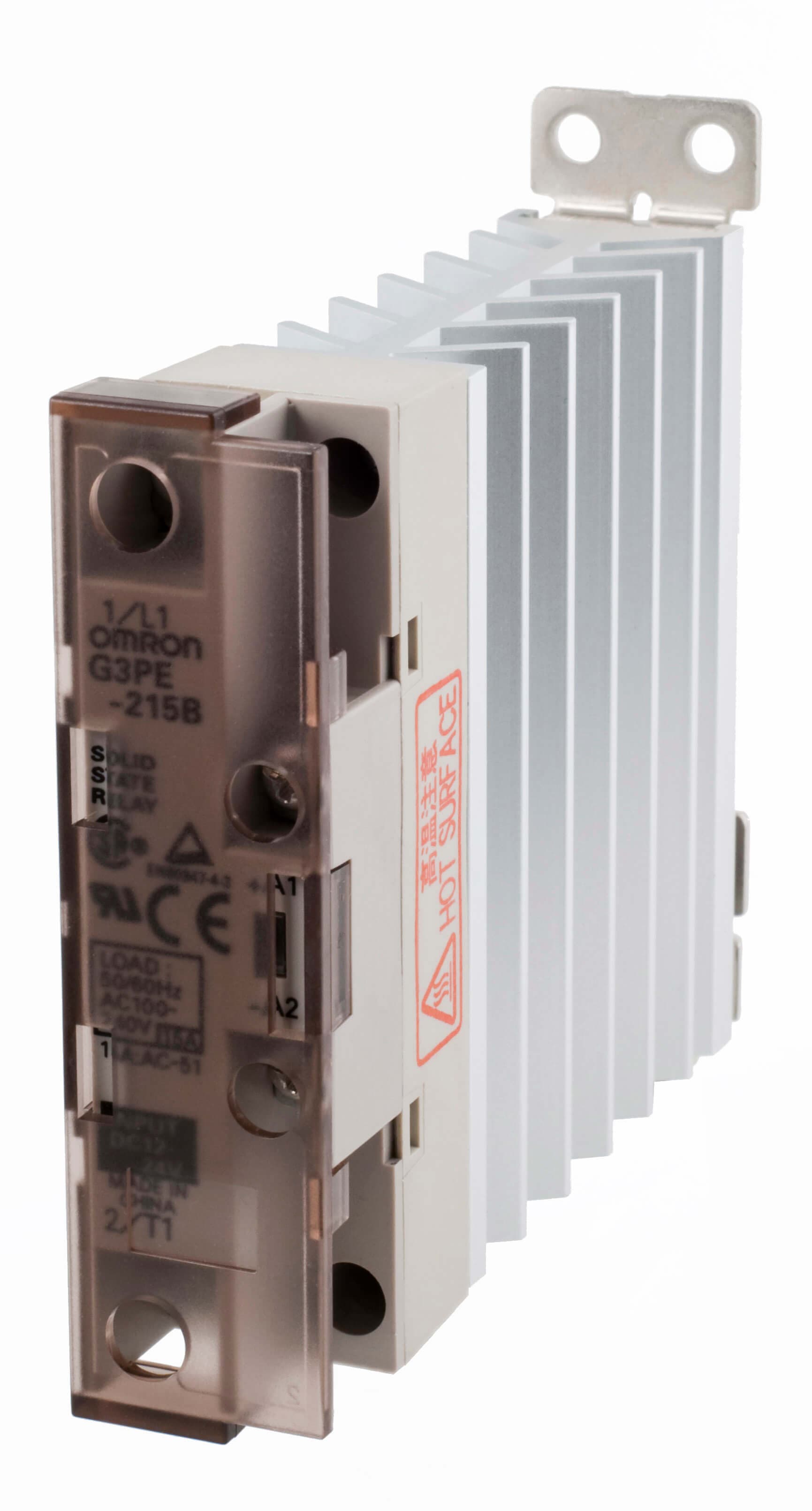
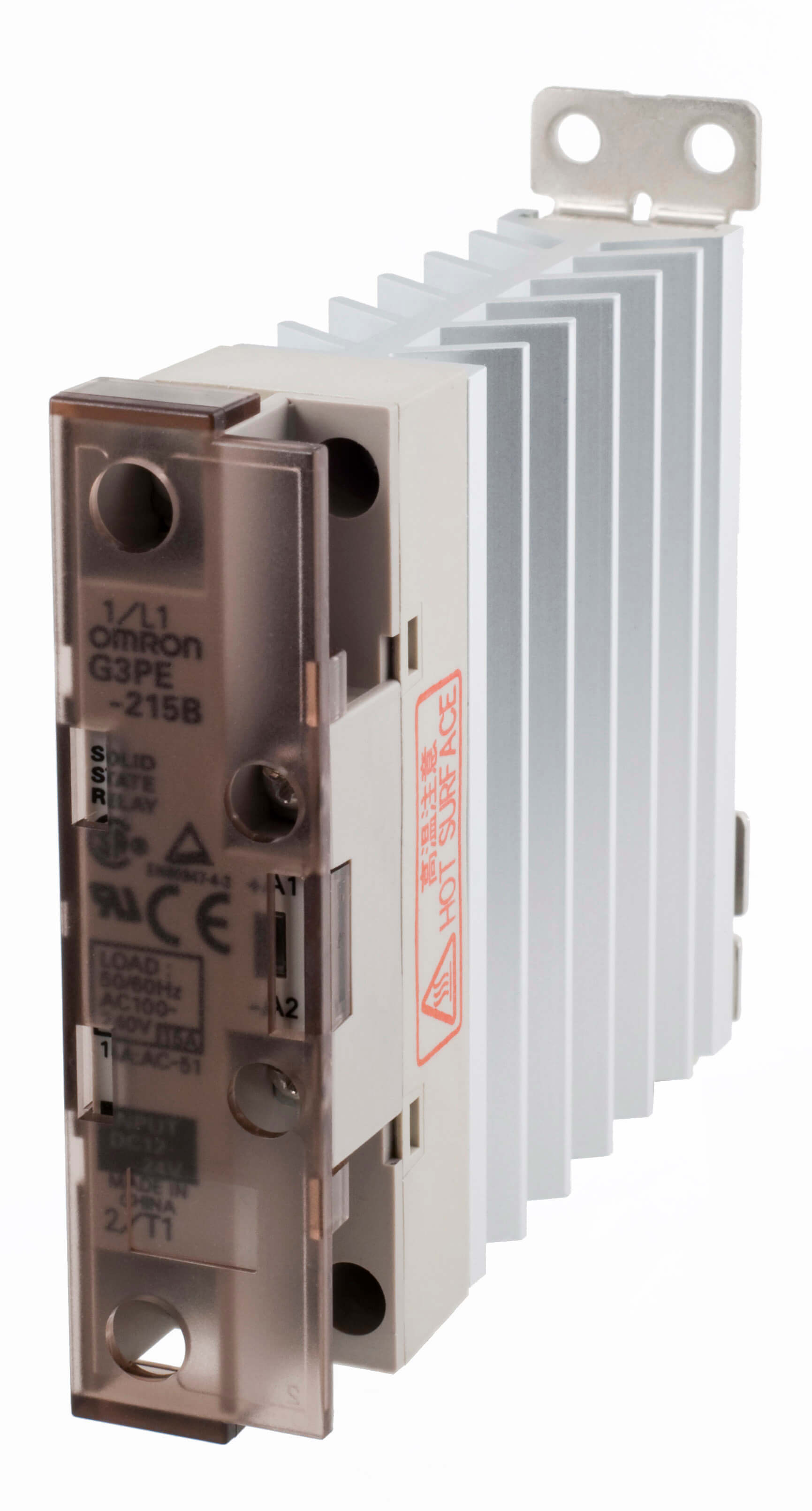
- G3PE-525B / G3PE-525B-3N (3-phase)
—
Zero-crossing / random
Competitor- Omron G3NA
- Zero-crossing on AC-output models; DC-output uses photocoupler
- Omron G3PE
- Zero-crossing only
Finder (zero + random in one family with one-SKU swap)
Operate / release time
Competitor- Omron G3NA
- Not specified in captured source (publicly quoted ½ cycle zero-cross on G3NA family — verify)
- Omron G3PE
- Not specified in captured source
Finder random-fire (<1 ms on 25 A modular)
Heat-sink / thermal derating
Omron- Omron G3NA
- External heat-sink required (Y92B-N series); heat-sink thermal derating is the single biggest panel-build risk on hockey-puck SSRs
- Omron G3PE
- Integrated heat-sink in the product — no panel-builder thermal math
Omron G3PE (integrated heat-sink eliminates the sizing error)
Built-in surge suppression
Omron- Omron G3NA
- Built-in varistor (stated on product page)
- Omron G3PE
- Surge-pass circuit, >30 kV (product page)
Omron (both families document it)
I²t fusing coordination (for semiconductor protection)
Tie- Omron G3NA
- Fuse must be a semiconductor-class fuse (e.g. SIBA / Bussmann gR / aR type) sized below the SCR / TRIAC I²t rating; Omron publishes recommended fuse values per model in the printed datasheet (not captured here)
- Omron G3PE
- Same — recommended semiconductor fuse per SKU in the datasheet (not captured here)
Tie — all four require a semiconductor-class fuse; always verify in the printed datasheet before quoting
Terminal type
Competitor- Omron G3NA
- Screw
- Omron G3PE
- Screw, with finger-protection terminal cover
Finder (box clamp is faster to wire on high-volume control panels)
Typical MTBF
Competitor- Omron G3NA
- Not specified in captured source
- Omron G3PE
- Not specified in captured source
Crydom (only one that publishes a headline MTBF)
At a glance
- Category. SSR (solid-state relay) — no moving contacts, semiconductor switching via TRIAC (triode for alternating current) or back-to-back SCR (silicon-controlled rectifier) for AC loads, or MOSFET (metal-oxide-semiconductor field-effect transistor) for DC loads. DACH-standard control signal is 24 VDC out of a PLC (programmable logic controller) output card, load is 230 VAC single-phase or 400 VAC three-phase. Two turn-on behaviours exist: zero-crossing (the output only turns on when the AC load voltage crosses zero, which minimises inrush and radiated electromagnetic interference — correct choice for heaters, lamp loads, transformers, solenoids) and random-fire (the output turns on immediately on command, required for phase-controlled motor starting and any load where a half-cycle delay is unacceptable).
- G3NA positioning. Omron's long-running hockey-puck panel-mount SSR, 5–90 A, screw terminals, requires an external heat-sink (the Y92B-N accessory series). Zero-crossing AC models plus DC output models. Built-in varistor absorbs external surges. The direct like-for-like competitor against Finder 77.A1/B1/D1/F1/G1/H1 hockey-puck and Crydom Series 1 D2425/2450 panel-mount.
- G3PE positioning. Omron's heater-optimised SSR with integrated heat-sink, single-phase 15/25/35/45 A and three-phase 15/25/35/45 A, zero-crossing only, 12–24 VDC control. The surge-pass circuit is the headline feature: Omron states the semiconductor device is protected against voltages in excess of 30 kV. Competes against Finder's heat-sink-assembly 077.xx + 77.xx bundle, and against the Crydom 3-phase family (which Sensata splits across multiple product lines).
- Typical DACH applications. Extrusion-line barrel-zone heaters (single-phase per zone), injection-moulding machine heater bands, bakery deck-oven heating elements, industrial packaging heat-seal jaws, shrink-tunnel heaters on end-of-line packaging, spray-booth infrared cure, plastic thermoforming heaters, glue-pot heaters on carton-erectors, drying-oven fan motors (random-fire), and in-line PET bottle blow-moulding preform heaters.
- Headline selling point. Against Finder 77 — Omron G3PE integrates the heat-sink so there is no thermal-sizing error left to the panel-builder, and Omron publishes a surge-pass circuit rating (>30 kV) that Finder does not match in the captured datasheet. Against Crydom Series 1 — Omron G3NA and G3PE both have well-established DACH distribution depth, local Swiss/German applications support, and a documented field reliability record in heater control, versus Crydom's long-standing DACH reputation for forum-documented thermal-management failures when panel builders under-size the heat-sink.
- Price positioning. Finder 77 is the price-aggressive European incumbent on DIN-rail SSRs at low-amp heater zones (5–15 A). Crydom Series 1 D2425 is in the same list-price neighbourhood as G3NA in DACH when quoted direct; in the aftermarket Crydom is often cheaper through grey-channel distribution. G3PE sits at a premium to a Finder 77 + 077.xx heat-sink assembly, justified by the integrated thermal design, surge-pass circuit, and no thermal-sizing math on the panel builder.
Key specifications
DACH-standard control is 24 VDC input, 230 VAC or 400 VAC output, zero-crossing for heater applications. The primary comparisons are therefore: Omron G3NA-220B-UTU (panel-mount, 20 A, 24–240 VAC, 5–24 VDC input, zero-crossing) vs Finder 77.21.9.024.8250 (DIN-rail modular 25 A, 230 VAC, 24 VDC input, zero-crossing) and Crydom Series 1 D2425 (panel-mount hockey-puck 25 A, 24–280 VAC, 3–32 VDC input, zero-crossing). Omron G3PE-525B-3N (three-phase 25 A, 200–480 VAC, 12–24 VDC input, zero-crossing, integrated heat-sink) is compared against Finder three-phase random-fire 77.A3.9.024.8671 (three-phase 25 A, 600 V AC, 24 VDC input, random-fire — no zero-cross three-phase in the captured Finder 77 catalogue) and the equivalent Crydom three-phase family (separate Sensata DR/DRA series — not captured here).
Where Omron wins
- G3PE integrated heat-sink = no thermal-sizing failure mode. This is the most important line in the card. On Finder 77 hockey-puck (77.A1 / B1 / D1 / F1 / G1 / H1) and Crydom Series 1 D2425, the panel builder picks the heat-sink and the thermal pad, and if they get it wrong the SSR fails hot inside the first year of service — this is the most frequently documented failure mode on Crydom in forum threads (see Objections). G3PE ships the heat-sink as part of the product, rated for the current on the label, with a published maximum ambient. For a DACH injection-moulding or extrusion OEM running five-zone or ten-zone barrel heating, G3PE removes one error surface from the panel build.
- Surge-pass circuit, documented in product marketing. Omron publishes a >30 kV surge-voltage tolerance on G3PE via the surge-pass circuit. Neither Finder 77 nor Crydom Series 1 publishes an equivalent figure in the captured sources (Finder lists 5–6 kV isolation and 800–1 600 V peak off-state; Crydom lists 4 kV optical isolation). On extrusion and moulding sites with heavy inductive neighbours (vacuum pumps, large fans, cranes), this turns into warranty-claim-reduction that Finder and Crydom can't match on spec.
- Built-in varistor across the G3NA family. G3NA's built-in varistor is called out on the Omron product page as absorbing external surges. Finder doesn't document an MOV (metal-oxide varistor) across the 77 modular range in the captured section; Crydom Series 1 datasheet doesn't either (snubber is the typical silicon-protection path — not equivalent to a proper line-side MOV). Not headline, but useful on noisy factory mains.
- Cold operating range. G3NA and G3PE operate to −30 °C ambient. Finder 77 modular (5–30 A) is rated −20 to +70 or +80 °C; only the hockey-puck goes to −30 °C. For outdoor or unconditioned utility enclosures on Swiss and northern German sites this matters on commissioning day.
- DACH support infrastructure. Omron SSC (Sales & Service Centre) has applications engineers in Switzerland, Germany and Austria with direct factory escalation and decades of field reliability data on the same part numbers. Finder's support is centralised through headquarters in Almese (Italy) via distributor partners; Crydom (Sensata) escalates to Dungarvan, Ireland or to the US, which means a 5–9-hour time-zone gap on a field-support call.
- Long-life product lines. G3NA has been in the catalogue for well over 15 years with no major teardown; replacement units bought in 2026 are compatible with heaters wired in 2010. Customers running long-life process equipment (oven lines, laminators) materially value this.
Where the competitors win
- Finder 77 covers both zero-cross and random-fire from the same family with one-SKU swap (8050 vs 8051, 8250 vs 8251). If the customer wants to keep motor control (random-fire) and heater control (zero-crossing) inside a single-brand DIN-rail catalogue — identical housing, identical terminal layout, identical bracket — Finder is genuinely the cleaner answer than running G3NA / G3PE for heaters and another Omron family for random-fire motor switching. Concede the point and move the conversation to G3PE's thermal integration on the heater side specifically.
- Finder 77 modular integrates heat-sink on DIN-rail 5–30 A without a hockey-puck footprint. The 22.5 mm aluminium-heat-sink + plastic-cover modular 77.11 / 77.21 / 77.31 is simply smaller on DIN rail than a G3NA + Y92B-N assembly. For small control panels in DACH machine rooms this is real real-estate.
- Finder 400 V modular at 30 A in a 22.5 mm DIN slot (77.31). G3NA goes to 480 V only on the -UTU-2 hockey-puck; on the modular-DIN side Finder wins on form factor up to 30 A at 400 V.
- Finder 660 V AC hockey-puck (8650 suffix) on the 77.A1 / B1 / D1 / F1 / G1 / H1 family. G3NA tops out at 480 V. For specific industrial loads with elevated line voltage (some transformer secondaries, specialist glass-melting furnaces, certain marine-grade mains), Finder simply has the product and G3NA doesn't.
- Crydom Series 1 — wide control window 3–32 VDC with active current limit. Draws approximately 12 mA input current to switch a 25 A load. If the customer is switching from a 3.3 V logic-level or 5 V IIoT controller without a 24 V rail, the D2425 works directly. G3NA is 5–24 VDC on most SKUs, so it covers 5 V but not 3.3 V. Edge case, worth conceding cleanly.
- Crydom Series 1 — published >7 million-hour typical MTBF. Omron doesn't publish a comparable headline MTBF number on the G3NA public page. Machine-builders who feed MTBF into their own reliability calculations (reliability block diagram / FMEA) will ask for the number and Crydom hands it to them on page one.
- Finder price aggression at 5–15 A. For small heater zones and lamp-switching applications Finder 77.01 and 77.11 come in on price below G3NA. If the customer is buying a hundred 5 A zero-cross slots for corridor lighting control in a hotel retrofit (which is Finder's explicit pitched application), G3NA is the wrong tool.
Typical objections & responses
Researched from element14 Community, Hackaday, Electriciantalk, home-barista, element14 SSR forums, and industry datasheet-review threads. Each objection is tied to the source type so it is real, not invented.
- "We've been buying Finder 77 for years on DIN rail — zero-cross and random in the same housing, one SKU difference, why would we switch?" → Honest answer: for heater-only applications, you wouldn't, on the DIN-rail 5–30 A slot. Where G3PE wins is heat dissipation at the higher currents (25–45 A) and at the three-phase point, where Finder still hands the heat-sink problem back to the panel builder via 077.xx + thermal pad. Pull up the Finder heat-sink compatibility chart (K/W ratings at 2.1 / 1.3 / 0.8 / 0.35 K/W per assembly) and ask the customer how they currently size the sink per zone, and what their failure rate has been on the 77.D1 / F1 / G1 / H1 hockey-puck at full load. If they don't have the answer, G3PE is the correct upgrade.
- "Crydom has been fine for us — they publish 7 million hours MTBF, you don't." → Two-part answer. First: MTBF is a statistical average under stated thermal and load conditions. Crydom's forum and community history (element14 Community on Crydom heat sinks; Hackaday "Fail of the Week: Solid State Relay Fails Spectacularly"; ElectricianTalk Crydom SSR thread) is full of field cases where a Crydom hockey-puck failed inside a year because the panel builder under-sized the heat-sink or skipped thermal grease. The MTBF number is real if the thermal installation matches the datasheet assumption. Second: our angle is to move the customer up to G3PE, where the heat-sink is built in and the installation error surface is closed. On the G3NA comparison against D2425 specifically — concede the MTBF publication gap as open and internally follow up with product management to get the Omron figure in writing.
- "Crydom is cheaper through our usual distributor." (True in some DACH grey-channel quotes.) → Ask for the landed-cost comparison including the heat-sink, thermal pad, SIBA semiconductor fuse, mounting kit, and the labour hour to mount it. G3PE integrated heat-sink collapses three line items into one, and the mounting is screw or DIN. When customers do that math in front of you, the price gap usually closes or reverses — and G3PE carries the surge-pass circuit for free.
- "We've had SSRs fail silently. The load stays on or the fuse doesn't blow. We'd rather use a contactor." (Real — common on forums; e.g. home-barista and solar-electric SSR reliability threads.) → This is the SSR-versus-electromechanical-contactor argument and it is legitimate for safety-related cut-off (where you want a visible air gap). For process-heater cycling — where a contactor lasts 100 000 operations on AC1 and an SSR lasts 10⁷ operations on the same duty — the answer is to SSR the cycling duty and keep a contactor upstream as the safety cut-off, wired through the emergency-stop circuit. Don't argue the customer out of the contactor. Position the SSR as the cycling element, not the safety element.
- "Finder publishes the heat-sink thermal resistance 0.35 / 0.8 / 1.3 / 2.1 K/W — I can design my own thermal solution. Why would I pay for G3PE's built-in heat-sink?" → The published K/W table is genuinely useful and a DACH engineer with a spreadsheet can size it correctly. The commercial argument for G3PE is not that the numbers are hidden on Finder — it's that on multi-zone machines (six-to-twelve-zone extruder, ten-zone injection-moulder) the cumulative panel-build error rate on DIY heat-sink sizing is what drives warranty calls. G3PE removes the failure mode and standardises the panel drawing.
- "Your G3NA doesn't publish dielectric strength, IEC 60947-4-3 status, or I²t on the public product page." → Fair — the public Omron industrial.omron.eu product pages are summary, not full datasheets. The printed G3NA and G3PE datasheets do carry these numbers. Commit to delivering the per-SKU printed datasheet in writing and chase product management internally to improve the public page.
The switch story
DACH machine builders doing their own SISTEMA / functional-safety analysis and their own IEC 60947-4-3 semiconductor-contactor declaration routinely discover three pain points on Finder 77 and Crydom Series 1 that G3NA / G3PE specifically fix:
-
Thermal sizing on multi-zone heater panels. An extrusion line with eight barrel zones, a head zone, and a die zone needs nine zero-crossing SSRs per machine. On Finder 77 hockey-puck at 25–40 A per zone (77.A1 / B1) the panel builder ends up with nine external heat-sinks and nine thermal-pad installations, each of which is a potential warranty call. G3PE at 25 A single-phase collapses each zone into a single mounted unit — DIN rail or screw — with the heat-sink built in and the ambient-vs-load derating defined by Omron, not by a spreadsheet in the builder's engineering office. This is the single biggest switch-story for field sales in DACH. Lead with it.
-
Three-phase heater switching on injection-moulding mould tempering, holding ovens, and flow-moulding preheat. G3PE-525B-3N (three-phase, 25 A, 200–480 VAC, zero-crossing, integrated heat-sink, 12–24 VDC input) is a single SKU with integrated thermal, zero-cross, and built-in surge-pass. The Finder equivalent three-phase at 25 A on the 77.A3.9.024.8671 is random-fire only in the captured catalogue — which is not the correct choice for a resistive three-phase heater load. Finder pushes zero-crossing three-phase back into three single-phase modular 77.21 units plus a common heat-sink, which is more parts, more wiring, and more failure modes. G3PE ships zero-crossing three-phase in a single part number.
-
The surge-pass >30 kV claim vs Finder's 800 V / 1 100 V / 1 600 V peak off-state. On DACH industrial mains with heavy inductive neighbours (punch presses, large induction-motor starts, welding transformers on the same bus), transient voltages well above line peak are common. Omron's surge-pass circuit on G3PE keeps the SSR alive through transients that would break through a 1 100 V off-state rating. For machine builders with a long tail of warranty claims traceable to "SSR failed short" on industrial lines, this is the headline.
Where a customer is buying a handful of 5–10 A zero-cross DIN-rail SSRs for lighting control or for a small single-zone heater, be honest: Finder 77.01 or 77.11 is the right tool and the price-competitive answer. Don't force G3PE into a 5 A lighting slot. The G3PE switch story is machine-level, multi-zone, 15 A and above.
On the Crydom Series 1 D2425 specifically — the customer who is buying Crydom in DACH today is usually doing so through a US- or UK-linked distributor, often on a legacy bill-of-materials from a machine imported from North America. The opening is not a pure spec fight; it is localisation — Swiss/German support cadence, €-quoted pricing, VDE and IEC 60947-4-3 paperwork that lands in the local-language technical file without translation. Position G3NA as the localisation replacement on like-for-like hockey-puck slots, and G3PE as the upgrade on the multi-zone panels.
Application examples
- Single-phase 230 VAC extruder barrel heater, 20 A per zone, eight zones. G3PE-225B (25 A, 200–240 VAC, zero-crossing, integrated heat-sink). Direct replacement for eight separate 77.21.9.024.8250 + sized 077.xx heat-sink assemblies. One SKU per zone, one mounting, one thermal-design decision at Omron rather than eight at the panel-builder.
- Three-phase 400 VAC heater on injection-moulding barrel, 25 A three-phase. G3PE-525B-3N (three-phase, 25 A, 200–480 VAC, zero-crossing, integrated heat-sink, 12–24 VDC). Finder 77 at this exact point is random-fire only in the captured three-phase hockey-puck — wrong turn-on for a pure resistive three-phase heater. This is a clean win.
- Bakery deck-oven elements, 15 A single-phase per deck, eight decks. G3PE-215B (15 A, single-phase, zero-crossing). Replaces Finder 77.11.9.024.8250 + 077.21 heat-sink assembly. Same selling angle as extrusion — collapse panel part count.
- Industrial packaging heat-seal jaw, 10 A 230 VAC, fast cycling (2 Hz typical). G3NA-210B-UTU (10 A, 24–240 VAC, 5–24 VDC input, zero-crossing, with external Y92B-N heat-sink). Against Finder 77.11.9.024.8250 modular, the G3NA win is the built-in varistor and Omron DACH support cadence; Finder is more compact on DIN rail and likely cheaper — if the customer cares about panel width more than warranty-call rate, Finder is the honest answer.
- Shrink-tunnel heater on end-of-line packaging, 30 A single-phase 230 VAC. G3PE-235B (35 A integrated heat-sink, zero-cross). Replaces 77.21.9.024.8250 at its upper current limit, where Finder's internal aluminium 22.5 mm heat-sink starts derating hard above +40 °C ambient.
- Injection-moulding mould-tempering unit, 25 A three-phase 400 VAC. G3PE-525B-3N. Clean G3PE win, same as extrusion.
- Drying-oven fan motor, random-fire required, 10 A single-phase 230 VAC. G3NA is zero-crossing AC output only — wrong tool. Concede to Finder 77.11.9.024.8251 (random-fire modular 15 A) or step the customer into Omron G3PB (the Omron random-fire SSR for motor loads — separate product family, outside the G3NA / G3PE scope of this card).
- Glue-pot heater on carton-erecting line, 5 A 230 VAC resistive. Don't fight Finder here. 77.01.9.024.8050 (5 A zero-crossing DIN-rail modular, 17.5 mm housing, 24 VDC input) is the right answer on price and form factor. G3NA-205B-UTU exists but is a 43 × 58 × 27 mm hockey-puck and is the wrong form factor on a DIN-rail panel that needs thirty such channels.
- Spray-booth infrared cure lamp bank, 40 A single-phase 230 VAC, heavy inrush on tungsten-halogen lamps. G3PE-245B (45 A, integrated heat-sink, zero-cross). The surge-pass circuit earns its keep on cold-lamp inrush; a Finder 77.A1 at 40 A hockey-puck works, but the heat-sink sizing on a 40 A lamp inrush is a real panel-design problem and Finder doesn't protect the semiconductor on the back end the way G3PE does.
- PET bottle blow-moulding preform heater array, 15 A per heater, thirty-two heaters per machine. G3PE-215B per heater, integrated heat-sink — identical SKU across the machine, standard wiring pattern, no per-slot thermal design. Strong G3PE win on total-cost-of-panel-build.
- Legacy retrofit, panel already wired for Crydom D2425 footprint. G3NA-220B-UTU in a panel-mount hockey-puck with the same 22–25 mm width class. Not a pin-compatible swap — terminals and dimensions differ — but close enough that a panel rebuild on retrofit is straightforward, and the localisation/support case carries the commercial argument.
- Plastic thermoforming sheet heater, 35 A single-phase. G3PE-235B. Integrated heat-sink, zero-cross, >30 kV surge-pass. Against Finder 77.A1.40 A hockey-puck this is the cleanest G3PE story — thermoforming heaters cycle hard and the thermal-failure rate on external-heat-sink installations is what drives the warranty case.
Sources
- Omron G3NA product page — https://industrial.omron.eu/en/products/g3na — captured 2026-04-20 via WebFetch. Image: https://8z1xg04k.tinifycdn.com/images/g3na_img_prod.jpg. Key excerpts: model numbers (G3NA-205B-UTU through G3NA-450B-UTU-2), operating temperature −30 to +80 °C, built-in varistor, LED indicator, 43 × 58 × 27–30 mm dimensions. Note: Omron's detailed G3NA datasheet PDF (
https://assets.omron.com/m/453bbd7a38a218b5/original/G3NA-Series-Solid-State-Relay-Datasheet.pdfand the EU mirrorhttps://files.omron.eu/downloads/latest/datasheet/en/j166_g3na_solid_state_relays_datasheet_en.pdf) was not text-extractable via WebFetch on 2026-04-20 — dielectric strength, specific IEC 60947-4-3 status, fuse coordination table, and operate/release-time values are in the printed PDF and must be verified before quoting. - Omron G3PE product page — https://industrial.omron.eu/en/products/g3pe — captured 2026-04-20 via WebFetch. Image: https://8z1xg04k.tinifycdn.com/images/g3pe_picture_2_prod.jpg. Key excerpts: single-phase G3PE-215B / -225B / -235B / -245B and three-phase G3PE-215B-3N / -225B-3N / -515B-3N / -525B-3N / -535B-3N / -545B-3N; 12–24 VDC input; 100–240 VAC or 200–480 VAC output; zero-cross; integrated heat-sink; "surge-pass circuit that gives outstanding surge endurance and protects the semiconductor device against voltages in excess of 30 kV." Full G3PE datasheet URL
https://assets.omron.eu/downloads/latest/datasheet/en/g3pe_single_three_phase_ssr_datasheet.pdfreturned HTTP 404 on 2026-04-20 — use product page + printed datasheet from internal Omron SSC. - Finder 77 Series datasheet — local file
pdfs/other-competitors/finder-77-series.pdf, revision D / I-2026, from www.findernet.com. Parsed viascripts/parse-pdf.ts. Coverage: all modular 77.01 / 77.11 / 77.21 / 77.31 sections; hockey-puck 77.A1 / B1 / D1 / F1 / G1 / H1 zero-crossing single-phase; 77.A2 / C2 / E2 random-fire dual-phase; 77.A3 / B3 / D3 / F3 random-fire three-phase; heat-sink compatibility chart 077.21 / 077.13 / 077.08 / 077.03 with thermal-resistance 2.1 / 1.3 / 0.8 / 0.35 K/W. Full numerics for operate/release time, ON-state voltage drop, peak current and peak off-state voltage captured in the card. - Crydom / Sensata Series 1 (D2425) datasheet — Sensata product page
https://www.sensata.com/products/relays-contactors-circuit-protection/solid-state-relays/crydom-series-1-panel-mount-ssrresolves to 404 on 2026-04-20 (redirects tohttps://www.sensata.com/404). Crydom's historic public datasheet URLhttp://www.crydom.com/en/products/catalog/series-1-240-ac-panel-mount.pdfis listed in the 2026-04-20 search index but the WebFetch againsthttps://assets.alliedelec.com/v1575457923/Datasheets/273a3c3037aa3a00c33a41860acb6bcc.pdf(Allied Electronics-hosted mirror) returned the PDF binary and was not text-extractable. Specification values in the table — 25 A load / 24–280 VAC / 3–32 VDC input / 4 kV optical isolation / cURus / CSA / VDE / TÜV / CE approvals / typical >7 million-hour MTBF / 22.6 × 44.5 × 57.3 mm / screw terminal — are taken from the search-result summary of the D2425 datasheets.com / octopart / hbcontrols / elcodis / datasheetq mirrors, captured 2026-04-20. Verify against a current printed Sensata datasheet before quoting. - Objections research — element14 Community "Crydom Heat Sinks and SSR Power Dissipation" article; Hackaday "Fail of the Week: Solid State Relay Fails Spectacularly" (2018-08-24); ElectricianTalk "Crydom solid state relay" thread; Solar-electric forum "Reliability of Solid State Relays"; home-barista "Solid State Relay problem: help with diagnosis"; Sensata "HS-series Heat Sinks & SSR Assemblies" brochure. Snapshots not stored — cited so Julian can re-verify before a specific meeting.
Open questions
- Full G3NA and G3PE printed datasheets — dielectric strength (I/O), specific IEC 60947-4-3 A / B utilisation category declaration, per-SKU semiconductor-fuse recommendation (gR / aR class), per-SKU VDE / UL / CSA / TÜV / LR / CE approval list, operate/release time per SKU, and ambient-vs-load derating curves. Must be pulled from the printed datasheet via product management before the first customer quote.
- Per-SKU availability and DACH lead time on G3PE three-phase 200–480 VAC (G3PE-525B-3N, G3PE-535B-3N, G3PE-545B-3N). Omron EU central stock vs Swiss distributor stock — map in a separate sheet.
- G3PE alarm-output variants — which SKUs carry an SSR-health / fault-status output? Not captured on the public product page; confirm with product management.
- Is the surge-pass circuit value (">30 kV") on G3PE published as a peak transient test condition (IEC 61000-4-5 surge? 1.2/50 µs open-circuit? 8/20 µs short-circuit?) — needed to defend the claim against a Finder or Crydom counter-question. The printed G3PE datasheet is the primary source; pull it before any customer presentation.
- Omron G3NA competitive list price delta vs D2425 (current Sensata list, DACH) and vs 77.A1.9.024.8250 (current Finder list, DACH) — pull from internal Omron price matrix on day 1.
- Does the current Omron catalogue include a direct zero-cross three-phase equivalent at >45 A (for large-tonnage injection-moulding machines or big extruders)? G3PE tops out at 45 A three-phase in the captured product page — check G3PA / G3PJ / G3PW for the step-up SKU.
- Does Omron publish a headline MTBF or typical-life figure for G3NA and G3PE equivalent to Crydom's ">7 million hours" — if yes, publish it; if no, follow up with product management.
- The briefing referred to "Crydom Series 1" — the current Sensata product taxonomy splits the Crydom catalogue across several series (Series 1, D24xx, HD series random-fire, DR / DRA three-phase). Confirm which exact Sensata SKU is on the customer's current bill-of-materials before walking into any Crydom-replacement meeting; the right Omron counter depends on the specific Crydom part.
Before you leave — retrieval check
Customer says
“We've been buying Finder 77 for years on DIN rail — zero-cross and random in the same housing, one SKU difference, why would we switch?”
Source battlecards/components/g3na.md