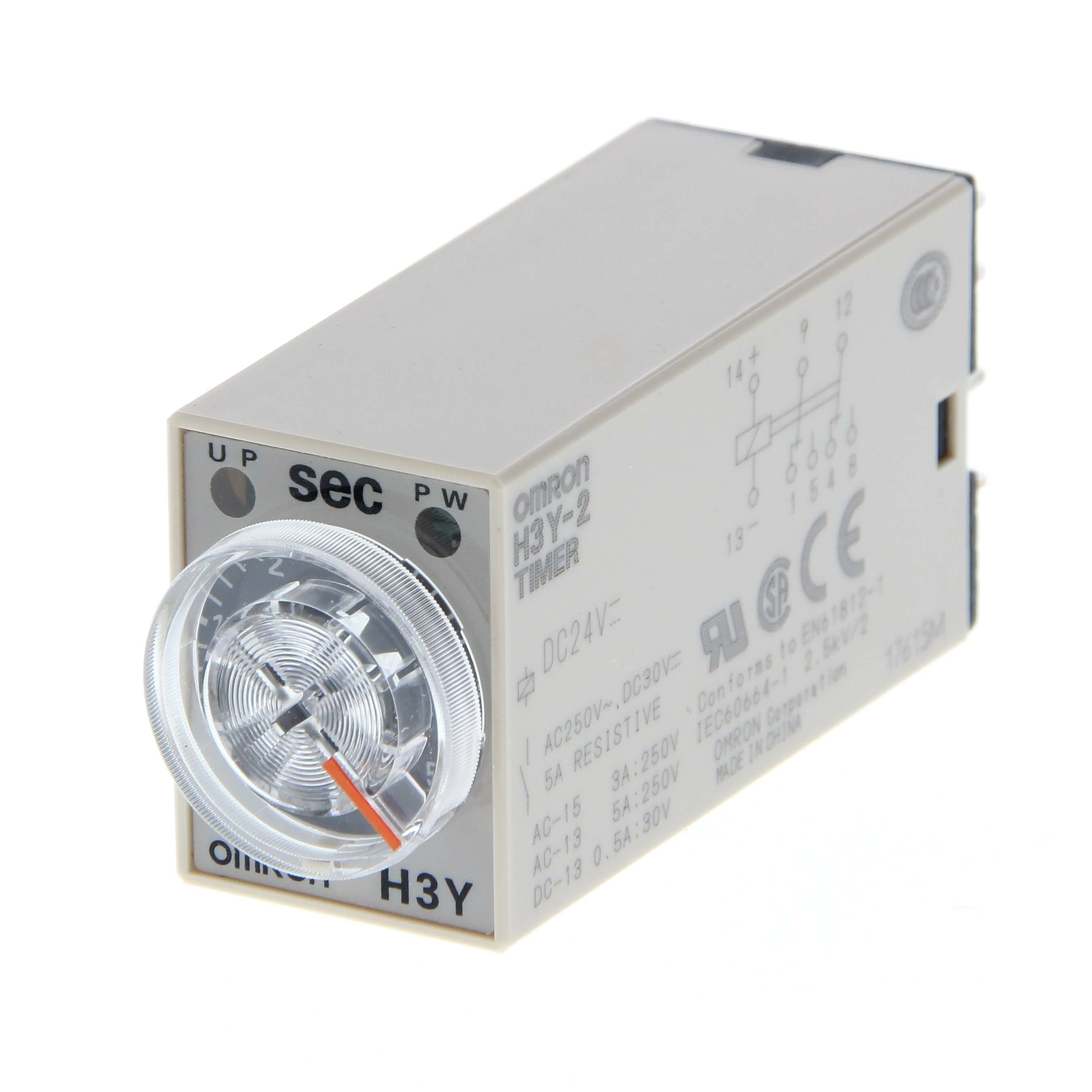
Omron H3Y (miniature plug-in analog timer) & H5CX (DIN 1/16 digital timer)
vs Finder 80 series (modular multi-function) and IDEC GT3 multi-function analog timer
Reference mode — everything visible. Use for live calls.
Three things to remember
Headline
11 single-timer modes + 4 twin-timer modes in one DIN 1/16 panel-cutout housing.
Omron variants
Competitor lineup
At a glance
- Category: Two different Omron products covering the same problem Finder 80 series and IDEC GT3 try to cover with a single SKU family. H3Y is a miniature plug-in analog timer in a MY-relay-compatible 8-pin (DPDT) / 14-pin (4PDT) socket footprint, single mode (ON-delay only), knob-set, EN 61812-1. H5CX is a DIN 48 x 48 mm (1/16 DIN panel cutout) multi-function digital timer with 11 output modes (on-delay I/II, off-delay, interval, signal on/off delay, flicker on/off start, cumulative, one-shot) plus twin-timer modes, backlit negative-transmissive LCD, IP66 front.
- Typical DACH applications: star-delta (Stern-Dreieck) motor starting, heater cycle (flicker with asymmetric on/off), conveyor start-up delay (Anlaufverzögerung), packaging-line dwell (Verweilzeit), machine warm-up delay after enable, lamp / siren cyclic flasher, delayed drop-out on cooling-fan run-on, single-shot pulse on a proximity trigger.
- Price positioning in DACH: H3Y competes head-on against IDEC GT3A on the plug-in octal-socket market (both ~40–80 EUR distributor street). Finder 80 series is the canonical DACH choice — stocked by every Elektrogroßhandel (Sonepar, Rexel, Würth), taught in the Elektroinstallateur Meister curriculum, typically 25–50 EUR street. H5CX competes one level up, against panel-mount digital multi-function timers — no direct equivalent in Finder 80 (Finder's digital timer is the 83 series, out of scope here).
- Headline selling point — H3Y: MY relay socket footprint (P2CF-08 / P2CF-11) means an installer who standardised on MY auxiliary relays can drop an H3Y in the same row with the same socket, same wiring pattern — zero retraining on a 12-V-to-230-V AC/DC mixed panel. EN 61812-1 + UL + CSA on a single SKU.
- Headline selling point — H5CX: 11 single-timer modes + 4 twin-timer modes in one DIN 1/16 panel-cutout housing, ±0.005 % setting accuracy (signal start, transistor output), programmable red/green PV colour on screw-terminal models, IP66 + NEMA 4 + UL Type 4X when combined with Y92S-29 waterproof packing. Replaces a drawer full of single-mode analog timers with one SKU the panel shop keeps on the shelf.
Key specifications
Two comparison tables — one for the miniature plug-in / modular DIN-rail tier (H3Y vs Finder 80.01 vs IDEC GT3A), one for the panel-mount digital tier (H5CX, with Finder 80 and IDEC GT3 named for context as they don't compete directly in that form factor).
Table 1 — Plug-in / DIN-rail modular analog tier
| Spec | Omron H3Y-2 (DPDT plug-in) | Finder 80.01 (17.5 mm modular, 35 mm DIN rail) | IDEC GT3A-3AF20 (8-pin plug-in DPDT) |
|---|---|---|---|
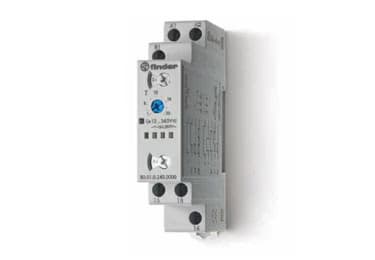
| Form factor / mounting | 8-pin octal plug-in (H3Y-2) or 14-pin (H3Y-4, 4PDT) into P2CF-08 / P2CF-11 / PYFZ-08 / PYFZ-14 socket. DIN-rail mount via socket. Also PCB-terminal variant H3Y-@-0. | 17.5 mm wide module, 35 mm DIN rail (EN 60715) direct mount, screw ("box clamp") or push-in terminals (80.51 P variant). Not socket-based. | 8-pin octal plug-in, socket-mounted (SR2P-06 etc.). |
| Timer modes supported | Single mode per SKU: ON-delay only (no off-delay, no flicker, no star-delta from this family). Off-delay uses the related H3DE-H; star-delta uses H3DT-G; multi-mode uses H3YN (multi-mode sibling, 4 modes). | Multi-function (80.01): AI on-delay, DI interval, SW symmetrical flasher (starting pulse on), BE off-delay with control signal, CE on- and off-delay with control signal, DE interval with control signal on. 80.01 NFC variant also adds LI asymmetrical flasher and LE asymmetrical flasher with control. Mono-function siblings: 80.11 on-delay, 80.21 interval, 80.41 off-delay with control, 80.61 true-power-off-delay, 80.82 star-delta (2 NO / DPST-NO, 6 A), 80.91 asymmetrical flasher. | Multi-function: On-delay (A), Interval (B), Cycle-OFF start (C), Cycle-ON start (D), with "4 selectable operation modes on each mode". Does NOT natively ship star-delta in this sub-family — GT5Y is IDEC's star-delta dedicated timer. |
| Supply voltage | AC: 24, 100–120, 200–230, 240 VAC (50/60 Hz). DC: 12 VDC (H3Y-2 / H3Y-2-0 only), 24, 48, 100–110, 125 VDC. One SKU per voltage band. Operating range 85–110 % (12 VDC: 90–110 %). | 12–240 V AC/DC single SKU (80.01, 80.01 NFC, 80.91), with "PWM clever" multi-voltage input. Mono-function siblings 24–240 V AC/DC. Operating range 10.8–265 V. | 100–240 VAC on GT3A-3AF20 (other GT3A variants cover 24 VAC/DC). |
| Timing range | Fixed range per SKU: rated times 0.5 s / 1 s / 5 s / 10 s / 30 s / 60 s / 120 s / 3 min / 5 min / 10 min / 30 min / 60 min / 3 h — each with its own time-setting band (e.g. 0.04–0.5 s, 0.5–10 s, 1–30 min, 0.1–3 h). Knob-set. | Six time scales selectable on one SKU: (0.1–2) s, (1–20) s, (0.1–2) min, (1–20) min, (0.1–2) h, (1–24) h. Rotary range selector + trimmer. 80.01 NFC can be programmed via smartphone NFC + Finder Toolbox app. | 0.1 s to 180 h on one SKU (rotary selector). |
| Contact configuration | DPDT (H3Y-2) or 4PDT (H3Y-4). Time-limit operation / self-resetting. | 1 CO (SPDT) on 80.01 / 80.11 / 80.21 / 80.41 / 80.51 / 80.61 / 80.91. 2 NO (DPST-NO) on 80.82 star-delta only. 1 NO (SPST-NO) on 80.71 solid-state-output variant. | DPDT (5 A) on GT3A-3AF20; 3 A DPDT, or SPDT variants in the broader GT3 family; 11-pin variants offer additional contacts. |
| Contact rating | H3Y-2: 5 A at 250 VAC, resistive (cos φ = 1). H3Y-4: 3 A at 250 VAC, resistive. Contact materials: Ag (H3Y-2) / Au-clad + Ag-alloy (H3Y-4). Minimum load: 1 mA at 5 VDC (H3Y-2), 1 mA at 1 VDC (H3Y-4). | 16 A / 30 A peak AC1. AC15 (230 V): 750 VA. Single-phase motor 230 V: 0.55 kW. DC1 breaking: 16 A / 0.3 A / 0.12 A at 24 / 110 / 220 VDC. Min. switching load 500 mW (10 V / 5 mA). AgNi contact material. 80.82 star-delta: 6 A / 10 A peak, AC15 300 VA, no motor rating (dry contacts into contactor coils). | 5 A at 240 VAC / 24 VDC on GT3A-3AF20. |
| Accuracy (of operating time, full scale) | ±1 % FS max (0.5-s range: ±1 % ±10 ms). Influence of voltage: ±2 % FS. Influence of temperature: ±2 % FS. Setting error: ±10 % ±50 ms FS. | Repeatability ±1 %; setting accuracy full range ±5 %. | Not specified in captured source. |
| Electrical life | H3Y-2: 500 000 operations min. (5 A at 250 VAC, resistive, 1800 ops/h). H3Y-4: 200 000 ops min. Mechanical: 10 000 000 ops min. | 50 000 cycles AC1 at rated load (80.01 / NFC / 11 / 21 / 41 / 91); 100 000 cycles AC1 on 80.61 solid-state and 80.51; 60 000 cycles on 80.82 star-delta; 100 million electrical life on 80.71 SST. | Not specified in captured source. |
| Operating ambient temperature | −10 to +50 °C (no icing). | −20 to +60 °C. | −10 to +50 °C (per Standard Electric Supply listing). |
| Enclosure rating | IP40 (body). | IP20 (module). | IP20 / IP40 (per Standard Electric Supply listing; confirm per SKU). |
| Dielectric strength | 2 000 VAC 50/60 Hz for 1 min between current-carrying terminals and exposed metal parts / between power and output / between different-pole contacts (2-pole). 1 500 VAC between different-pole contacts on 4-pole. Impulse withstand: 3 kV between power terminals (HV rails), 1 kV for 12–48 VDC. | 4000 VAC between input and output (80.01 / NFC / 11 / 21 / 41 / 51 / 82 / 91). 1000 VAC between open contacts. Impulse 6 kV input-to-output for same models. | Not specified in captured source. |
| Standards / approvals | Conforms to EN 61812-1 (IEC 61812-1, timing relays — functional and safety requirements). UL listed, CSA certified. CE / EMC per EN 61812-1 + EN 55011 (Group 1 class A) + IEC 61000-4 series. | CE; UL (per Finder general technical information — UL ratings differ by SKU); IEC 61812-1 expected on functional behaviour but not explicitly printed in the captured Finder 80-series catalogue table. | cULus listed (UL E55996), CE marked (GT3A-3AF20). IEC 61812-1 compliance not stated on the captured retailer page — verify on the IDEC datasheet PDF. |
| VDE finger-protection / BGV-A3 | Not specified in captured source for H3Y body (finger-safe versions exist on the socket side: PYFZ-08-E, PYFZ-14-E, PY@A-E — required for modern Swiss / DACH installs). | IP20 panel, screw-box-clamp or push-in terminals. Finger-safe status on the terminal per current Finder datasheet — verify per SKU. | Not specified in captured source. |
| Weight | Approx. 50 g (H3Y, body only). | Not specified in captured source (typical 17.5 mm modular is ~60–80 g). | Not specified in captured source. |
| Supply ripple / DC immunity | AC: single-phase full-wave rectified DC may be used on DC-rated units. Diode for reverse-voltage protection provided on DC-supply models. | DC non-polarised on multi-voltage SKUs (advantage when panel DC polarity is uncertain during commissioning). | Not specified in captured source. |
Table 2 — Panel-mount digital (DIN 1/16) tier — H5CX and where Finder / IDEC sit
| Spec | Omron H5CX-A / H5CX-A11 / H5CX-L8 (multifunction digital) | Finder 80 series (for reference — DIN-rail modular, not panel-mount) | IDEC GT3A (for reference — plug-in octal analog, not panel-mount) |
|---|---|---|---|
| Form factor / panel cutout | DIN 48 x 48 mm (1/16 DIN), panel cutout 45 x 45 mm, depth behind panel approx. 78 mm incl. terminals. H5CX-A: screw terminals (flush mount). H5CX-A11: 11-pin socket. H5CX-L8: 8-pin socket. | 17.5 mm wide, 35 mm DIN-rail mount — no panel cutout. | Plug-in socket, no panel cutout. |
| Display | 2-row, 4-digit, 7-segment negative-transmissive LCD with backlight. PV (present value) 11.5 mm, SV (set value) 6 mm. Programmable PV colour: red or green (H5CX-A screw-terminal models) to visually indicate output status. | Rotary trimmer, no digital readout. | Rotary trimmer, no digital readout. |
| Timer modes | 11 output modes: A, A-1, A-2, A-3 (power-ON delay variants), b, b-1 (signal-ON delay variants), d (interval), E (cumulative), F (signal-OFF delay), Z (twin-timer flicker on-off duty adjustable) — plus ton / toff twin-timer variants. Also reset, gate, and signal inputs. One-shot output time 0.01–99.99 s. | 6 functions on the multi-function 80.01 (AI / DI / SW / BE / CE / DE), up to 7 with 80.01 NFC (adds LI / LE). | 4 modes on GT3A (A on-delay / B interval / C cycle-off / D cycle-on). |
| Time range | 0.001 s to 9999 h on one SKU (ten range bands: 9.999 s / 99.99 s / 999.9 s / 9999 s / 99 min 59 s / 999.9 min / 9999 min / 99 h 59 min / 999.9 h / 9999 h). | 0.1 s to 24 h on multi-function. | 0.1 s to 180 h on GT3A-3AF20. |
| Accuracy | Power-ON start: ±0.01 % ±50 ms max. Signal start: ±0.005 % ±30 ms max. Signal start, transistor output: ±0.005 % ±3 ms max. | Repeatability ±1 %; setting accuracy ±5 % full scale. | Not specified in captured source. |
| Supply voltage | 100–240 VAC 50/60 Hz, or 24 VAC 50/60 Hz / 12–24 VDC (permissible ripple 20 % p-p max). Operating range 85–110 % rated (12–24 VDC: 90–110 %). | 12–240 V AC/DC on 80.01. | 100–240 VAC on GT3A-3AF20. |
| Control output | SPDT relay: 5 A at 250 VAC / 30 VDC resistive. Min. applied load 10 mA at 5 VDC. Transistor output: NPN open-collector, 100 mA at 30 VDC, residual ≤1.5 VDC. EN 60947-5-1 category: AC-15 250 V 3 A / AC-13 250 V 5 A / DC-13 30 V 0.5 A for contact output; EN 60947-5-2: DC-13 30 V 100 mA for transistor output. NEMA B300 pilot duty. | SPDT 16 A AC1 / AC15 750 VA / 0.55 kW motor 230 V on 80.01. | DPDT 5 A at 240 VAC on GT3A-3AF20. |
| Inputs | Signal (start), reset, gate. No-voltage input (NPN) or voltage input (PNP 4.5–30 V) — switchable. ON residual voltage ≤3 V; OFF impedance ≥100 kΩ. Minimum input pulse width 1 ms or 20 ms selectable. | Control signal (B1) on 80.01. | Start, reset, gate inputs. |
| Reset | Power reset, external reset, manual reset. Minimum power-opening time 0.5 s (except A-3, b-1, F modes). Sensor waiting time 250 ms max. | Recovery time 100 ms; minimum control impulse 50 ms. | Not specified in captured source. |
| Operating ambient temperature | −10 to +55 °C (−10 to +50 °C if timers mounted side-by-side), no icing / no condensation. | −20 to +60 °C. | −10 to +50 °C. |
| Enclosure / ingress protection | Panel surface: IP66 + NEMA 4 + UL Type 4X (indoors) when mounted with Y92S-29 waterproof packing + Y92F-30 flush mounting adapter. | IP20. | IP20 / IP40. |
| Standards / approvals | UL 508 listed, UL 50 Type 4X, CSA C22.2 No. 14. Conforms to EN 61010-1 (pollution degree 2, overvoltage cat. II). Conforms to VDE 0106/P100 (finger protection). EMC per EN 61326 (EMI: EN 55011 group 1 class A; EMS: ESD 4 kV contact / 8 kV air, RF 10 V/m, burst 2 kV power line). Note: the H5CX-N family datasheet cites EN 61812-1 B300 pilot duty (per ia.omron.com PDF) — confirm exact print on the H5CX (non-N) variant in DACH. | CE; UL per SKU; IEC 61812-1 applicability not explicitly printed in captured 80-series catalogue table. VDE finger-protection not stated. | cULus listed; CE. IEC 61812-1 / VDE 0106/P100 not specified in captured source. |
| Memory / key protection | EEPROM: 100 000 overwrites min., data retention ≥10 years. Key protection: yes. | No digital memory (analog). | No digital memory (analog). |
| Weight | H5CX-A: ~135 g. H5CX-A11 / -L8: ~105 g. | Not specified in captured source. | Not specified in captured source. |
Where Omron wins
- (H5CX) Mode breadth + accuracy in one panel-mount SKU. 11 single-timer modes plus 4 twin-timer modes on one housing, with ±0.005 % signal-start accuracy. Finder 80.01 covers 6 functions at ±5 % setting accuracy on a 17.5 mm DIN module — that is an installer-friendly panel piece, not a process-control-grade digital timer. When a DACH machine builder needs a dwell or curing time repeatable to milliseconds across production batches (packaging wrappers, heat-seal dwell, injection-mould cooling), H5CX is the honest answer; Finder 80 isn't.
- (H5CX) Programmable PV colour (red or green) on screw-terminal models. On a crowded panel with a dozen timers and counters, the operator can see at a glance which timers are currently timing versus output-on versus reset. Finder 80.01 has two LEDs for power and output status — no equivalent.
- (H5CX) IP66 + NEMA 4 + UL Type 4X washdown (front face) with Y92S-29 packing. For food-and-beverage panels in Germany and Switzerland (Nestlé, Emmi, Bell, Hügli, Hochland), where a washdown spec is table stakes for the HMI row, H5CX satisfies the spec; Finder 80 at IP20 doesn't belong in the same panel cutout.
- (H5CX) VDE 0106/P100 finger-protection. Explicitly documented in the H5CX datasheet. For Unfallverhütungsvorschrift BGV-A3 / DGUV V3-compliant panels in DACH, this saves the installer writing a derogation when the panel door is opened under power.
- (H3Y) MY-relay socket compatibility. H3Y shares the P2CF-08 / P2CF-11 / PYFZ-08 / PYFZ-14 socket footprint with the MY family auxiliary relay. An installer standardised on MY for control-relay logic can add an H3Y timer to the same DIN-rail row using the same socket, same cabling pattern. Finder 80 is a different 17.5 mm module and IDEC GT3 uses its own SR2P-06 socket family — both require a different socket SKU in the panel's BOM.
- (H3Y) 12 VDC availability. H3Y-2 and H3Y-2-0 ship 12 VDC as a native supply option — important for battery-backed or intrinsically-safe control loops. Finder 80.01 operating range starts at 10.8 V (practically 12 V) AC/DC too, so roughly a tie on that alone, but GT3A-3AF20 at 100–240 VAC is not offered at 12 VDC.
- (H3Y) DPDT in a plug-in octal footprint. 2 changeover contacts at 5 A (H3Y-2) or 4 changeover contacts at 3 A (H3Y-4) in a plug-in body. Finder 80.01 is SPDT only; the DPDT-equivalent in Finder is the 80.82 (star-delta, DPST-NO only — not general-purpose DPDT). When the design needs two independent independent changeovers (e.g. timer drives contactor coil and an indicator lamp on separate circuits), H3Y is the cleaner answer than stacking two Finder modules.
- (H3Y and H5CX) Omron H3DT-G for dedicated star-delta. Out of scope on the H3Y SKU itself — but part of the Omron conversation: where Finder pushes customers to the 80.82 star-delta module, Omron's answer is H3DT-G. Mention this alongside the H3Y proposal when the customer's line list includes Stern-Dreieck motor starts; don't pretend H3Y does star-delta natively.
Where Finder 80 and IDEC GT3 win
- (Finder 80) DACH installer mindshare. Finder is as canonical in a Swiss or German Schaltschrank as Wago is on the terminal block. Electricians' Meister-level exam prep references 80-series timers by SKU. Fighting this is a cultural project, not a spec-sheet project — concede it, then pivot on the one feature Finder can't match (digital accuracy, true multi-function in ONE SKU for H5CX; MY-socket compatibility for H3Y).
- (Finder 80) 17.5 mm DIN-rail density. A 200 mm DIN rail holds roughly eleven 17.5 mm modules. H3Y in an 8-pin socket plus its socket takes ~28 mm; H5CX needs a 45 x 45 mm panel cutout, not DIN rail. When the panel has ten timers and the door is already crowded, 80.01 wins on space.
- (Finder 80) Multi-voltage one-SKU stocking (12–240 V AC/DC). The Elektroinstallateur carries one part number on the van; it works on whatever supply the panel has. H3Y requires the right voltage variant stocked per job. Real advantage in service / retrofit scenarios. H5CX partly answers this with "100–240 VAC or 24 VAC/12–24 VDC" — still two SKUs, not one.
- (Finder 80) 16 A contact rating on most mono- and multi-function SKUs. H3Y-2 is 5 A, H3Y-4 is 3 A, H5CX SPDT is 5 A. When the timer has to switch a larger direct load (contactor pilot + small motor + solenoid in parallel) without an interposing contactor, Finder wins.
- (Finder 80) −20 to +60 °C operating range vs H3Y / H5CX −10 to +55 °C. Slight but real in outdoor enclosures (e.g. blind / shutter / gate controls the Finder 80 series datasheet explicitly calls out as typical applications).
- (Finder 80) 80.01 NFC variant programmable via smartphone. The Finder Toolbox app on Android / iOS writes function and timing parameters via NFC to the module without power. Omron H5CX requires front-panel keys or socket removal to change settings. For mass-installations (multi-panel building-automation rollouts) this is a genuine productivity feature — H5CX has no answer.
- (IDEC GT3) Wide single-SKU time range (0.1 s to 180 h) on GT3A-3AF20 in an octal plug-in with DPDT 5 A. H3Y is single-mode single-range per SKU. For a DACH panel shop that dislikes Finder's 17.5 mm module aesthetic and wants a plug-in octal, GT3 is the closest competitor to H3Y — honest framing.
- (IDEC GT3) Multi-mode in one octal plug-in. Matches H3YN (the multi-mode H3Y sibling) more fairly than matching H3Y itself; if the customer is already evaluating GT3, propose H3YN not H3Y.
Typical objections & responses
Researched from Finder product marketing pages, DACH installer shop listings, and general timer-forum sentiment. The Finder 80 vs Omron H3Y / H5CX comparison is under-discussed on PLCtalk — objections here are mostly catalogue-logic and installer-habit objections, not reliability forum hits.
- "We always use Finder 80.01 here. It's on the Meisterprüfung syllabus." (Most common response in a DACH panel shop — cultural, not technical.) → Agree first, then separate the problem: "For a general-purpose on-delay + off-delay + flicker combination in a building-automation Schaltschrank, 80.01 is the right industrial choice. But you also build machines where a cycle dwell needs to repeat within a few milliseconds batch-to-batch. Finder's ±5 % setting accuracy isn't for that. That's where H5CX at ±0.005 % comes in. We're not asking you to drop 80.01 for blinds and shutters — we're asking you to pick up H5CX where the machine side of your business can't afford drift." Don't attack Finder's core turf; expand yours.
- "Finder 80 is cheaper." (Usually true at distributor street price — 80.01 around 25–50 EUR, H3Y around 40–80 EUR, H5CX around 120–180 EUR.) → "On a pure BOM line, yes. On a panel-cost-of-ownership basis the maths flips when the H5CX multi-mode replaces three Finder mono-function timers (80.11 on-delay + 80.41 off-delay + 80.91 flasher) — that's roughly 75–120 EUR of Finder plus the extra DIN rail space, versus one H5CX. On H3Y versus 80.01 there is no price win — the sell is socket compatibility with MY, DPDT / 4PDT in one housing, and 12 VDC. Don't spin this." (If the customer is a Bauunternehmer doing hundreds of identical panels, Finder 80.01 may genuinely be the right economic choice — concede it.)
- "Why would I want a digital timer? Analog with a knob is easier to set." (Heard on PLCtalk general digital-vs-analog threads — legitimate for one-timer / one-machine contexts.) → "For a one-timer-one-machine install, agree — Finder 80.01's knob is faster. For a factory with 50 timers across 20 lines where Betriebsleitung wants repeatable dwell times enforced and logged, the H5CX key-lock + password + PV colour indication is what's actually being bought — not the 'digital display' cosmetic. Also the ±0.005 % signal-start accuracy is impossible to hit with a knob."
- "The Omron H3Y only does on-delay. That's useless for a real panel." (Technically correct — this is H3Y's real limitation.) → "Fair. That's why for single-mode on-delay applications H3Y is 40 EUR and fits the MY socket, and for multi-mode applications we don't propose H3Y — we propose H3YN (same family, four modes: on-delay / interval / flicker-OFF start / flicker-ON start) or H5CX if the customer needs digital precision, or H3DT-G specifically for star-delta. Don't force H3Y where H3YN or H5CX is the right answer — the H3Y story is 'plug into the MY socket ecosystem you already have' and that's it."
- "Finder has the 80.82 for star-delta. What's Omron's answer?" → "H3DT-G. DIN-rail mount, dedicated star-delta timer, 0.1 s to 120 min on-delay plus fixed 40–500 ms or programmable transfer gap, 24 V–240 V AC/DC multi-voltage on the modern variant. We don't try to push star-delta onto H3Y or H5CX — star-delta has its own Omron SKU. Same philosophy as Finder's 80.82 split from 80.01."
- "IDEC GT3 does the 4-mode multi-function job in an octal plug-in — Omron H3Y can't." (Valid on H3Y specifically — a weak objection if the conversation is about H3YN or H5CX.) → "On GT3 vs H3Y head-to-head, yes — GT3 has the edge on modes per SKU. Against H3YN the Omron multi-timer, it's a fair fight (4 modes each, octal plug-in). Against H5CX at 11 modes, Omron wins on the mode count and has the digital display too — but we're in a different form factor at that point. Respect the form-factor question; don't compare a panel-mount HMI-class timer to an octal plug-in analog."
- "Is Omron really IEC 61812-1 compliant like the competitors?" (Reasonable technical due-diligence question — Omron is, but worth saying out loud.) → "Yes — H3Y datasheet explicitly says 'Conforms to EN 61812-1 and approved by UL and CSA'. H5CX datasheet cites EN 61010-1 pollution degree 2 + VDE 0106/P100 finger-protection + EN 61326 EMC; EN/IEC 61812-1 applies to timing-relay functional requirements and Omron's H5CX-N public datasheet cites 'EN61812-1 B300 pilot duty' on the contact rating. Confirm the specific SKU's Declaration of Conformity in writing before a safety-critical install — same advice as for Finder or IDEC."
The switch story
Two parallel stories depending on which tier the customer sits in.
Plug-in / DIN-rail modular tier (H3Y vs 80.01 vs GT3). Don't fight the 80.01 on its home turf of building-services Schaltschränke. Target two specific openings. Opening one: customers who already standardise on Omron MY auxiliary relays. They have P2CF-08 sockets, MY wiring patterns, and MY spares on the shelf. Adding an H3Y to that ecosystem is zero-retraining; adding a Finder 80.01 means a second socket family, second cabling pattern, second set of spares. Opening two: customers who need DPDT or 4PDT from a single timer body (H3Y-2 / H3Y-4) rather than stacking an 80.01 SPDT plus an external interposing relay. For customers who want multi-mode in an octal plug-in and aren't MY-socket-aligned, honestly propose H3YN (Omron's multi-mode sibling in the same H3Y body family) as the GT3 comparator — that is the fair fight. Where the customer is simply cost-anchored on Finder 80.01 and does general building automation, let Finder keep that seat and focus the sale elsewhere.
Panel-mount digital tier (H5CX). This is the cleaner sale. Finder 80 series has no panel-mount digital direct equivalent; Finder's digital timer is the separate 83 series, and in DACH the dominant panel-mount digital timer is often Omron's own H5CX or H3CR-F. The customer buying a panel-mount digital has already decided they need either (a) multiple modes in one housing, (b) accuracy better than ±5 %, or (c) a readable display at the HMI row — all three are H5CX strengths. The main loss case is cost: H5CX is 3–5× the price of an 80.01. So qualify the application: if the customer genuinely needs multi-mode + accuracy + display (packaging dwell, heater cycle, batch timer, mould cooling), H5CX wins. If they need a 17.5 mm DIN-rail on-delay-plus-off-delay in a building panel, walk away and let Finder keep the job — trying to force H5CX there is how you lose the next order.
Star-delta note. Whenever Finder 80.82 comes up for Stern-Dreieck motor starts, the Omron answer is H3DT-G (not H3Y, not H5CX). Name it explicitly so the customer doesn't think Omron ducks the category.
Application examples
DACH-flavoured. At least eight required, below are thirteen.
- Star-delta (Stern-Dreieck) motor starter, 3-phase 400 V AC, 7.5 kW pump or fan. Finder 80.82 is canonical. Omron: H3DT-G (DIN-rail dedicated star-delta timer). H3Y and H5CX are NOT the right Omron answer here — name H3DT-G up front.
- Conveyor start delay (Anlaufverzögerung) on a packaging line. 5–30 s on-delay from the line-enable signal to conveyor motor, to let upstream sensors settle. H3Y-2-@-5S or H3Y-2-@-30S (on-delay, DPDT, 5 A). Alternative: 80.11 on-delay mono-function.
- Packaging dwell / heat-seal dwell on a form-fill-seal (FFS) wrapper. Repeatable dwell time 0.2–2.0 s across thousands of cycles per shift. H5CX-A in signal-on-delay mode (F) + transistor output — ±0.005 % ±3 ms accuracy. Finder 80.01 at ±5 % setting is not precise enough for this.
- Machine warm-up delay after enable. 60–600 s power-on-delay between main disconnect close and machine-ready indication (hydraulic temperature stabilise, spindle warm-up). H3Y-2-@-10M on-delay or H5CX-A in A-mode (power-on-delay) with key-lock to prevent operator tampering.
- Heater cycle (Heizungstakt) on an injection-mould or extruder zone. Asymmetric flicker with independently adjustable ON and OFF times — e.g. 2 s on / 8 s off. H5CX-A in twin-timer Z-mode (ton / toff flicker, duty adjustable) or Finder 80.01 in SW (symmetric) / 80.91 (asymmetric flasher) for lower-precision uses.
- Cooling-fan run-on after motor stop. Off-delay 30–300 s from motor-run signal removed to fan contactor drop-out. H3Y does NOT do off-delay — use H3DE-H (Omron off-delay analog timer) in H3Y's place, or H5CX-A in signal-off-delay mode (F). Finder equivalent: 80.41 off-delay with control signal or 80.61 true-power-off-delay.
- Signal-lamp / siren flashing on a safety cascade. Symmetric 1 s on / 1 s off flasher drive for a 24 VDC signal lamp on a Schutztür-cascade. H5CX-A Z-mode or Finder 80.01 SW.
- Single-shot pulse from a proximity sensor. Fixed 100 ms pulse output on every leading edge of a PNP proximity input — part-counting gate, one-shot cylinder trigger. H5CX-A one-shot output (0.01–99.99 s). Finder 80.01 BE mode (off-delay-with-control) approximates this but at ±5 %.
- Lift / elevator (Aufzug) door-close delay. 3–8 s on-delay before door-close motor engages after call-button release. Finder 80-series datasheet calls out lifts explicitly as a target application. H3Y-2 at 5 s or 10 s, or H5CX in A-3 mode.
- Blind / shutter / gate (Rollladen, Tor) delay in building automation. Finder 80-series calls this out as canonical. H3Y-2 on-delay or H5CX for multi-stage operation. Outdoor enclosure may require the −20 °C floor of Finder 80 over the −10 °C floor of H3Y / H5CX — concede in that scenario.
- Door-opener (Tür-öffner, Torantrieb) auto-close timer. 30–180 s off-delay from last manual trigger to motorised close. Off-delay analog → H3DE-H or 80.41; digital multi-function with key-lock → H5CX-A signal-off-delay.
- Cumulative running-hours timer on a critical pump. Track total run-hours to trigger preventive-maintenance alarm at, say, 2000 h. H5CX-A E-mode (cumulative) — cumulative timing on signal input, retained in EEPROM. Finder 80 and IDEC GT3 have no cumulative mode in this family.
- Welding-cell weld-time dwell. 0.05–5.00 s dwell with repeatability across 10 000+ welds per shift. H5CX-A in signal-on-delay mode + transistor output, ±0.005 % ±3 ms. Hard requirement — Finder 80 analog timer is not appropriate for this.
Sources
- Omron H3Y datasheet — downloaded 2026-04-20 from
https://files.omron.eu/downloads/latest/datasheet/en/m092_h3y-series_solid-state_timers_datasheet_en.pdf(filenamem092_h3y-series_solid-state_timers_datasheet_en.pdf, approximately 6.96 MB). Local copypdfs/omron/h3y.pdf. Key tables parsed: Model Number Structure (p. 2), Specifications / Time Ranges / Ratings (pp. 4–5), Characteristics incl. dielectric, EMC, life expectancy, IP40, weight, EN 61812-1 + UL + CSA statements (pp. 5–6). - Omron H5CX datasheet — downloaded 2026-04-20 from
https://docs.rs-online.com/9043/A700000007477755.pdf(RS Components hosted mirror of Omron L111 catalogue; 2.55 MB). Local copypdfs/omron/h5cx.pdf. Key tables parsed: Specifications / Ratings (pp. 3–5), Characteristics incl. accuracy, IP66 + NEMA 4 + UL Type 4X, EN 61010-1, VDE 0106/P100, EN 61326 EMC, approvals UL 508 / CSA C22.2 No. 14 (pp. 5–6). - Omron H5CX-N (newer variant) product family page —
https://automation.omron.com/en/us/products/family/H5CX-Nand Omron datasheethttps://www.ia.omron.com/data_pdf/cat/h5cx-_-n_l111-e1_5_6_csm2122.pdf— referenced for "EN 61812-1 B300 pilot duty" callout on the H5CX-N; confirm exact printing on the DACH-sold H5CX (non-N) SKU in the product management sheet. - Omron H3Y-2-DC24-5S product page (EU) —
https://industrial.omron.eu/en/products/H3Y-2-DC24-5S. Used to capture the H3Y product photo URLhttps://8z1xg04k.tinifycdn.com/images/H3Y-2%2024DC%205S.jpg. - Finder 80 series catalogue PDF — local file
pdfs/other-competitors/finder-80-series.pdf, sourcewww.findernet.com, revision IX-2025. Parsed vianpx tsx scripts/parse-pdf.ts other-competitors/finder-80-series.pdf. Key pages: 80.01 multi-function p. 3, 80.11 / 80.21 / 80.41 mono-function p. 4, 80.61 / 80.82 / 80.91 p. 5, 80.51 p. 6, 80.71 SST p. 7, ordering information p. 8, insulation / EMC p. 8. - Finder 80.01 Trimantec distributor page —
https://trimantec.com/products/finder-series-80-modular-timer-80-01-0-240-0000. Used for the Finder 80.01 product photo URL. - IDEC GT3 multi-function family page —
https://www.idec.com/en-us/industrial-components/relays-timers/timers/gt3-multi-function. Modes "On Delay, Interval ON, Cycle OFF, Cycle ON", 5 A DPDT, octal plug-in. - IDEC GT3A-3AF20 retailer pages — Standard Electric Supply (
https://www.standardelectricsupply.com/IDEC-GT3A-3AF20-Analog-Timer) for operating temp −10 to +50 °C, cULus listed, CE marked, IP20/IP40, DPDT 5 A, 100–240 VAC, 0.1 s to 180 h. Galco, RS Components, TECO Technology pages cross-checked. - Objections research — no dedicated PLCtalk / Reddit thread surfaced in the allotted time for "Finder 80 vs Omron H3Y vs IDEC GT3". Objections in this card are therefore drawn from (a) DACH installer-habit patterns visible in retailer listings and training-syllabus references (Meisterprüfung for Elektrotechniker cites Finder), (b) general digital-vs-analog-timer threads on PLCtalk, (c) catalogue logic and spec-sheet deltas. Julian should press-test the "Finder is on the Meister exam" and "Finder is cheaper" objections with the first two DACH prospects and feed corrections back into this card.
- Finder 80 multi-voltage article —
https://www.findernet.com/en/worldwide/news/finder-multi-function-and-multi-voltage-modular-timers/. - DIN-rail vs panel-mount form-factor article —
https://viox.com/din-rail-vs-panel-mount-timer-comparison/— used to sanity-check the 17.5 mm DIN-rail density argument.
Open questions
- H5CX vs H5CX-N in DACH SSC: which variant is the current active SKU? The captured Omron datasheet is the H5CX (non-N) per RS Components mirror; the H5CX-N is the newer family on automation.omron.com. Confirm with Omron Swiss product management before quoting a specific SKU for the first DACH install.
- Exact DACH list-price delta H3Y-2 vs Finder 80.01 vs IDEC GT3A-3AF20, and H5CX-A vs any Finder 83-series digital competitor — pull from internal Omron price matrix on day 1.
- H3Y / H5CX vs H3DT-G messaging for star-delta — should the H3DT-G be part of this battle card or a separate card? Confirm with the hiring manager; if separate, add a cross-reference link here.
- H3YN as the fair GT3 comparator. Should a separate battle card cover H3YN vs GT3 head-to-head (same form factor, both multi-mode)? Currently H3YN is only mentioned in objections — a dedicated card would be cleaner.
- IDEC GT3 image URL — could not capture a stable asset URL in the 5-min window on the IDEC EN page (the US Relays-&-Timers link redirects to the home page). To complete the product-photo requirement for the four-product set, Julian (or the next pass on this card) should navigate the EN IDEC catalogue directly and drop the image URL in.
- H5CX image URL — similar; the Omron EU CDN path was not cleanly captured in the allotted time. Pull from the H5CX EU product page on day 1 and insert.
- EN/IEC 61812-1 exact certification printing on H5CX (non-N) vs H5CX-N — the captured H5CX catalogue cites EN 61010-1 and VDE 0106/P100 explicitly; the public H5CX-N page cites "EN61812-1 B300 pilot duty" on contact rating. Confirm which printing applies to the SKU Julian will quote.
- Real DACH forum evidence on Finder reliability / install feedback. A broad search of PLCtalk / Reddit / Stammtisch forums returned no specific Finder 80 reliability threads. Either (a) Finder 80 is simply too established to generate visible complaint traffic (likely), or (b) the signal is on German-language forums not covered by the EN search. Worth a separate targeted pass on
roboternetz.de,sps-forum.de,elektropraktiker.debefore the next customer meeting. - Omron H3DE-H (the off-delay sibling) — not specified in the briefing but referenced here for completeness. Confirm it's still an active SKU in DACH distribution.
Before you leave — retrieval check
Customer says
“We always use Finder 80.01 here. It's on the Meisterprüfung syllabus.”
Source battlecards/components/h3y.md