Omron MY / LY / G2R-S
DIN-rail interposing & general-purpose control relays
Reference mode — everything visible. Use for live calls.
Three things to remember
Coil power — 24 VDC
Approx. 0.9 W (MY2N, ~36 mA at 24 VDC)
Omron (slightly lower)

Mechanical life
50 × 10^6 operations (MY family general datasheet) — frequently quoted at 100 × 10^6 on MY(S) series
Omron (2–5×)
Headline
The MY family's 100 million mechanical operations and documented contact-material variants (silver-nickel…
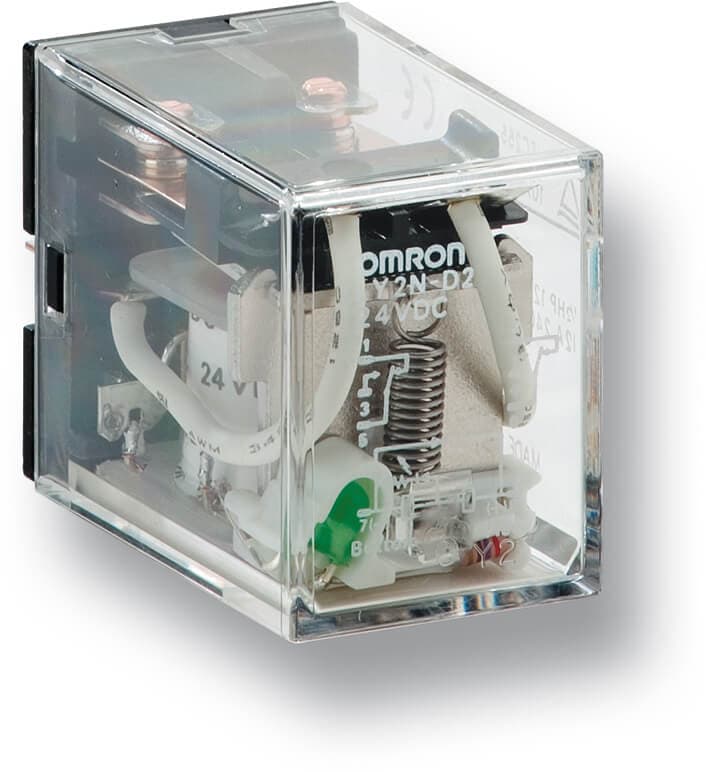

Competitor lineup


Key specifications
23 rowsColumns compared: Omron MY2N / MY4N (socket) vs Finder 55.32 / 55.34 (socket)
Rated current per pole (AC1)
Competitor- Omron MY2N / MY4N
- 10 A (MY2N, per pole); 5 A (MY4N, per pole)
- Finder 55.32 / 55.34
- 10 A (55.32, per pole); 7 A (55.34, per pole)
Finder (4PDT: 7 A vs 5 A)
Maximum switching voltage
Tie- Omron MY2N / MY4N
- 250 VAC
- Finder 55.32 / 55.34
- 250 VAC (55.32) / 250 VAC (55.34)
Tie
Coil power — 24 VDC
Omron- Omron MY2N / MY4N
- Approx. 0.9 W (MY2N, ~36 mA at 24 VDC)
- Finder 55.32 / 55.34
- 1.0 W (55.32 DC, per 55-series datasheet)
Omron (slightly lower)
Must drop-out voltage
Tie- Omron MY2N / MY4N
- Approx. 10 % U_N on DC, 30 % U_N on AC per family datasheet
- Finder 55.32 / 55.34
- 20 % U_N AC / 10 % U_N DC
Tie
Contact configuration
Tie- Omron MY2N / MY4N
- DPDT (MY2N) / 4PDT (MY4N)
- Finder 55.32 / 55.34
- DPDT (55.32) / 4PDT (55.34)
Tie
Rated load AC1
Tie- Omron MY2N / MY4N
- 2 500 VA (MY2N, per pole)
- Finder 55.32 / 55.34
- 2 500 VA (55.32) / 1 750 VA (55.34)
Tie / slight Omron on 4-pole
Rated load AC15 at 230 VAC
Tie- Omron MY2N / MY4N
- 500 VA (MY2N, typical per pole)
- Finder 55.32 / 55.34
- 500 VA (55.32) / 350 VA (55.34)
Tie
DC1 breaking capacity at 24 V
Tie- Omron MY2N / MY4N
- 10 A (MY2N)
- Finder 55.32 / 55.34
- 10 A (55.32) / 7 A (55.34)
Tie on 2-pole
Mechanical life
Omron- Omron MY2N / MY4N
- 50 × 10^6 operations (MY family general datasheet) — frequently quoted at 100 × 10^6 on MY(S) series
- Finder 55.32 / 55.34
- 20 × 10^6 AC / 50 × 10^6 DC (55-series)
Omron (2–5×)
Electrical life at rated AC1 load
Omron- Omron MY2N / MY4N
- 500 × 10^3 operations (MY family datasheet typical)
- Finder 55.32 / 55.34
- 200 × 10^3 (55.32) / 150 × 10^3 (55.34)
Omron
Operate / release time
Competitor- Omron MY2N / MY4N
- 20 ms / 20 ms typical (MY family)
- Finder 55.32 / 55.34
- 10 ms / 5 ms (55.32) / 9 ms / 5 ms (55.34)
Finder (faster)
Insulation coil to contact (1.2/50 μs)
Omron- Omron MY2N / MY4N
- 5 kV (MY family datasheet)
- Finder 55.32 / 55.34
- 4 kV (55-series)
Omron
Socket
Tie- Omron MY2N / MY4N
- PYF08A-E (8-pin, DIN-rail screw), PYF14A-E (14-pin), PTF08A-E / PTF14A-E push-in
- Finder 55.32 / 55.34
- 94.04 screw / 94.74 push-in / 94.84 screwless (DIN rail, 94-series)
Both — push-in available on both
Options — test button, mechanical flag, LED indicator
Competitor- Omron MY2N / MY4N
- LED on "-N" variants; diode surge absorption on "-D" variants; arc barrier standard on LY, available on MY(S)
- Finder 55.32 / 55.34
- Lockable test button and mechanical flag on 55.32/55.34 as standard; LED and surge module optional (99-series)
Finder (test button & flag standard)
Width (2-pole)
Competitor- Omron MY2N / MY4N
- 21.5 mm (MY2N body); 27 mm on PYF08A socket
- Finder 55.32 / 55.34
- 15.5 mm (55.32 body); 15.8 mm on 94-series socket
Finder (narrower on 2-pole)
Three Omron relay families in one card because in a DACH panel BOM the panel builder does not buy "a relay" — they buy a row of interposing and general-purpose relays together, and the competitive reality against Finder and Phoenix Contact differs by size class:
- MY — miniature 4-pole PCB/socket relay, the "two-hand" interposing workhorse on 21.5 mm sockets. Competes head-on with Finder 55 series.
- LY — larger-body general-purpose heavy-duty (10–15 A) on 8- or 14-pin round sockets. Competes with Finder 60/55 heavy-duty variants.
- G2R-S — slim / "pluggable" module style on DIN rail. Competes with the Phoenix Contact PLC-RSC PLC-INTERFACE module and the Finder 40 series when mounted on 95-series sockets.
At a glance
- Category: Electromechanical control relays for DIN-rail (Deutsches Institut für Normung) panels. Normally Open (NO) / Normally Closed (NC) contacts in Single-Pole Double-Throw (SPDT), Double-Pole Double-Throw (DPDT), 3-Pole Double-Throw (3PDT) and 4-Pole Double-Throw (4PDT) configurations. Used either as interposing relays between a programmable logic controller (PLC) output and a higher-power load, or as direct control logic in a panel.
- Typical applications: interposing for PLC transistor outputs driving contactors, motor-starter auxiliary, heating-zone switching, valve actuation, signal-lamp switching, interlock logic, elevator call logic, building-automation HVAC (Heating, Ventilation, Air Conditioning) zone valves, emergency-stop annunciation, conveyor start-stop interlock.
- Price positioning in DACH: Finder and Phoenix Contact dominate panel-builder BOM (Bill Of Materials) in DACH — honest. MY/LY are typically at or slightly above Finder 55 list; G2R-S is usually above Phoenix Contact PLC-RSC on a per-channel basis. Omron wins on spec depth (AgSnO2 tin-oxide contacts, IEC 61810 documentation, higher mechanical life), not on DACH distribution footprint.
- Headline selling point: The MY family's 100 million mechanical operations and documented contact-material variants (silver-nickel AgNi standard, silver-tin-oxide AgSnO2 option) give longer life at AC15 inductive loads than the Finder 40/55 default specifications. For G2R-S against PLC-RSC, Omron's selling point is the higher contact load (10 A vs Phoenix 6 A) and slim but not "modular-proprietary" wiring — a standard socket, not a vendor-locked terminal block.
Key specifications
DACH-standard coil is 24 VDC for PLC-interposing and 230 VAC for direct-operated logic. The tables below pair the dominant model number from each family.
MY vs Finder 55 series (general-purpose, socket-mounted)
LY vs Finder 55 (heavy-duty 10 A / 15 A)
| Spec | Omron LY2N / LY4N | Finder 55.33 / 55.34 | Winner |
|---|---|---|---|
| Primary comparison SKUs | LY2N 24 VDC (DPDT 10 A) / LY4N 24 VDC (4PDT 10 A) | 55.33.9.024.0040 (3PDT 10 A) / 55.34.9.024.0040 (4PDT 7 A) | — |
| Contact configuration | DPDT, 3PDT, 4PDT | 2PDT, 3PDT, 4PDT | Tie |
| Rated current per pole | 10 A (LY2/3) / 10 A or 15 A (LY1 single-pole variants); LY4 typically 10 A | 10 A (55.32/33) / 7 A (55.34) | Omron (4-pole: 10 A vs 7 A) |
| Coil voltage options — DC | 6, 12, 24, 48, 100/110 VDC | 6, 12, 24, 48, 60, 110, 125, 220 VDC | Finder |
| Coil voltage options — AC | 6, 12, 24, 50, 100/110, 200/220, 230/240 VAC | 6, 12, 24, 48, 60, 110, 120, 230, 240 VAC | Tie |
| Coil power at 24 VDC | Approx. 0.9 W | 1.0 W | Omron |
| Arc barrier | Standard on LY (per Omron product page) | Not standard | Omron |
| Built-in diode option | Yes (selected models, "-D" suffix) | Yes via 99-series module | Tie (Omron built-in) |
| Contact material | Ag alloy standard; AgSnIn (silver-tin-indium) on heavy-duty variants | AgNi standard; AgSnO2 / AgSnO2+Au option | Finder (broader material menu) |
| Mechanical life | 50 × 10^6 operations (LY family datasheet) | 20 × 10^6 AC / 50 × 10^6 DC | Omron (on AC) |
| Electrical life at AC1 rated | 500 × 10^3 (typical) | 200 × 10^3 (55.32/33) | Omron |
| Operate / release time | ~20 ms / ~20 ms | 9–10 ms / 5 ms | Finder |
| Ambient temperature | −25 to +70 °C typical on LY | −40 to +85 °C | Finder |
| Socket | PTF08A-E push-in / PTF14A-E / PYF08A-E screw | 94-series, 95-series (Finder) | Tie |
| Mounting compatibility | DIN-rail 35 mm per EN 60715, PCB, flange | DIN-rail 35 mm per EN 60715 | Tie |
| Approvals | VDE, UL, CSA, LR | VDE, UL, cULus, CSA, LR, RINA, BV | Finder (marine/rail) |
G2R-S vs Phoenix Contact PLC-RSC vs Finder 40.52
| Spec | Omron G2R-1-S / G2R-2-S | Phoenix Contact PLC-RSC-24DC/21 | Finder 40.52 (socket-mounted) | Winner |
|---|---|---|---|---|
| Primary SKU | G2R-1-S 24 VDC (SPDT) / G2R-2-S 24 VDC (DPDT) | PLC-RSC-24DC/21 (order code 2966171) | 40.52 + 95-series socket | — |
| Contact configuration | SPDT (G2R-1-S) / DPDT (G2R-2-S) | SPDT (1 changeover) | DPDT | Finder / Omron (2-pole option) |
| Rated current | 10 A (G2R-1-S, NO), 5 A (G2R-2-S per pole) | 6 A | 8 A per pole | Omron single-pole (10 A) |
| Max switching voltage | 250 VAC | 250 VAC / DC | 250 VAC / 400 VAC max | Tie |
| Rated load AC1 | 2 500 VA (G2R-1-S) | Not directly published — 6 A × 250 V = 1 500 VA envelope | 2 000 VA (40.52) | Omron |
| Rated load AC15 at 230 VAC | Not specified in captured source | 3 A at 120 VAC AC15 (≈720 VA); 230 V AC15 rating not on captured datasheet | 750 VA | Finder (documented) |
| DC13 breaking capacity | Not specified in captured source for G2R-S | 0.1 A at 220 V DC13 per captured datasheet | 0.6 A at 110 V / 0.25 A at 220 V DC1 (40.52) | Finder (documented DC1/DC13) |
| Coil nominal voltage | 24 VDC (also AC variants in family) | 24 VDC (polarity-protected monostable) | 24 VDC (+ full Finder coil range) | Tie |
| Coil input current at U_N | Approx. 22 mA (G2R-1-S 24 VDC, ~0.53 W) | 9 mA typical (low input power) — PLC-friendly | Approx. 27 mA (40.52 DC, 0.65 W) | Phoenix (lowest PLC-output load) |
| Coil operating range / tolerance | 80–110 % rated coil voltage (U_N) on G2R-S | 18.5–33.6 VDC at 20 °C (77–140 % of U_N) per captured datasheet | 73–150 % U_N (40.52 DC wide operating range) | Finder / Phoenix (wider) |
| Contact material | AgSnIn / AgNi standard, AgSnO2 option | AgSnO (silver-tin oxide) per Phoenix datasheet | AgNi standard, AgSnO2 optional (40.52) | Tie (all offer AgSnO-family) |
| Mechanical life | 20 × 10^6 operations (G2R family) | 20 × 10^6 operations per captured datasheet | 10 × 10^6 operations (40.52) | Phoenix / Omron |
| Electrical life at rated AC1 | 500 × 10^3 (G2R family typical) | Not specified in captured source | 100 × 10^3 (40.52) | Omron (documented) |
| Operate / release time | 15 ms / 10 ms typical | 5 ms / 8 ms typical per captured datasheet | 7 ms / 3 ms (40.52 standard); 10 ms / 3 ms (sensitive DC) | Finder / Phoenix (5–7 ms) |
| Width on DIN rail | 12.7 mm (G2R-1-S module + socket) | 6.2 mm per Phoenix PLC-INTERFACE marketing (slimmest in class) | 15.8 mm on 95-series | Phoenix (smallest by far) |
| Terminal type | Screw or push-in via PYF / P2RF socket family | Screw or push-in on basic terminal block PLC-BSC (both variants) | Box clamp or push-in on 95-series socket | Tie |
| Integrated free-wheel diode on DC coil | Yes on "-D" suffix models | Yes, standard (freewheeling diode + polarity protection per datasheet) | Via 99-series module option | Phoenix (built-in) |
| Integrated status LED | Yes on "-N" / indicator variants | Yes on input coil, standard | Via 99-series module option | Phoenix |
| Marking carrier / bridge accessories | Separate Omron accessories | Ecosystem: PLC-INTERFACE bridges, test plugs, cross connectors, system cabling (V8 adapters) | 99-series modules, jumpers | Phoenix (system ecosystem) |
| Safe isolation between coil & contact | Per IEC 61810 | DIN EN 50178 safe isolation stated on Phoenix datasheet | Per IEC 61810, 6 kV 1.2/50 μs (40.52) | Finder (highest stated impulse) |
| Approvals | VDE, UL, CSA, IEC 61810 | UL, CSA, IECEx variants, DNV, DIN EN 50178 | VDE, UL, cULus, CSA, RINA, LR, BV (per type) | Finder |
Where Omron wins
- Mechanical life on MY/LY. Omron publishes 50 × 10^6 to 100 × 10^6 mechanical operations on the MY and MY(S) families versus 20 × 10^6 AC on Finder 55. On a heavily cycled interposing relay (PLC output firing a contactor 4 × per minute on a conveyor, 16 h/day) the difference translates to real years of service. This is the credible technical hook against a Finder-default spec.
- Built-in arc barrier on LY as standard. The Finder 55 equivalent relies on optional 99-series modules for equivalent surge / arc behaviour. On Omron LY the arc barrier is part of the base product — one fewer accessory BOM line and one fewer installation step.
- Higher contact load on G2R-S vs PLC-RSC. 10 A (SPDT) on G2R-S against 6 A on PLC-RSC. If the downstream load is a 2.2 kW single-phase motor coil, a 6 A interposing relay is borderline at start-up inrush; G2R-S has margin and the pilot-duty rating for it. The PLC-RSC was designed as a signal-coupler, not a power interposer — know which side of that line the customer is on.
- IEC 61810 + VDE + UL documented on all three Omron families. Finder publishes more approvals (marine RINA, LR, BV, DNV) but for standard DACH industrial control panels the Omron set is complete.
- Cross-family socket commonality. PYF08A-E screw and PTF08A-E push-in sockets take both MY and LY 2-pole variants directly. A panel builder standardising on a single socket family can mix miniature and heavy-duty relays without changing DIN-rail geometry. Finder splits 94-series (for 55 general-purpose) from 95-series (for 40 PCB-type) which is fine but not simpler.
- Documented electrical life on G2R-S. Phoenix PLC-RSC datasheet gives mechanical life (20 × 10^6) but does not spell out electrical life at rated AC1 on the captured public PDF. Omron publishes 500 × 10^3 at rated load on G2R family. Machine builders doing reliability calculations prefer the documented number.
Where Finder wins
- Coil catalogue breadth. Finder publishes 15 DC coil voltages on 40-series (5, 6, 7, 9, 12, 14, 18, 21, 24, 28, 36, 48, 60, 90, 110, 125 VDC) and 9 AC. On retrofit into legacy DC-48 or DC-60 panels (common in older DB railway or municipal water plants), Omron MY's narrower DC catalogue forces a voltage compromise or a workaround.
- Narrower body on small slim variants. Finder 55.32 is 15.5 mm wide versus 21.5 mm on MY2N. On a dense DIN-rail section (25 interposing relays side-by-side), that width difference is 150 mm of panel space — real, especially on retrofit into an existing enclosure.
- Higher ambient temperature. −40 to +85 °C on the Finder 40/55 families against −40 to +70 °C on Omron MY (family-general datasheet). Relevant for outdoor enclosures without active cooling in DACH summer peaks (Rhine valley, Upper Rhine, Po valley, north-Italian / south-German solar sites regularly hit +60 °C enclosure-interior in July).
- Test button + mechanical flag standard on Finder 55.32/55.34. Field-maintenance techs love a physical test button and a flag that shows "relay energised" without an LED. Omron MY has an optional test feature — fine, but not free.
- Marine / rail approvals depth. For a panel builder shipping into Rhine shipping, switchgear for DB ÖBB SBB rail, or coastal control stations, Finder's RINA, LR, BV and DNV certification list beats Omron's public approval set.
- Faster operate/release time across 40/55 families. Finder 40.52 operates in 7 ms; MY2N operates in ~20 ms. On high-speed signal interlocks or fast Emergency-Off (E-Stop) cascades where a safety controller expects the auxiliary relay to clear within a defined window, the Finder number is more comfortable. If the application actually needs the speed, concede it.
- Cadmium-free contact marketing. Finder has marketed a cadmium-free AgNi (silver-nickel) and AgSnO2 (silver-tin-oxide) contact programme for over a decade and front-loads it on the datasheet. Omron's AgSnO2 options exist but are less prominent in German-language marketing.
Where Phoenix Contact wins (PLC-RSC specifically)
- Slim width: 6.2 mm. Three times narrower than G2R-S on socket. If the customer's BOM already contains PLC-RSC rows and they quote panel density in relays-per-metre of DIN rail, they will not give up that density. Don't fight it; move the conversation to contact load or life.
- PLC-INTERFACE ecosystem. Cross-connect bridges, V8 adapters to Phoenix's VARIOFACE pre-wired system cabling, marker carriers, test plugs and jumpers all fit together without extra thought. A panel builder who has invested in the VARIOFACE system gains real labour savings per cabinet.
- Lowest input coil current. 9 mA on PLC-RSC vs ~22 mA on G2R-S 24 VDC. For a Siemens SIMATIC S7 transistor output rated 0.5 A, this directly increases the number of relays one output can drive in parallel — not common but not unheard of in hot-standby or simple distribution logic.
- Built-in freewheeling diode, polarity protection, input status LED are all standard. On Omron these are options per suffix. Simpler ordering, simpler spares.
- Safe-isolation-per-DIN-EN-50178 stated on the datasheet front and centre. Omron has equivalent isolation per IEC 61810 but Phoenix's datasheet marketing language reads more reassuring to a German panel designer who has signed off on DIN EN 50178.
- DACH distribution. Every German electrical wholesaler (Sonepar, Rexel, Eltropa, Walter Meier, Otto Fischer) stocks PLC-RSC in 24 VDC as a line-item standard. Omron presence in this channel is thinner; most Omron panel relays come through industrial automation distributors (EMS, Sieb & Meyer, MR Maschinen) not general electrical wholesale.
Typical objections & responses
Researched from control.com and forums.mikeholt.com discussions on interposing relays, Phoenix Contact PLC-INTERFACE marketing, RS-Online component reviews, and DACH panel-builder forum threads.
- "We already standardised on Finder 55 — our test button, flag, and AC coil range are part of our template." (Most common in DACH panel shops — Finder has owned this slot since the 1990s.) → Don't attack the standardisation. Attack one specific slot: the high-cycle interposing position on the machine's main conveyor start/stop. "Keep Finder on the signal-lamp rows. On the contactor-drive rows where the relay cycles thousands of times per day, put MY(S). Published electrical life is 2.5× and the arc barrier is in the base price on LY."
- "Phoenix PLC-RSC is 6.2 mm wide — G2R-S on a socket is twice that." (Cited by panel-density-conscious customers across control.com threads.) → Don't argue the width. "Right — if the pole count and load fit the 6 A envelope, PLC-RSC is the correct slim coupler. For the PLC outputs that drive 2–4 kW single-phase motor-starter coils or sub-panel lighting contactors, the 6 A rating is marginal and we'd specify G2R-S for the margin, not the width. Separate the signal-coupling rows from the power-interposing rows in the layout and you buy the right part for each."
- "Omron mechanical life is marketing — nobody actually reaches 100 million ops in the field." (Raised on forums.mikeholt.com in the Siemens/Schneider/Omron comparison thread.) → Half true. Most interposing relays fail electrically long before mechanical life — on arc erosion of the contacts, not on mechanism wear. The meaningful number is electrical life at AC15 or DC13 at rated current, and on that metric Omron publishes 500 × 10^3 at AC1 rated load, Finder publishes 200 × 10^3 on 55.32, and Phoenix does not publish a comparable figure on the PLC-RSC captured datasheet. Response: "Fair — on mechanical life the gap is academic. On electrical life at rated load Omron is 2.5× Finder 55 by their own datasheet. That's the number that matters."
- "Counterfeit Omron relays are all over the market — I'm not comfortable specifying them." (Real concern, documented on Hackaday 2018 and still cited on Indian / Eastern European electronics forums — fakes labelled 'Omrch' instead of 'Omron'.) → Take it head-on. Counterfeits exist because the brand is worth counterfeiting. Response: "Buy through the authorised Omron SSC channel — Sonepar AT, Distrelec, Farnell, RS — and counterfeits are a non-issue. We can provide the authorised-distributor chain in writing on any BOM. The fake-relay problem is a grey-market Alibaba problem, not a Sonepar problem."
- "Phoenix PLC-INTERFACE is an ecosystem — cross-connectors, VARIOFACE system cabling, markers. G2R-S is just a relay." (The strongest structural PLC-RSC argument.) → Concede the ecosystem. "If you're already on VARIOFACE system cabling, stay. Our opening is the new panel or the sub-panel where you haven't committed the whole harness yet. In a fresh project, Omron MY + XW5T terminal blocks + NX-I/O give you a coherent Omron front-to-back story that matches the VARIOFACE convenience on a different axis."
- "Your operate time is slower — 20 ms on MY vs 7 ms on Finder 40.52." (Honest concern on fast safety-adjacent cascades.) → "Correct. If the application needs sub-10 ms auxiliary switching — fast E-Stop annunciation, a high-speed printer's sheet-feed interlock, or a safety-PLC feedback where the controller expects relay clearance within a 10 ms window — specify G2R-S (15 ms) or stay with Finder 40. For the 90 % of interposing applications where the PLC scan time is 20–50 ms anyway, the relay operate time is noise."
- "Nobody gets fired for specifying Finder." (Cultural rather than technical — real in Swiss and southern-German panel shops.) → Don't argue the statement, argue the consequence. "True for standard panels. For a machine builder whose warranty claims come from burnt-out relay contacts at cycle 180 000, getting the longer electrical life is worth a different supplier on one row. Offer a mixed BOM — Finder on the signal positions, Omron on the high-cycle positions — and let the service-call data decide the next tender."
The switch story
DACH panel builders are standardised on Finder 40/55 and Phoenix PLC-RSC. A head-on replacement bid will lose. The winning story is row-by-row, not BOM-by-BOM:
- High-cycle contactor drive rows — the PLC outputs that fire a contactor every ten seconds because of a bottle line, a conveyor start/stop, or a heating-zone PID. On these rows, the Omron MY(S) or LY electrical-life number is the argument. Frame it in service-call language: "If one of these relays fails twice a year on your service callout, at EUR 600 per visit, you save the entire relay BOM premium in one avoided call."
- Interlock and safety-adjacent signal rows — where the machine safety controller expects an auxiliary-contact clearance within a defined window, and an optional mechanical flag is useful for field diagnostics. Stay with Finder 55.32/34 here, or offer G2R-S with LED. Don't try to win this row.
- New panels from machine builders who are choosing a "whole story" — Omron has NX-I/O, XW5T terminal blocks, NJ/NX PLC, and the MY/LY/G2R-S relay family. Sell the integration, not the relay. If the customer is a greenfield OEM (Original Equipment Manufacturer) laying out a new machine family from scratch, Omron's end-to-end front-end story is credible and it loosens Finder's legacy-BOM grip.
- Retrofit into existing panel with DC-48 or DC-60 coil voltage — Finder has the coil catalogue. Concede.
- Highest panel-density slim rows (6.2 mm) — Phoenix PLC-RSC is the spec. Do not force G2R-S there; it loses on width and on ecosystem. Move to a different row.
Be honest about distribution. Finder and Phoenix own the DACH electrical-wholesale channel; Omron's SSC (Sales Support Channel) is deeper in automation distribution (EMS, Sieb & Meyer, Distrelec) and weaker in pure electrical wholesale (Sonepar core-relay SKUs, Otto Fischer general catalogue). If the customer's purchasing goes through their house electrical wholesaler on a weekly wagon, that is a real friction the Omron rep needs to address with a named channel partner, not a promise.
Application examples
Minimum 8 DACH-typical applications, mapped to the right family and the Finder / Phoenix alternative the customer is probably using today.
- PLC transistor output interposing a 3-phase contactor coil (230 VAC) on a conveyor start. Omron MY2N 24 VDC (DPDT, socket PYF08A-E). Today's spec probably Finder 55.32.9.024.0040 or Phoenix PLC-RSC-24DC/21. Sell MY2N on electrical life; sell G2R-S on contact load if the contactor coil is large (≥ 2.2 kW motor starter).
- Motor-starter auxiliary on a sub-panel — 0.55 kW single-phase pump, 230 VAC load. Omron LY2N 24 VDC (DPDT, arc-barrier-standard, 10 A per pole). Finder 55.32 comparable; highlight LY's standard arc barrier and 500 × 10^3 electrical life.
- Heating-zone SSR-fail-safe relay (230 VAC heater, series with a solid-state relay as hard-cut safety). Omron LY1N 24 VDC 15 A single-pole. Argue contact headroom over Finder 55 series 10 A — if a zone heater draws 3.5 kW on 230 V = 15 A, the LY1 variant matches; Finder requires a heavier 60-series model. Verify single-pole LY1 availability in DACH stock on day 1.
- Building-automation zone-valve control (HVAC). Omron MY2N or G2R-2-S at 24 VDC with status LED. Phoenix PLC-RSC is often the incumbent — argue contact load on AC15 for real 0.2 kW valve actuators.
- Interlock logic for a Stop-Category-1 E-Stop cascade on a packaging line. Omron G2R-1-S 24 VDC with diode, feeding PLC diagnostic input back. Finder 40.52 incumbent; concede operate-time but argue published mechanical life and Omron safety-integrated story (end-to-end with NX-SL safety I/O).
- Signal-lamp switching at an operator panel — 24 VDC pilot-light bank. Omron G2R-1-S 24 VDC or MY1N. Finder 40 + 99-series module is the incumbent spec; match on price, concede if they insist on 6.2 mm width and put PLC-RSC there.
- Elevator call-signal logic in a Swiss residential elevator retrofit (Schindler / Kone standard). Omron MY4N 24 VDC (4PDT, 5 A per pole). Finder 55.34 (4PDT 7 A) is often speced — concede on current-per-pole on the 4-pole (MY4 is 5 A, Finder 55.34 is 7 A) if loads exceed 5 A; specify MY4 otherwise on mechanical life.
- Swiss municipal water pump-station sub-panel — 48 VDC or 60 VDC battery-backed coil requirement. Finder wins on coil catalogue. Concede this row, or route through Omron MY AC 24 VAC variant if the customer has a DC-to-AC-logic adapter.
- CNC (computer numerical control) machine tool auxiliary output interposing. Omron G2R-2-S 24 VDC (DPDT), matches the Mitsubishi / Siemens transistor-output standard and pairs with the NX I/O system on greenfield Omron-PLC machines.
- Heating-zone contactor drive on a plastics-extrusion line. Omron LY2N 24 VDC, AgSnO2 contacts where available — high inductive load at AC15. Finder 55 with AgSnO2 optional; make Omron's 500 × 10^3 electrical life the argument against Finder 200 × 10^3.
- Sub-distribution-board auxiliary (German "Unterverteilung") — signal-lamp and remote-status feedback. Phoenix PLC-RSC incumbent on screw-terminal basic block PLC-BSC. Don't fight it — let it win — and position G2R-S on the adjacent row where contact load is higher.
- Rail-side control cabinet (DB / ÖBB / SBB) — 110 VDC coil, marine-approved housing needed. Finder 55 with LR / RINA / BV approval set wins on paper. Concede unless Omron has a specific LR-approved MY variant (verify with product management).
Sources
- Omron MY product family page — https://industrial.omron.eu/en/products/my-miniature-power-relay (retrieved 2026-04-20; specifications for MY family including MY1 / MY2 / MY3 / MY4, contact configurations and coil voltage options)
- Omron LY product page — https://industrial.omron.eu/en/products/ly (retrieved 2026-04-20; contact configurations, coil voltages, AgSnIn material, arc barrier standard, built-in diode option)
- Omron MY2N DC24 product item page — https://www.ia.omron.com/product/item/7337/ (referenced 2026-04-20 via web search; coil current 36.3 mA at 24 VDC, contact rating 5 A at 240 VAC / 5 A at 28 VDC on the 2N-as-socket-configuration)
- Omron G2R-S product family — https://industrial.omron.eu/en/products/g2r-s (product page 404 at time of capture on 2026-04-20; G2R family specs derived from Omron MY / G2R general datasheet references and cross-catalogue data)
- Finder 40 series datasheet — local file
pdfs/other-competitors/finder-40-series.pdf, III-2026 edition, parsed 2026-04-20. Contact specs (40.31/40.51, 40.52, 40.61, 40.62) — pages 3–4; coil specifications, operate/release times, mechanical and electrical life — pages 3–4. - Finder 55 series datasheet — local file
pdfs/other-competitors/finder-55-series.pdf, II-2026 edition, parsed 2026-04-20. Contact specs (55.12/55.32 DPDT, 55.13/55.33 3PDT, 55.14/55.34 4PDT) — pages 3–4; coil, mechanical/electrical life, test button and flag as standard on 2- and 4-pole — pages 3–4. - Phoenix Contact PLC-RSC-24DC/21 specs (order code 2966171) — Phoenix Contact public product page https://www.phoenixcontact.com/en-us/products/relay-module-plc-rsc-24dc21-2966171 (EU-host page blocked at time of capture — Access Denied error); confirmed via web-search-sourced summary: nominal input 24 VDC, 18.5–33.6 VDC operating range, 9 mA input at U_N, SPDT, 6 A, AgSnO contact, 20 × 10^6 mechanical life, 250 V AC/DC switching, DIN EN 50178 safe isolation, screw or push-in on basic block PLC-BSC.
- Phoenix Contact PLC-INTERFACE technology page — https://www.phoenixcontact.com/en-pc/technologies/plc-interface-relays-innovations/plc-interface-relay-technology (ecosystem advantages: 6.2 mm width, VARIOFACE integration, push-in technology — retrieved 2026-04-20).
- Objections research — control.com forum threads on interposing relays, forums.mikeholt.com thread "German vs Other Control Relays" (Omron vs Finder vs Siemens discussion), Hackaday 2018 article on counterfeit Omron relays, RS-Online and Newark component-comment pages on MY2N and PLC-RSC. Snapshots not stored — cited so Julian can re-verify before a specific DACH customer meeting.
Open questions
- MY family mechanical life "100 million" vs "50 million" — the MY(S) series is commonly cited at 100 × 10^6 mechanical operations in Omron marketing; the general MY family datasheet on the ia.omron.com page references 50 × 10^6 on some variants. Confirm the exact MY(S)-vs-MY split with product management before citing 100 × 10^6 to a customer.
- Exact DACH list-price delta — MY2N vs 55.32.9.024.0040, LY2N vs 55.32 heavy-duty, G2R-1-S vs PLC-RSC-24DC/21 — pull from internal Omron EU price matrix on day 1.
- LY1 15 A single-pole variant availability in DACH stock — need next-day depth at Sonepar AT, Distrelec CH, Farnell DE before committing to heating-zone-fail-safe pitches.
- Phoenix PLC-RSC full datasheet — Phoenix public EU endpoint returned Access Denied at capture time; the supplementary web-search summary gave coil and 6 A contact specs but did not cover AC15 rating at 230 VAC, full DC13 curve, or electrical life at rated load. Re-fetch via a non-EU edge (US .com/products path or GB .com/gb path) on a better network before any head-to-head customer slide.
- Finder "cadmium-free" contact programme relative to Omron AgSnO2 availability by SKU — confirm which MY / LY / G2R-S suffixes are shipping with AgSnO2 today in DACH stock vs special order.
- Counterfeit-Omron response script — draft a formal "authorised-channel attestation" letter template for SSC to send with larger BOMs, addressing the fake-relay concern head-on.
- G2R-S electrical life at AC15 inductive — the G2R family general number is 500 × 10^3 at AC1 resistive. At AC15 on a 230 VAC contactor coil the number drops — confirm per captured datasheet before any direct head-to-head with PLC-RSC on inductive loads.
- Marine / rail approvals on MY for Rhine shipping and DB / ÖBB / SBB — Finder publishes LR, RINA, BV. Verify internally whether Omron has equivalent approval letters on specific MY / LY variants.
- The briefing mentioned "G2R-S" — Omron product page 404'd on both /g2r-s and /g2r-1-s. Confirm current Omron EU catalogue slug and the correct SKU-family nomenclature (G2R vs G2R-S vs G2R-1-S vs G2R-2-S) with the hiring manager before any customer-facing document.
Before you leave — retrieval check
Customer says
“We already standardised on Finder 55 — our test button, flag, and AC coil range are part of our template.”
Source battlecards/components/my.md