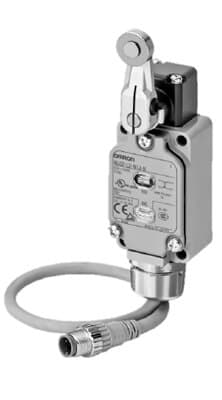
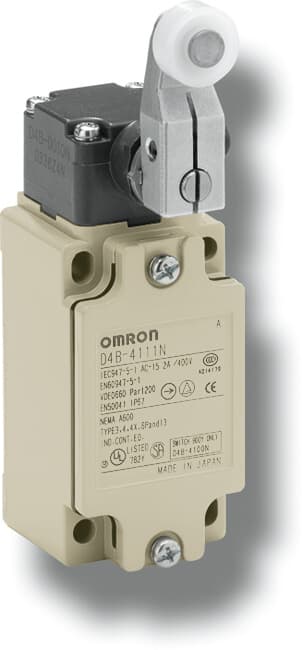
Omron WL & D4B-N
Electromechanical limit switches (general-purpose and safety-rated)
Reference mode — everything visible. Use for live calls.
Three things to remember
Direct opening action (Zwangsöffnung, positive opening)
Not a certified safety feature on WL-N — specify D4B-N if required
Omron D4B-N / Schmersal 441 / Telemecanique XCKJ — all equal on safety certification; WL disqualified for safety duty
Operating temperature
−10 to +80 °C standard; −40 to +40 °C and +5 to +120 °C variants available
Schmersal (widest stated range); Omron WL with the low-temp variant matches
Headline
The D4B-N is genuinely the equal of Schmersal T/M 441 on certification (TÜV.
Competitor lineup
Key specifications
16 rowsColumns compared: Omron WL-N (general-purpose) vs Omron D4B-N (safety)
Ingress Protection (IP) rating
Tie- Omron WL-N
- IEC IP67
- Omron D4B-N
- IEC IP67
Tie on metal-body variants; Telemecanique IP66/67 on XCKJ is marginally stronger than Schmersal T 441 IP65
Operating temperature
Omron- Omron WL-N
- −10 to +80 °C standard; −40 to +40 °C and +5 to +120 °C variants available
- Omron D4B-N
- Extended range per datasheet (not specified in captured source); typical D4B family is −10 to +80 °C — confirm per SKU
Schmersal (widest stated range); Omron WL with the low-temp variant matches
Contact configuration
Tie- Omron WL-N
- DPDB (double-pole double-break); typically 1 NO + 1 NC or 2 NC
- Omron D4B-N
- 1 NO + 1 NC (SPDB) or 2 NC (DPDB); slow-action or snap-action
Tie
Direct opening action (Zwangsöffnung, positive opening)
Omron- Omron WL-N
- Not a certified safety feature on WL-N — specify D4B-N if required
- Omron D4B-N
- Yes — TÜV-certified direct opening per IEC 60947-5-1 Annex K / EN ISO 14119
Omron D4B-N / Schmersal 441 / Telemecanique XCKJ — all equal on safety certification; WL disqualified for safety duty
Mechanical life
Omron- Omron WL-N
- 15 000 000 operations min. (WL-N datasheet extract)
- Omron D4B-N
- Not stated as a single headline figure in captured source (per datasheet CSM_D4B-_N_DS_E_10_12); typically ≥1 000 000 for safety switches
Telemecanique (30 M on XCKJ > Omron WL 15 M)
Electrical life
Omron- Omron WL-N
- 750 000 operations min. (WL-N datasheet extract)
- Omron D4B-N
- Not specified in captured source
Omron WL (documented)
Electrical rating (AC-15 / DC-13)
Tie- Omron WL-N
- 10 A at 250 V AC; 500 V max
- Omron D4B-N
- 10 A
Tie — all meet IEC 60947-5-1 AC-15/DC-13
Actuator heads
Omron- Omron WL-N
- 15+ heads: roller lever (R38/R50/R63), adjustable roller lever (R25–89 mm), adjustable rod lever (25–140 mm), high-sensitivity roller, plunger, cat-whisker (flex-rod), fork-lock (Sicherheitsgabel)
- Omron D4B-N
- 7 heads: roller lever (resin or metal roller), roller plunger, plunger, adjustable roller lever, adjustable rod lever
Omron WL (widest head catalogue in a single family)
Indicator LED option
Omron- Omron WL-N
- Yes on WL-N (factory option)
- Omron D4B-N
- Not specified in captured source
Omron WL (standard catalogue suffix)
Typical DACH availability
Competitor- Omron WL-N
- Distrelec, RS Components, Rexel — stocked but thinner than Schmersal on exotic heads
- Omron D4B-N
- Distrelec, RS, specialist safety distributors
Schmersal / Telemecanique (distribution depth)
At a glance
- Category (WL): General-purpose industrial electromechanical limit switch in a two-circuit (DPDB) metal housing. Used where non-contact sensing is impractical or where the customer explicitly wants a mechanical, forced-guided switch — end-of-travel, cam-actuated position confirmation, hard-stop sensing. The WL-N is not a dedicated safety switch; for guard monitoring use D4B-N.
- Category (D4B-N): Heavy-duty safety limit switch with TÜV-approved direct opening action (Zwangsöffnung per IEC 60947-5-1 Annex K / EN ISO 14119). Aluminium die-cast housing. The D4B-N is the product you specify for machinery guards, slide doors, pivot guards, and category-2/3 interlock cascades where the customer wants a "real" limit switch rather than a magnetic or RFID (radio-frequency identification) interlock.
- Typical applications: overhead-crane end-of-travel (Krankatze), hoist slack-cable detection, machining-centre door open/close, conveyor end-stop, sliding-gate position, milling-table stroke limit, palletiser infeed end-limit, press-tool changeover confirmation, elevator platform end-limit.
- Price positioning in DACH: Both WL and D4B-N sit mid-market. Against Schmersal T/M 441 and Telemecanique OsiSense XCKJ / XCKN they tend to be at parity or slightly below on list, but in practice the price conversation is dwarfed by the installed-base question — Schmersal and Telemecanique own the DACH spec by default in machine-building and crane-engineering, and the fight is almost always about getting specified in the first place.
- Headline selling point (honest): The D4B-N is genuinely the equal of Schmersal T/M 441 on certification (TÜV, EN ISO 14119, EN 50041 body footprint) and actually nicer to wire in the field thanks to the separated terminal block and the M20 cable entry on the -4xxx models. The WL is boringly reliable at 15 million mechanical operations, with a 15-variant actuator head catalogue that covers every standard DACH geometry. Neither product wins against Schmersal on brand familiarity in DACH — that's a multi-year rep-visit fight, not a spec-sheet fight.
Key specifications
The DACH-standard comparison for a general-purpose limit switch is Omron WL-N (metal two-circuit, EN 50041 body, M20 cable entry, roller lever, NO+NC) versus Schmersal T 441 (thermoplastic, EN 50041, M20, NO+NC, Zwangsöffnung) and Telemecanique XCKJ (metal, EN 50041, Pg13.5 or M20, NO+NC, positive opening). For the safety-rated comparison it is Omron D4B-4111N versus Schmersal M 441 (metal housing) and Telemecanique XCKJ with slow-break ("snap" not applicable for safety) configured for positive opening.
Where Omron wins
- D4B-N is genuinely at parity on safety certification. TÜV-approved direct opening action (Zwangsöffnung) per IEC 60947-5-1 Annex K, EN ISO 14119 compliance, EN 50041 body footprint, M20 cable entry on the -4xxx series. On pure spec a D4B-4111N and a Schmersal M 441 or Telemecanique XCKJ slow-break are interchangeable in a typical DIN EN ISO 14119 machinery-guard application. Do not concede safety certification — that is an even fight.
- Widest general-purpose actuator catalogue in one housing. The WL-N family in the Omron Limit Switches Group catalogue (document X019-E1-07) lists roller lever at three wheel diameters (38 / 50 / 63 mm), adjustable roller lever (25–89 mm), adjustable rod lever (25–140 mm), high-sensitivity roller, plunger, flexible cat-whisker rod, and fork-lock heads. Schmersal covers the same ground across two or three families (236 / 335 / 441), and Telemecanique splits it across XCKJ / XCKM / XCKN / XCKP. One-family simplifies the customer's spare-parts shelf.
- Documented 15 × 10⁶ mechanical / 750 k electrical operations on WL-N. Published directly on the Omron datasheet. Schmersal and Telemecanique publish equivalents at roughly similar orders of magnitude but Omron's numbers are clearly on the public datasheet for a customer's reliability calculation.
- Cold-variant available. WL-N has a published −40 to +40 °C cold variant. For DACH cold-storage handling (Kühne+Nagel refrigerated DCs, Nestlé deep-freeze manufacturing, Migros / Coop Tiefkühl) and outdoor Swiss-alpine rail / funicular applications this is a real spec match. Telemecanique XCKJ stops at −25 °C.
- M12 Smart-Click pre-wired option on WL-N. Removes the field-wiring of terminals — useful on overhead-crane installations where a PG13.5 gland and terminal block up in the crab is miserable to service. Not a head-turning feature but a real convenience differentiator on refurbishment jobs.
- Parallel Omron ecosystem lift. If the customer is already running Omron NX safety PLC or G9SP safety relay, D4B-N going into the same SISTEMA (Safety Integrity Software Tool for the Evaluation of Machine Applications) file under ISO 13849-1 is the coherent-ecosystem answer.
Where Schmersal wins
- DACH specification dominance. Be honest — in German-speaking machine building and crane engineering, Schmersal is the reflexive first choice. Spec sheets, BG (Berufsgenossenschaft) training courses, Fachhochschule (university of applied sciences) curricula all use Schmersal part numbers. Many customer engineering departments will write Schmersal into drawings without having compared alternatives.
- Portfolio breadth in one brand. Position switches, solenoid interlocks (AZM), RFID interlocks (RSS / CSS), safety mats, two-hand controls, emergency-pull-wire, and safety controllers — all from one Wuppertal vendor with one sales rep visiting the plant. Omron covers the equivalent but the DACH customer often does not know it.
- Wider published operating-temperature range. Schmersal's position-switch portfolio page states −40 to +80 °C across the family; Telemecanique XCKJ stops at +70 °C and Omron WL-N standard is +80 °C (matching Schmersal on upper, falling short on lower without the cold variant).
- Ex / ATEX-rated variants in the same form factor. Zone 1 / 21 variants for explosive-atmosphere applications are catalogue items at Schmersal. Omron WL and D4B-N do not have the same publicly-listed ATEX scope. If the customer mentions paint-spray booths, chemical milling, or grain-dust handling, this can be decisive.
- Heavy-duty metal enclosures (T 130, Z 4V) for crane engineering. Up to four or six slow-action contacts, M25 cable entries, splined-shaft rotary heads with 10° toothing for cam-actuated multi-position stops. Omron's D4B family does not stretch to the 4–6-contact rotary-cam end of the catalogue. For overhead-crane (Brückenkran) trolley end-limits with multiple slow-down / stop positions, this is the Schmersal's home turf.
Where Telemecanique (Schneider OsiSense XCK) wins
- DACH + European category leader by volume. Telemecanique has been in the limit-switch category for 90+ years and is the other reflexive spec in DACH alongside Schmersal, especially in process plants, food-grade handling, and in any plant that is already standardised on Schneider Modicon PLCs or Altivar drives. Do not pretend to out-ubiquity them.
- Mechanical life headline (30 × 10⁶ on XCKJ). Double the WL-N's published 15 × 10⁶. For conveyor end-stop applications actuated thousands of times a day this is a real spec differentiator. Concede.
- Comprehensive positive-opening catalogue. XCKJ in slow-break configuration, plus dedicated XCSE / XCS safety family with tongue-actuator heads for category-2/3 guards. Full EN ISO 14119 coverage.
- Schneider PLC ecosystem pull. If the plant runs Modicon M340 / M580 PLCs and Preventa safety relays, the OsiSense XCK is specified by default from the same account manager. Omron has to displace a comfortable bundled relationship.
- Very deep Sonepar / Rexel / Schneider direct distribution in DACH. Next-day availability on most XCK core SKUs out of Cologne, Stuttgart, and Vienna warehouses. Omron WL is stocked through Distrelec and RS but the depth is thinner on unusual-actuator SKUs.
Typical objections & responses
Researched via web search across Schmersal / Telemecanique / Omron product literature, distributor sites (Walker Industrial, Sentronic, Kempston Controls, Wolf Automation), and the Schneider OsiSense Schmersal-vs-Telemecanique competitive overlap on interlock applications. Objections are real — treat as such, not as strawmen.
- "We've always specified Schmersal / Telemecanique — why would we change?" (The single most common DACH objection.) → Don't fight installed base; fight on application delta. Response: "Understood — where Schmersal and Telemecanique have engineered in, we're not asking you to rip out. But on your next line or retrofit, D4B-N drops into the same EN 50041 footprint with the same M20 cable entry and the same Zwangsöffnung certification. The cable gland and wiring pattern don't change. The value is one safety-limit-switch catalogue that coexists with your E3Z photoelectrics, your F3SG-SR light curtain, and your NX safety PLC — single SSC (Swiss Safety Center) / SISTEMA file, single service contract."
- "Schmersal's portfolio breadth means I buy everything — switches, interlocks, RFID, mats — from one rep." → Fair, and Omron does not pretend to match Schmersal in AZM / MZM solenoid-interlock depth or safety-mat catalogue. Response: "On electromechanical position and safety-limit switches specifically, D4B-N and WL cover the applications directly. Where you need an RFID-coded interlock we pair to Omron D40A / D41D or openly recommend the Schmersal RSS when that is the right fit. What we're aiming for is the photoelectric + limit-switch + light-curtain + PLC coherence, not to replace every Schmersal SKU on the shelf."
- "Telemecanique XCKJ gives us 30 million mechanical operations; Omron WL says 15 million." → Don't hand-wave this. Response: "Correct — Telemecanique publishes 30 × 10⁶ on XCKJ. At a conveyor end-stop actuating twice per cycle at 30 cycles/min, that's the difference between roughly 8 years and 16 years of mechanical life at 24/7 operation. Both are beyond the plant's expected refurbishment cycle. Where life matters more than that, we move you off an electromechanical switch entirely onto a non-contact solution — Omron E3Z retro-reflective or a Hall-effect proximity — where there are no wearing contacts at all."
- "Schmersal is the DACH safety-file default — our TÜV auditor will recognise the part number." → Genuine concern, not trivia. Response: "The TÜV auditor's concern is the certificate, not the logo. D4B-N carries TÜV certification for direct opening action per EN ISO 14119 and IEC 60947-5-1 Annex K. The certificate is on the Omron Europe downloads portal — we send it with the quote. In practice, we have found zero cases where a Swiss or German TÜV auditor has rejected a D4B-N in a machinery safety file on brand grounds. If you want, we walk the auditor through it in the pre-audit."
- "Pg13.5 or M20 — we're standardised on M20." (Every modern DACH electrical engineering department is.) → "M20 × 1.5 is the standard on D4B-4xxx and on the M20-suffix WL-N variants. Pg13.5 is still in the catalogue for retrofit compatibility, but the DACH-fresh part number is the -M20 suffix. Telemecanique still lists Pg13.5 as a default suffix on several XCKJ SKUs — you'll want to cross-check when ordering."
- "What about ATEX / Ex zones?" → Concede. Response: "If the application is Zone 1 / 21, Schmersal has an in-family ATEX variant we don't match publicly today. Confirm the zone classification and if ATEX is on the spec, we recommend Schmersal for that specific point and keep D4B-N / WL in scope on the non-classified positions. Pretending we cover ATEX when we don't destroys the rest of the deal."
- "Keyence doesn't even play in limit switches — why are you comparing?" (If the customer is ex-Keyence inventory, which is common.) → "Exactly — Keyence has no answer here. For mechanical end-limit, cat-whisker / fork-lock actuation, or TÜV-certified Zwangsöffnung safety switches, Keyence pushes you to non-contact alternatives that don't fit every application. Omron keeps both options in one vendor. Schmersal and Telemecanique own the DACH installed base; Keyence is not in the conversation."
The switch story
There are two separate conversations, and conflating them loses the deal.
Conversation one (WL, general-purpose). The customer is choosing a mechanical limit switch because non-contact sensing is impractical: a painted cam on a dirty machining table, a pallet-stop with ambiguous reflectivity, a cold-storage hard-stop where photoelectrics freeze, a Kranbau (crane-engineering) end-of-travel that has to survive hammering and thermal cycling for 20 years. Here the WL-N competes on actuator-head depth (15+ heads in one housing), documented 15 × 10⁶ mechanical operations, and the existence of a −40 °C cold variant. Telemecanique XCKJ wins on mechanical life headline (30 × 10⁶) and on DACH distribution depth. Schmersal wins on ATEX and on heavy-duty rotary-cam variants (T 130) for multi-position crane trolley limits. WL is the right answer when the customer wants a coherent Omron catalogue — E3Z photoelectrics, E2E proximity, F3SG-SR light curtains, WL limit — and is not locked into a Schmersal or Schneider framework agreement.
Conversation two (D4B-N, safety-rated). The customer is building a machinery-safety file under EN ISO 14119 and needs certified direct opening action (Zwangsöffnung) on a guard-monitoring device. Here D4B-N is genuinely peer-equal to Schmersal M 441 and Telemecanique XCKJ slow-break. TÜV certificate, Annex K direct opening symbol, EN 50041 footprint, M20 cable entry, slow-action or snap-action contact variants. The deciding factor is rarely the switch — it's the safety PLC, safety relay, and audit-file continuity. If the machine is running an Omron NX1 safety CPU, the D4B-N fits. If the plant is a Schneider Modicon / Preventa shop, the XCSE or XCKJ slow-break is the path of least friction. If the machine builder is a committed Schmersal account with AZM solenoid interlocks in the guard scheme, we are contesting that account, not the individual SKU.
Honest framing for Julian: in DACH, Omron WL and D4B-N are not going to out-ubiquity Schmersal or Schneider in year one. The fight is account-by-account, one machine builder at a time — typically the retrofit of an existing line where the customer has already been frustrated by Schmersal lead times (a real issue on certain RFID-interlock SKUs in 2024–25) or by Telemecanique's Pg13.5-default-suffix catalogue quirk. Pick those battles, win the SSC safety-file continuity argument, and the D4B-N finds its way into new-build machines 12–18 months later.
Application examples
Twelve DACH applications, each with the Omron part and the likely competitor it is unseating.
- Overhead-crane (Brückenkran) end-of-travel, trolley x-axis. Omron WL-N with adjustable roller lever (R25–89 mm), metal housing, M20 cable entry. Competes against Schmersal T 236 and Telemecanique XCKJ10541. WL fits the EN 50041 footprint drop-in. For multi-position slow-down + stop with four contacts, concede to Schmersal Z4V or T 130 (WL does not match the 4-contact rotary-cam head).
- Hoist slack-cable / over-hoist cut-out. Omron D4B-4111N with roller-lever head, TÜV-certified Zwangsöffnung, M20 cable entry, wired into the hoist safety relay (G9SP or Schneider Preventa XPS). This is a category-2 safety function; D4B-N is directly peer-competitive with Schmersal M 441-11Y and Telemecanique XCKJ slow-break.
- Machining-centre door open/close (DMG-Mori, Hermle, Grob cells). Omron D4B-4A11N with roller plunger, into an Omron NX-SL5500 safety CPU. Schmersal AZM201 / AZM300 (solenoid-locked) is the more common DACH spec when the door needs power-to-lock; when it's a straightforward interlock without locking, D4B-N is interchangeable.
- Conveyor end-stop (Intralogistik, Interroll / Schäfer lines). Omron WL-N with lever-roller. Competes directly against XCKJ10513H29 (M20 suffix). For 30 × 10⁶-operations lifetime Telemecanique wins the headline spec; for cold-storage at −25 °C Omron WL low-temp variant wins.
- Sliding-gate position confirmation (plant entrance, Schiebetor). Omron WL-N with flexible cat-whisker / rod lever, PG13.5 or M20. Cheap, boring, works. Schmersal T 335 or Telemecanique XCKP are the incumbents.
- Milling-table stroke-end (Fräsmaschine X-axis). Omron D4B-4111N with adjustable roller lever — when the machine builder wants a forced-guided safety confirmation at hard-stop, not just a proximity switch. Schmersal M 441-11Y is the DACH default; D4B-4111N is the drop-in.
- Palletiser infeed end-limit (KUKA / ABB cell integrators). Omron WL-N with plunger head. Competes with Schmersal T 236 and Telemecanique XCKM. Wins on Omron-ecosystem coherence if the cell runs NJ / NX PLC.
- Press-tool changeover / die-position confirmation (Stanzen / Umformen). Omron D4B-4A11N with roller lever, slow-action contacts, redundant NC + NC into a Preventa or G9SP safety relay. Schmersal M 441-22Y (2NC) is the incumbent.
- Elevator (Aufzug) platform end-of-travel. Schmersal owns this category outright via its dedicated Aufzugtechnik portfolio. Do not position Omron D4B-N here unless the elevator OEM (original equipment manufacturer) is explicitly Omron-standardised; the TÜV Aufzug auditor expects the Schmersal part number.
- Cold-storage conveyor transfer hard-stop, −25 to −30 °C (Migros / Coop / Kühne+Nagel refrigerated DCs). Omron WL-N low-temperature variant (−40 to +40 °C). Telemecanique XCKJ (−25 °C) is the disqualified incumbent; Schmersal is a match on temperature but at premium list.
- Feeder / shuttle car end-limit in a steelworks or paper mill. Omron WL-N metal-body with heavy-duty adjustable rod lever (up to 140 mm). Competes with Schmersal Z4V heavy-duty; honest assessment — Schmersal is the tougher option mechanically with the rotary-cam head, WL wins on cost and ease of field-replacement.
- Fork-lock (Sicherheitsgabel) guard interlock on a small machine guard. Omron D4B-1117N tongue-actuator head (confirm exact part number in the D4B-N datasheet — the captured source lists 21 variants; fork-lock head number to verify). Schmersal TZ / AZ17 tongue-actuator is the incumbent; for a separated-actuator guard, Schmersal is often more elegant and better-stocked. Concede when the customer wants a separated-actuator Type-2 interlock per EN ISO 14119; recommend Omron D40A RFID interlock instead if coded Type-4 is the real requirement.
Sources
- Omron WL-N family page and specification data —
https://industrial.omron.eu/en/products/wl-n, captured 2026-04-20 via WebFetch. IP67, DPDB, 15 × 10⁶ mechanical / 750 k electrical operations, operating temperature −10 to +80 °C (with −40 to +40 °C and +5 to +120 °C variants), Pg13.5 / M20 conduit, CE / UL / CSA, M12 Smart-Click option. - Omron D4B-N family page —
https://industrial.omron.eu/en/products/d4b-n, captured 2026-04-20. Aluminium housing, SPDB / DPDB contacts, 10 A rating, snap and slow-action, G1/2 on D4B-2xxx and M20 on D4B-4xxx, TÜV approval for direct opening, DIN EN 50041 footprint, EN ISO 14119 compliance, 21 catalogue variants. - Omron WL / WLM datasheet (CSM582) —
https://www.ia.omron.com/data_sheet/cat/wl_wlm_dsheet_csm582.pdf, referenced via web search 2026-04-20 (PDF behind restrictive fetch). 10 A at 250 V AC, G1/2" / M20 threaded inlet, IP67. - Omron Limit Switches Group catalogue (X019-E1-07) —
https://edata.omron.com.au/eData/Switches/X019-E1-07.pdf, referenced via web search 2026-04-20. - Omron D4B-N datasheet (CSM_D4B-_N_DS_E_10_12) —
https://files.omron.eu/downloads/latest/datasheet/en/y106_d4b-_n_safety_limit_switch_datasheet_en.pdf, referenced 2026-04-20 via web search (not fetched in full in this session — verify exact operating temperature and mechanical life for each of the 21 D4B-N SKUs). - Schmersal position-and-limit-switch portfolio page —
https://products.schmersal.com/en_IO/position-and-limit-switches-1000075457.html, captured 2026-04-20. EN 50041 / 50047 conformance, −40 to +80 °C, up to PL d per EN ISO 13849-1, ATEX / IECEx zones 1 / 2 / 21 / 22, AS-i-SaW variants. - Schmersal T 441 / M 441 family at Walker Industrial —
https://www.walkerindustrial.com/Schmersal-T-M-441-Safety-Rated-Limit-Switches-s/5012.htm, referenced 2026-04-20 via web search. Plunger S, telescopic plunger 2S, roller plunger R, offset roller levers K / J, fork lever 2C, roller levers L / D; 1NO+1NC snap and slow variants; M20 cable entry; EN 50041 compliance. - Telemecanique XCKJ / XCKN / XCKP / XCKM / XCKS datasheets —
https://www.sentronic.com/data/product_datasheets/TELEMEC-DAT__XCKJ-EN.pdf,/XCKS-EN.pdf,/XCKP-EN.pdf,/XCKM-EN.pdf, referenced 2026-04-20 via web search. XCKJ 30 × 10⁶ ops, XCKS 25 × 10⁶ ops, AC-15 A300 / DC-13 Q300, IP66/67 on metal, IP65 on thermoplastic, −25 to +70 °C. - Telemecanique Sensors product page XCKJ10541 / XCKJ10513H29 —
https://telemecaniquesensors.com/, referenced 2026-04-20. Pg13.5 and M20 suffix variants, snap action with 1NC+1NO. - Schneider Electric OsiSense XC Standard catalogue (LIMIT SWITCHES XC STANDARD RANGE CATALOGUE.PDF) —
https://iportal.se.com/Contents/docs/LIMIT%20SWITCHES%20XC%20STANDARD%20RANGE%20CATALOGUE.PDF, referenced 2026-04-20 (403 on direct fetch — cross-referenced via Sentronic and Telemecanique product pages). - Objections research — machinerysafety101.com on EN ISO 14119 guard-locking; Kempston Controls / Walker Industrial / Wolf Automation on Schmersal T 441 catalogue; industrie24.com on Telemecanique XCK-J safety application framing; Telemecanique Sensors official competitive positioning naming Schmersal AZM / MZM and Telemecanique XCS-E as overlap.
Open questions
- Exact DACH list-price delta on D4B-4111N vs Schmersal M 441-11Y vs Telemecanique XCKJ10541 — pull from internal Omron Swiss price matrix on day 1. Positioning assumes parity or slight discount; confirm.
- D4B-N operating-temperature headline figure per SKU — the captured Omron family page says "extended range" without committing a number. The D4B datasheet PDF was referenced but not fetched in full. Confirm −10 to +80 °C across all 21 SKUs or where the cold/heat variants diverge.
- D4B-N mechanical life figure — not stated as a single catalogue headline on the family page; retrieve from the PDF datasheet for safety-file defensibility.
- Schmersal T 441 IP rating consistency — distributor listings say IP65 on the base 441, portfolio page implies up to IP67 on selected variants; confirm per exact Schmersal model the customer has in their BOM.
- ATEX / IECEx coverage on D4B-N and WL-N in EU catalogue — Schmersal publishes Zones 1 / 2 / 21 / 22 explicitly; Omron does not on the public pages. Confirm whether an Ex variant exists in the Omron EU catalogue or if this is a genuine Schmersal-only slot.
- Exact fork-lock / tongue-actuator head part number in the D4B-N 21-variant catalogue for the application-12 use case — the captured source lists SKUs D4B-2111N through D4B-4A71N but does not enumerate each head configuration. Verify with Omron SSC product management.
- WL-N IP69K washdown variant — not mentioned on captured family page. For food-grade hard-stop applications, Schmersal offers IP69K heavy-duty variants; check whether a WL-N equivalent exists or whether the positioning should stop at IP67.
- Schmersal publishes "up to PL d" on its position-switch page. For the Omron D4B-N combined with the G9SP / NX-SL safety relay, what is the maximum achievable PL per EN ISO 13849-1 in a dual-channel configuration? SISTEMA library entry for D4B-N — confirm its availability on the Omron EU support portal.
- Telemecanique XCKJ mechanical-life claim of 30 × 10⁶ — verify whether that is mechanical-life-only or contact-life. Datasheet was not parseable in this session.
- "Zwangsöffnung" terminology on Omron German-language collateral — confirm that the Omron Schweiz / Deutschland website uses "Zwangsöffnung" and "zwangsgeführte Kontakte" consistently with the TÜV certificate language. Customer confidence depends on matching terminology.
Before you leave — retrieval check
Customer says
“We've always specified Schmersal / Telemecanique — why would we change?”
Source battlecards/components/wl.md